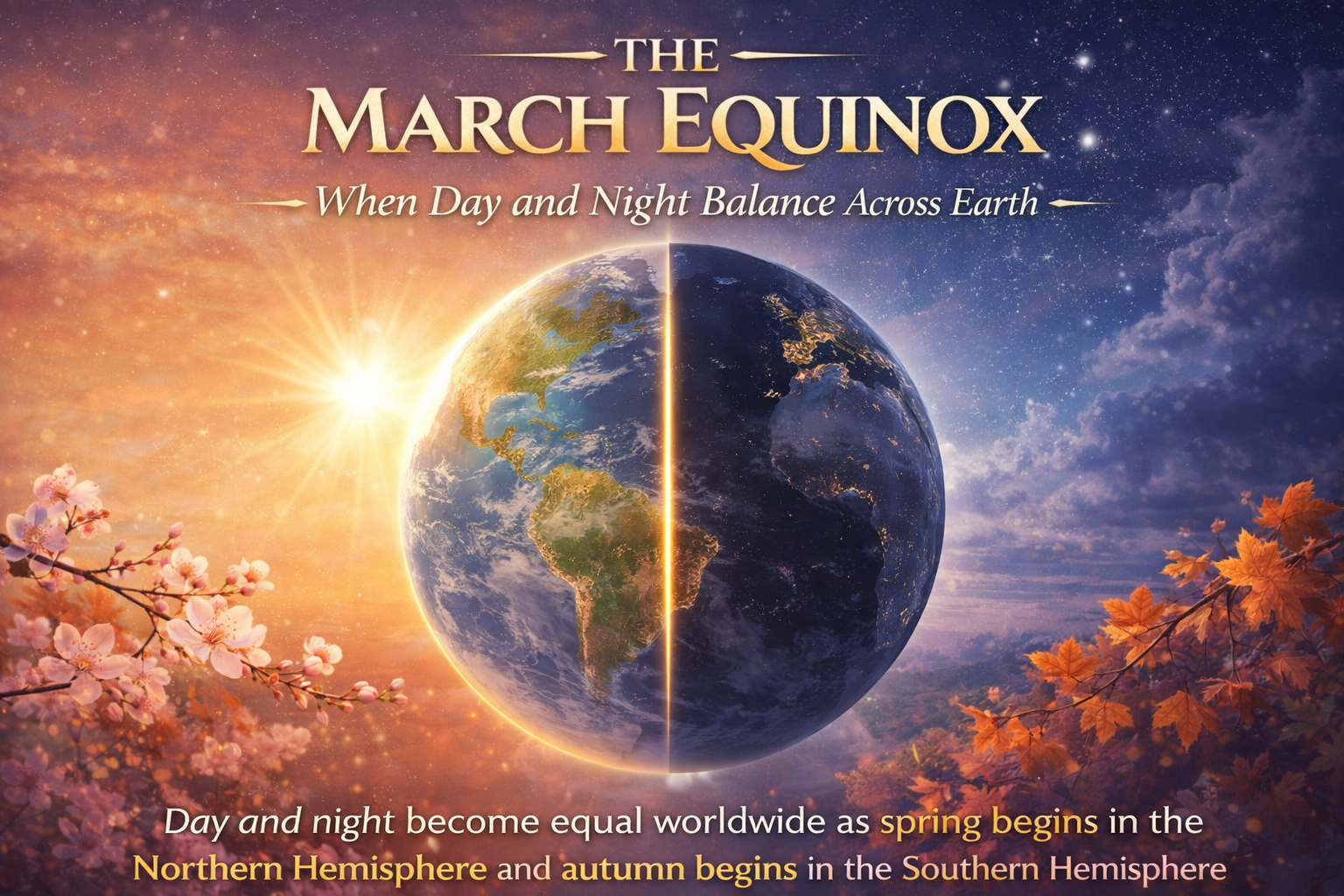
Every year, our planet reaches a remarkable moment of balance — a time when day and night become nearly equal across the entire world. This event, known as the March Equinox, marks a turning point in Earth’s seasonal cycle and reminds us of the elegant motion of our planet around the Sun.
In 2026, the March Equinox occurs on March 20, when the Sun appears directly above Earth’s equator. For a brief moment, sunlight is distributed almost equally between the Northern and Southern Hemispheres, creating one of the most harmonious alignments in our solar system.
? What Is an Equinox?
The word “equinox” comes from Latin:
-
Aequus – meaning equal
-
Nox – meaning night
Together, they describe the unique astronomical moment when day and night are nearly the same length everywhere on Earth.
Equinoxes occur twice each year:
-
March Equinox – around March 20
-
September Equinox – around September 22–23
These two events happen because of Earth’s axial tilt of about 23.5 degrees and the way our planet orbits the Sun.
During the equinox, Earth’s tilt is neither leaning toward nor away from the Sun, allowing sunlight to strike the equator directly.
☀️ Why Day and Night Become Equal
Normally, one hemisphere of Earth receives more sunlight than the other due to the planet’s tilt. But during the equinox:
-
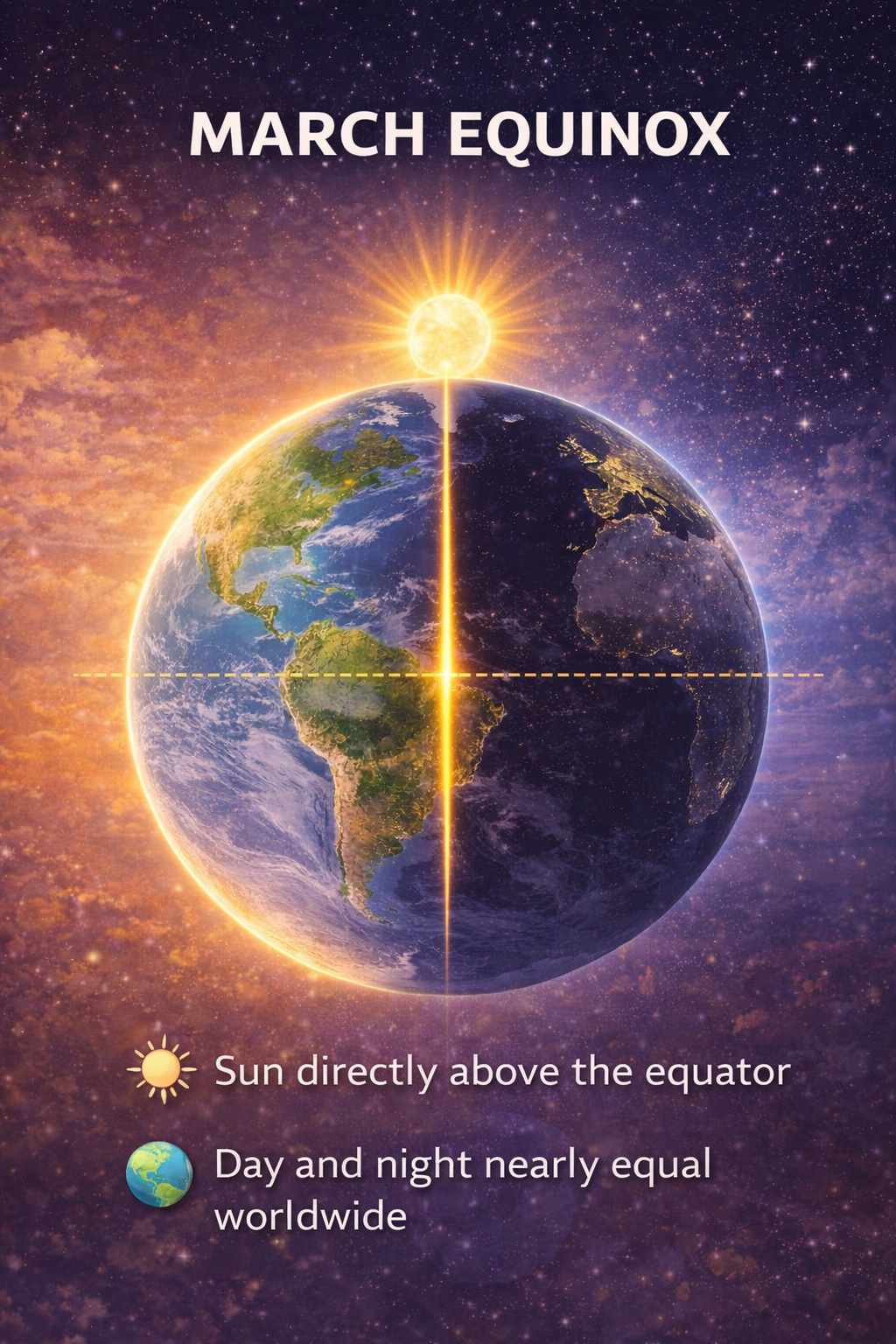
The Sun sits directly above the equator
-
Both hemispheres receive almost identical amounts of daylight
-
The boundary between night and day (called the terminator) runs almost perfectly from the North Pole to the South Pole
As a result, most places on Earth experience about 12 hours of daylight and 12 hours of darkness.
? Spring Begins in the Northern Hemisphere
For countries in the Northern Hemisphere, the March Equinox marks the first official day of astronomical spring.
This shift brings:
-
Longer daylight hours
-
Rising temperatures
-
Blooming plants and flowers
-
Increased biological activity across ecosystems
Across Europe, North America, and Asia, the equinox symbolizes renewal, growth, and the awakening of nature after winter.
? Autumn Begins in the Southern Hemisphere
While the Northern Hemisphere welcomes spring, the Southern Hemisphere enters autumn.
Countries such as Australia, South Africa, Chile, and Argentina begin transitioning into cooler seasons.
Trees slowly shed leaves, temperatures begin to fall, and daylight gradually shortens as the region moves toward winter.
? A Rare Planetary Alignment of Light
One fascinating feature of the equinox is the orientation of Earth’s day–night boundary.
On this date:
-
The terminator line aligns nearly perfectly with Earth’s poles
-
Sunrise and sunset occur almost exactly due east and due west
-
The Sun rises precisely in the east and sets precisely in the west
This alignment makes the equinox one of the best times to observe perfect east–west solar alignment.
?️ Ancient Civilizations and the Equinox
For thousands of years, civilizations have observed and celebrated the equinox.
Many ancient monuments were designed to align with the Sun during these moments.
Famous examples include:
Chichén Itzá – Mexico
During the equinox, sunlight creates the illusion of a serpent slithering down the pyramid of Kukulkan.
Stonehenge – United Kingdom
The monument aligns with solar positions during key seasonal transitions.
Angkor Wat – Cambodia
The temple’s architecture highlights the equinox sunrise.
These alignments show how deeply ancient cultures understood the cycles of Earth and the sky.
? A Global Moment of Balance
Perhaps the most poetic aspect of the March Equinox is that it is shared by the entire planet at the same moment.
No matter where you live — whether in a bustling city or a remote wilderness — Earth is experiencing a brief period of cosmic symmetry.
For a short time, our world exists in near-perfect equilibrium between light and darkness.
✨ Why the Equinox Matters
Beyond marking seasonal changes, the equinox highlights the incredible precision of Earth’s orbit and tilt.
It reminds us that:
-
Earth’s motion through space governs life on our planet
-
The balance of sunlight shapes climates and ecosystems
-
Our planet operates within a vast cosmic rhythm
These celestial moments connect astronomy, nature, and human history in a way few events can.
? The Next Seasonal Shift
After the March Equinox, daylight will continue increasing in the Northern Hemisphere until the June Solstice, when the region experiences its longest day of the year.
Meanwhile, the Southern Hemisphere will move toward the June Winter Solstice, marking its shortest day.
The cycle continues — a timeless rhythm that has shaped life on Earth for billions of years.
✨ The March Equinox reminds us that even in the vast mechanics of the cosmos, balance is possible.
And for a brief moment each year, the entire planet shares the same length of day and night — a quiet harmony written into the motion of our world.