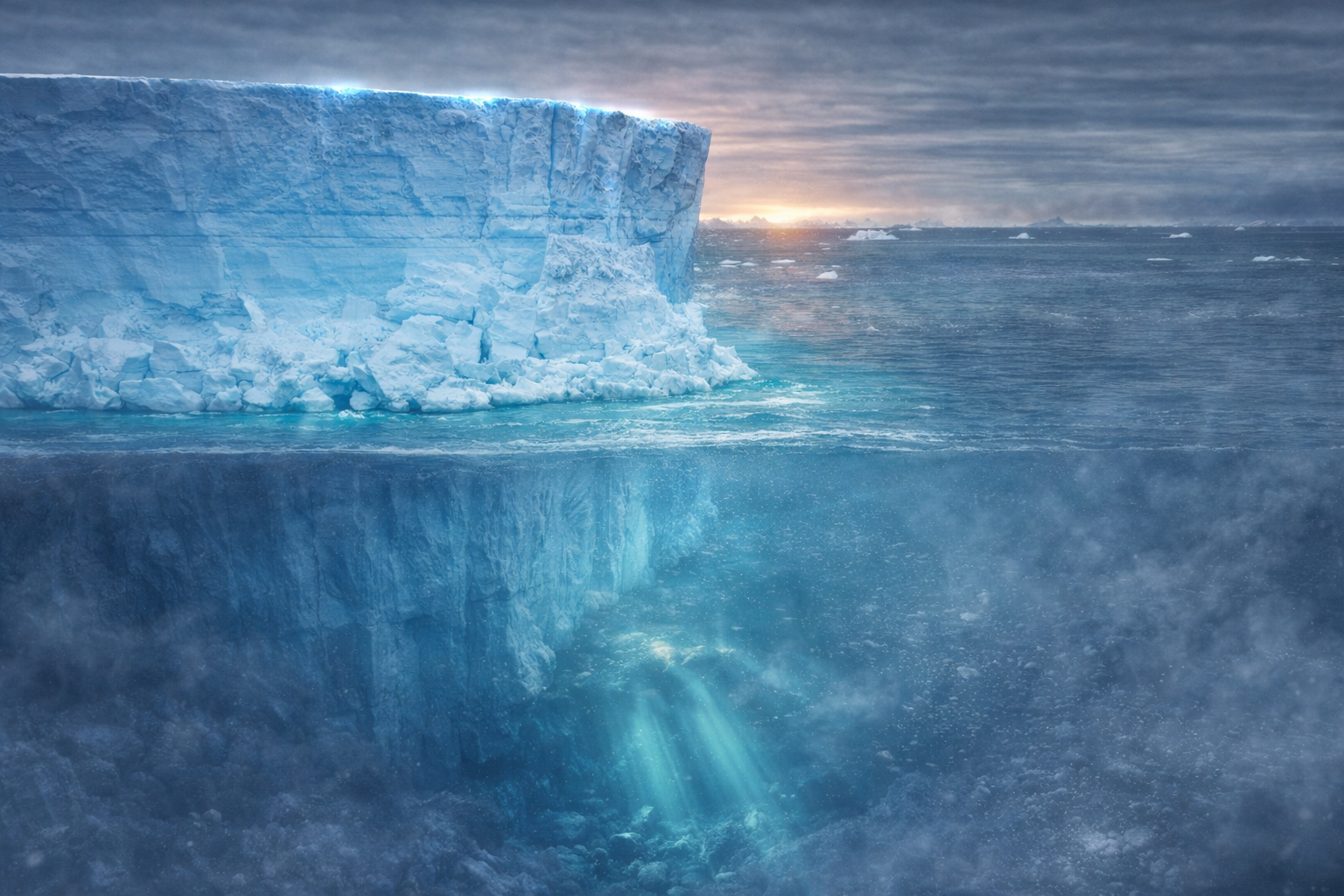
A colossal iceberg — nearly the size of Chicago — has broken away from Antarctica, and what it has revealed beneath the ice is nothing short of extraordinary.
For the first time in centuries, a hidden section of the Antarctic seafloor has been exposed to the open ocean, giving scientists a rare opportunity to study an ecosystem that has evolved in complete darkness, isolated from the rest of the world.
? A Giant Iceberg Breaks Free
The iceberg, which detached from an Antarctic ice shelf, spans hundreds of square kilometers — comparable in size to a major city like Chicago.
These massive icebergs are not uncommon in Antarctica. They form when large sections of ice shelves crack and break away in a natural process known as calving.
However, what makes this event remarkable is not just the size of the iceberg — but what it left behind.
? A Hidden Ecosystem Revealed
Beneath the thick Antarctic ice, scientists have discovered a thriving underwater ecosystem that has likely existed undisturbed for hundreds — possibly thousands — of years.
Without sunlight, this environment does not rely on photosynthesis like most ecosystems on Earth. Instead, life here survives through alternative energy sources, such as:
- Chemosynthesis (using chemical reactions instead of sunlight)
- Nutrient flows carried by ocean currents
- Organic matter falling from above
This allows a surprising diversity of life to exist in one of the harshest environments on the planet.
? Life in Complete Darkness
Early observations suggest the presence of:
- Deep-sea organisms adapted to extreme cold
- Fragile sponge and coral-like structures
- Microbial communities forming the base of the ecosystem
These organisms have evolved to survive under:
- Near-freezing temperatures
- Crushing pressures
- Total darkness
Studying them could provide valuable insights into how life might exist in similar extreme environments — even beyond Earth.
? Why This Discovery Matters
This discovery is significant for several reasons:
1. Understanding Extreme Life on Earth
It helps scientists better understand how life adapts to extreme conditions — knowledge that could be applied to astrobiology and the search for life on icy moons like Europa or Enceladus.
2. Climate Change Insights
Events like iceberg calving are part of natural cycles, but their frequency and scale are closely monitored as indicators of climate change.
Studying newly exposed seafloor regions can reveal how ecosystems respond to environmental shifts.
3. A Rare Scientific Opportunity
These hidden ecosystems are incredibly difficult to access. When an iceberg breaks away, it creates a short window for researchers to explore previously unreachable environments.
? A Reminder of Earth’s Hidden Worlds
Despite centuries of exploration, large parts of our planet remain unknown — especially beneath the oceans and polar ice.
Discoveries like this remind us that Earth still holds countless secrets, waiting to be uncovered.
Beneath kilometers of ice, in complete darkness, life not only survives — it thrives.
As the iceberg drifts into the open ocean, it leaves behind more than just exposed seafloor.
It reveals a hidden chapter of our planet — one that challenges our understanding of life, resilience, and the boundaries of the natural world.
And perhaps most importantly…
It makes us wonder:
What else is still hidden beneath Antarctica?