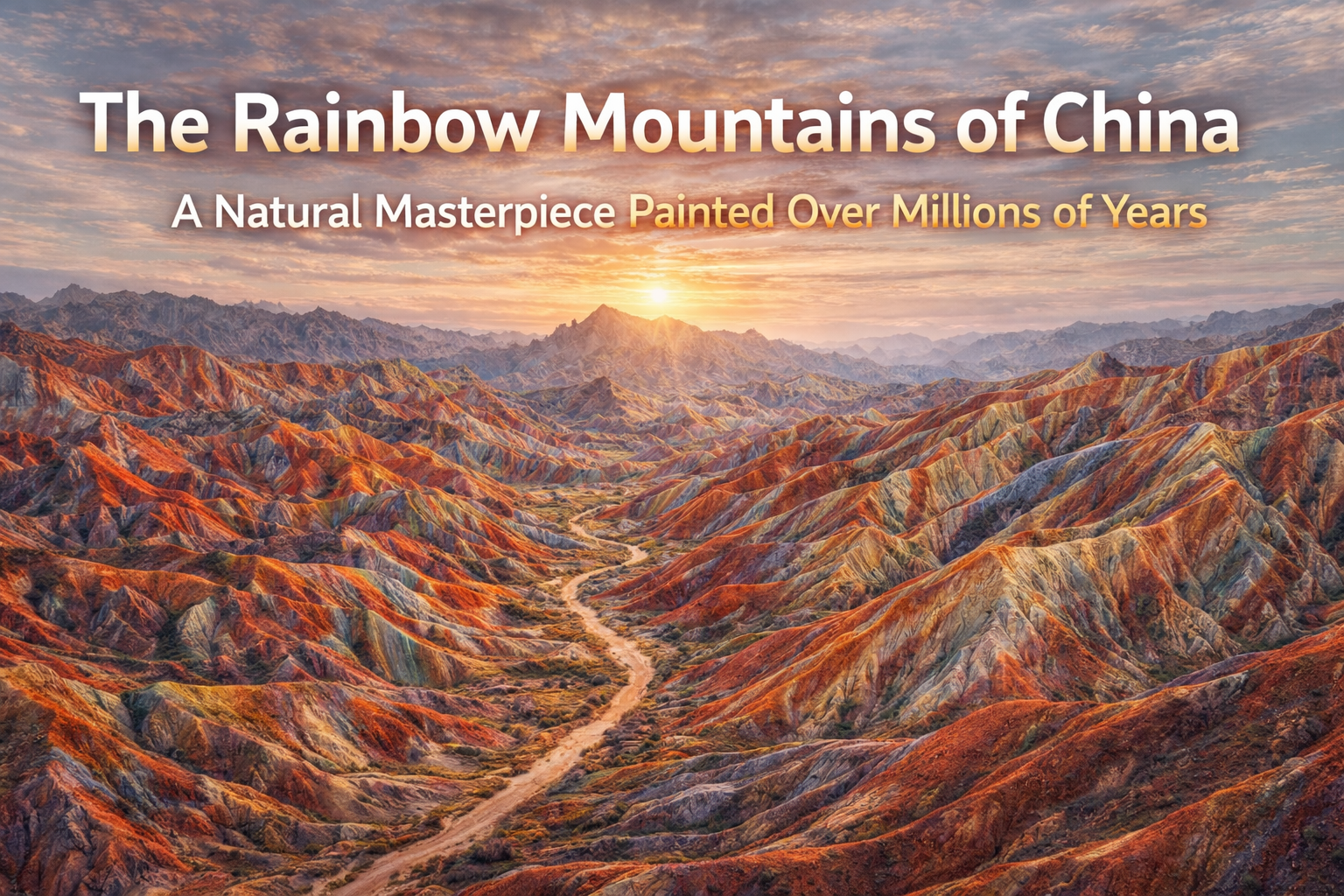
Deep in China’s Gansu Province lies one of the most surreal landscapes on Earth — the Zhangye Danxia Rainbow Mountains. With their striking bands of red, orange, yellow, and gold stretching across rolling hills, the mountains appear almost as if they were painted by a giant artist’s brush. But the incredible colors that define this landscape are not the result of paint or human intervention. They are the product of millions of years of geological processes.
A Natural Masterpiece Formed Over Millions of Years
The Rainbow Mountains are part of the Zhangye Danxia Landform Geological Park, located in northwestern China along the historic Silk Road. The formations began developing roughly 24 million years ago, when layers of sandstone and mineral deposits gradually accumulated across the region.
Over time, tectonic activity associated with the uplift of the Tibetan Plateau pushed these layered sediments upward. As the Earth’s crust shifted and folded, the once-flat sedimentary layers were bent and tilted, forming the dramatic ridges and valleys visible today.
Wind and water erosion then sculpted the landscape further, carving the mountains into their current flowing shapes.
Why the Mountains Are So Colorful
The breathtaking colors of the Zhangye Danxia formations come from different minerals trapped within the rock layers.
Some of the most important minerals include:
-
Iron oxide – responsible for deep red tones
-
Limonite – producing yellow hues
-
Chlorite – adding green shades
-
Various mineral mixtures – creating oranges, browns, and subtle blues
Over millions of years, these minerals oxidized and reacted with environmental conditions, producing the vibrant bands that now stretch across the mountains like natural stripes.
The alternating layers of sandstone and mineral-rich sediments created a geological “layer cake” that erosion later exposed.
The Role of Erosion
Erosion played a crucial role in shaping the modern appearance of the Rainbow Mountains. Rain, wind, and temperature changes gradually wore away softer layers of rock, revealing the colorful mineral bands underneath.
Because the rock layers vary in hardness, erosion occurs unevenly. This process creates the sharp ridges, rounded hills, and flowing lines that make the landscape look almost like waves of color rolling across the earth.
A UNESCO-Protected Geological Wonder
Due to its extraordinary geological value, the Zhangye Danxia landform has gained international recognition. The area is now protected as part of Zhangye Danxia National Geological Park, attracting scientists, photographers, and travelers from around the world.
The park covers over 300 square kilometers and contains some of the most vivid examples of Danxia landforms on Earth.
“Danxia” refers to a unique type of landscape formed by red-colored sandstone and steep cliffs shaped by erosion — a geological phenomenon found mainly in China.
One of the Most Photogenic Landscapes on Earth
Today, the Rainbow Mountains are considered one of the most visually spectacular geological formations on the planet. The colors become especially vibrant after rainfall or during sunrise and sunset, when soft light enhances the contrast between the mineral layers.
Observation platforms throughout the park allow visitors to safely explore the area and witness the natural phenomenon without disturbing the fragile landscape.
Photographers often describe the view as looking like a giant natural painting stretching across the horizon.
Nature’s Artwork
While the Zhangye Danxia Rainbow Mountains may appear almost surreal, they serve as a powerful reminder of the immense time and natural forces required to shape Earth’s landscapes.
Layer by layer, mineral by mineral, and year by year, nature slowly created one of the planet’s most colorful geological wonders — a masterpiece millions of years in the making.