In the remote Arctic town of Utqiagvik, Alaska, the Sun has officially stopped setting.
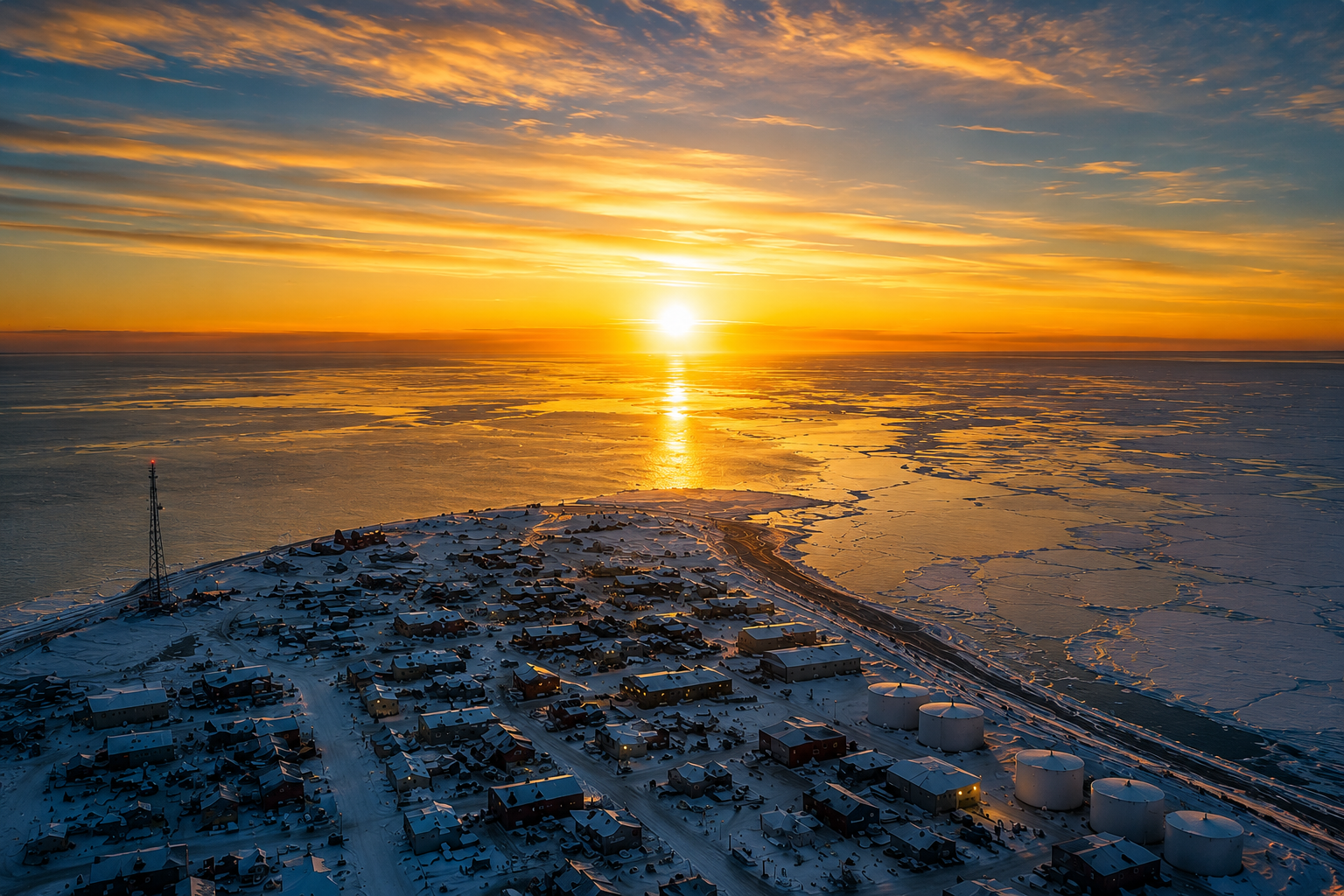
On May 10, residents of the northernmost community in the United States witnessed their final traditional sunset for more than 80 days as the region entered one of Earth’s most surreal natural phenomena: the Midnight Sun.
The last sunset occurred at approximately 1:48 a.m. local time. Just over an hour later, the Sun rose again at 2:57 a.m. — and from that moment forward, it will remain above the horizon continuously until Aug. 2.
Located more than 320 miles (515 kilometers) north of the Arctic Circle along Alaska’s northern coastline, Utqiagvik experiences some of the most dramatic seasonal light shifts anywhere on the planet. Home to fewer than 5,000 residents, the town exists in an environment where daylight and darkness behave in ways unfamiliar to most of the world.
What Causes the Midnight Sun?
The phenomenon occurs because Earth is tilted on its axis by about 23.5 degrees.
As the Northern Hemisphere tilts toward the Sun during summer, regions close to the Arctic Pole receive continuous sunlight. Instead of rising and setting normally, the Sun appears to circle the sky, dipping close to the horizon during the “night” hours without ever fully disappearing.
This creates weeks — and in some Arctic locations, even months — of uninterrupted daylight.
In Utqiagvik, the Midnight Sun lasts for over 80 consecutive days every year.
A World Where Night Never Comes
Despite the endless daylight, Arctic summers are far from tropical.
Even during July, typically the warmest month of the year, average daytime temperatures in Utqiagvik hover around just 49°F (9°C). Snowfall during summer is still common, and temperatures only occasionally rise above 70°F (21°C).
Yet the constant sunlight dramatically transforms daily life.
Residents often rely on blackout curtains to sleep, while tourists travel from around the world to witness the bizarre spectacle of seeing the Sun glowing over the frozen Arctic Ocean at midnight.
Photographers and skywatchers frequently describe the experience as dreamlike — a place where time itself seems to behave differently.
The Opposite Extreme: Polar Night
The endless daylight will not last forever.
Although the Sun will begin setting again in early August, true darkness still won’t immediately return. The Arctic sky will remain in continuous twilight for weeks, with genuine nighttime darkness not arriving until late September.
Then, as winter tightens its grip on the Arctic, Utqiagvik will enter the opposite extreme: Polar Night.
During this period, the Sun disappears below the horizon entirely for weeks at a time, plunging the region into prolonged darkness illuminated only by moonlight, stars, and the northern lights.
Together, these extreme cycles serve as one of the clearest reminders that life near the top of the world operates on a completely different rhythm from the rest of Earth.
For the people of Utqiagvik, the Midnight Sun is not just an astronomical phenomenon — it is a way of life.