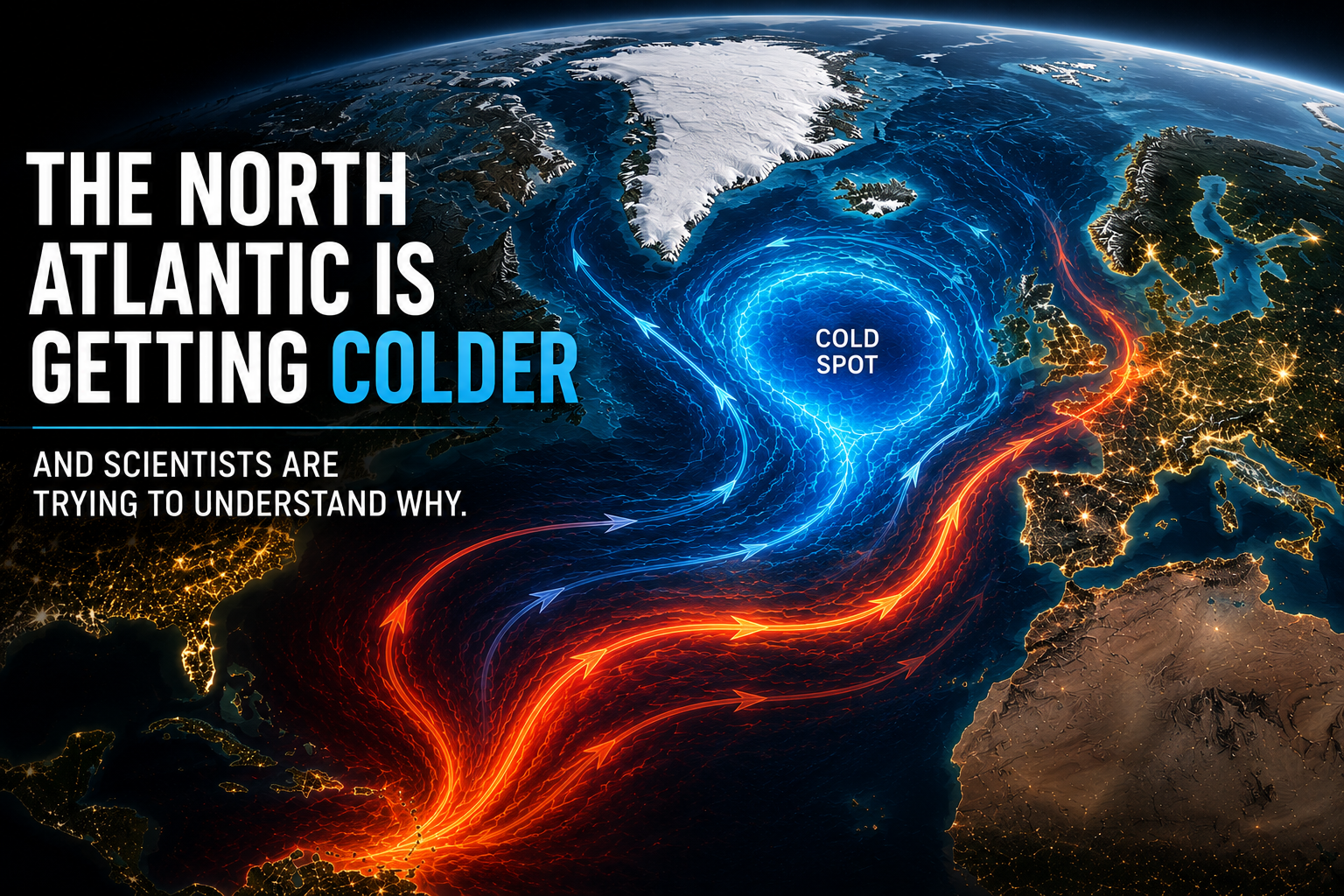
For decades, global warming has driven ocean temperatures steadily upward. Yet hidden within the North Atlantic lies one of the most puzzling climate anomalies on Earth—a region south of Greenland that has stubbornly resisted this warming trend.
Scientists refer to it as the North Atlantic Warming Hole, or more commonly, the North Atlantic Cold Spot. While surrounding oceans continue to break heat records, this patch of water has remained unusually cold. Rather than contradicting climate change, researchers believe it may actually be one of its clearest warning signs.
A Cold Spot in a Warming Ocean
Satellite observations and long-term ocean temperature records have consistently revealed an area of below-average sea surface temperatures stretching across the North Atlantic between Greenland, Iceland, and the Labrador Sea.
This “cold blob” stands out because it exists in the middle of an ocean that is otherwise warming rapidly. Scientists have monitored the anomaly for decades, and while its exact behavior varies from year to year, its persistence has attracted growing attention from climate researchers around the world.
The Role of the AMOC
Many scientists believe the cold spot is closely connected to the Atlantic Meridional Overturning Circulation (AMOC)—one of Earth’s most important ocean circulation systems.
The AMOC functions like a massive global conveyor belt. Warm, salty surface water travels northward from the tropics toward Europe, where it releases heat into the atmosphere. As the water cools and becomes denser, it sinks deep into the ocean before flowing back south.
This continuous circulation helps regulate temperatures across Europe, influences rainfall in Africa and the Americas, affects hurricane development, and plays a vital role in Earth’s climate.
If this circulation slows, less warm water reaches the North Atlantic. The result can be a localized cooling effect, even while the rest of the planet continues to warm.
Why Might the AMOC Be Slowing?
Researchers believe several factors could contribute to a gradual weakening of the AMOC.
One major factor is the accelerated melting of Greenland’s ice sheet. As enormous quantities of freshwater enter the North Atlantic, they reduce the salinity of surface waters. Freshwater is less dense than salty water, making it harder for cold water to sink—a process essential to keeping the AMOC moving.
At the same time, rising global temperatures are altering wind patterns, ocean stratification, and heat distribution, adding further stress to the circulation system.
While scientists continue to investigate these complex interactions, multiple studies suggest the AMOC is weaker today than it was during much of the last millennium.
Could the Current Collapse?
This question often appears in headlines, but the scientific answer is more nuanced.
There is currently no evidence that the AMOC is about to shut down suddenly. However, many climate scientists agree that continued weakening could significantly influence regional climates over the coming decades.
Potential consequences include:
- Cooler conditions across parts of Northern Europe despite global warming.
- Changes in rainfall patterns affecting agriculture.
- Increased sea-level rise along portions of the eastern coast of North America.
- Shifts in marine ecosystems and fisheries.
- Changes in storm tracks and weather extremes.
Scientists continue to study how sensitive the AMOC may be to future greenhouse gas emissions.
Why This Cold Spot Matters
The North Atlantic Cold Spot reminds us that climate change is not simply about temperatures increasing everywhere equally.
Earth’s climate is governed by interconnected systems involving oceans, ice sheets, winds, and atmospheric circulation. A warming planet can produce unexpected regional cooling when these systems are disrupted.
Rather than contradicting global warming, the cold spot may actually demonstrate how profoundly climate change can alter the planet’s natural balance.
Understanding this anomaly could improve future climate predictions and help societies prepare for long-term environmental change.
Looking Ahead
The North Atlantic Cold Spot remains one of modern climate science’s most intriguing mysteries.
As satellites, autonomous ocean sensors, and climate models become increasingly sophisticated, scientists hope to better understand how this anomaly is evolving—and what it may reveal about the future of Earth’s oceans.
The world’s oceans regulate weather, store vast amounts of heat, and sustain countless ecosystems. Watching how they change is essential not only for scientists, but for everyone living on a rapidly changing planet.
Sources
- Intergovernmental Panel on Climate Change (IPCC) Sixth Assessment Report (AR6)
- NASA Earth Observatory
- NOAA (National Oceanic and Atmospheric Administration)
- Potsdam Institute for Climate Impact Research (PIK)
- Nature Climate Change
- Journal of Climate