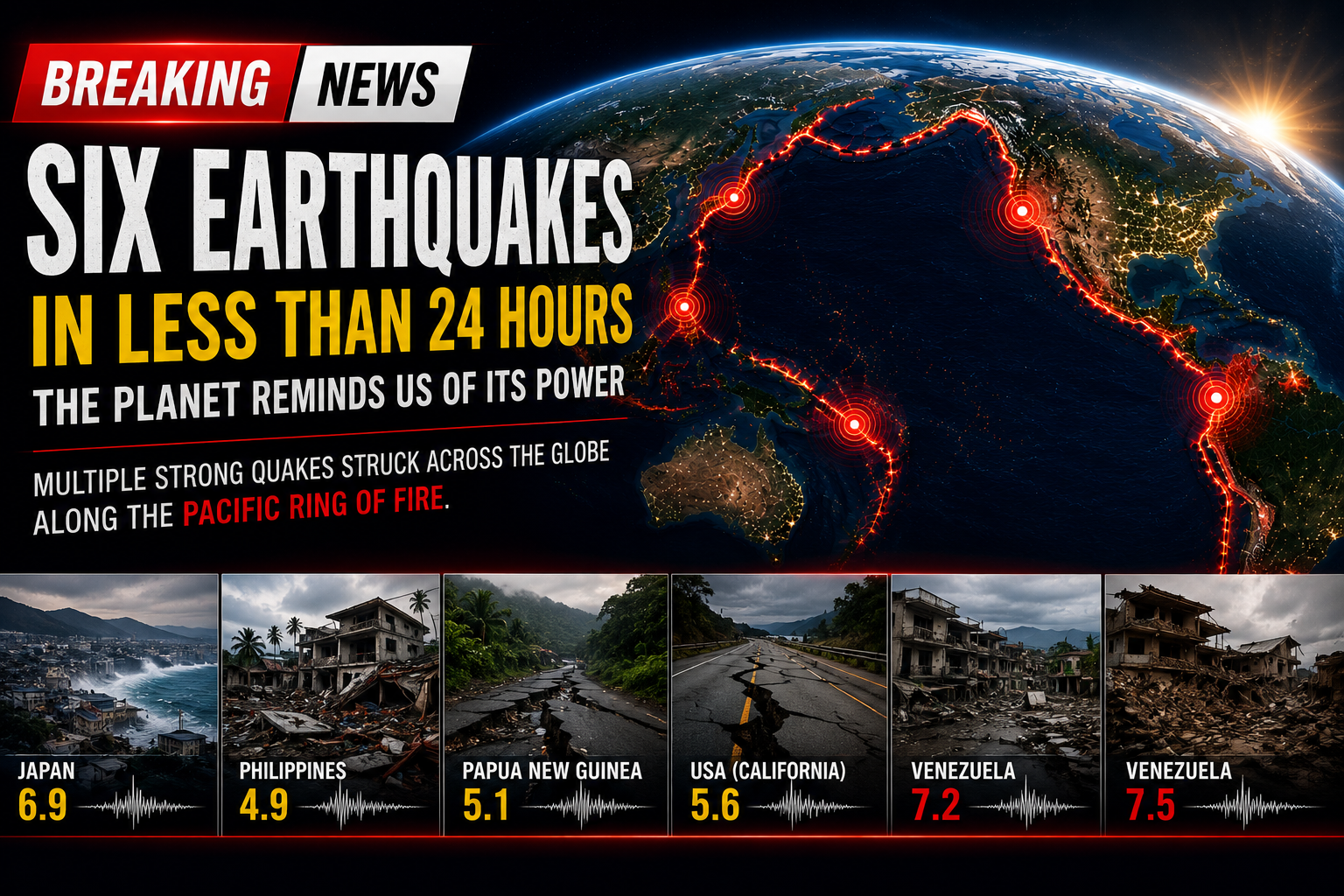
In less than 24 hours, several significant earthquakes were reported across different parts of the world, drawing renewed attention to one of Earth’s most geologically active regions: the Pacific Ring of Fire.
From the coast of Japan to California, from Papua New Guinea and the Philippines to northern South America, seismic activity reminded millions of people that our planet is constantly changing beneath our feet.
While the earthquakes occurred in different countries and were not necessarily part of a single connected seismic sequence, their close timing has sparked widespread public interest and raised an important question:
Why do so many earthquakes seem to happen around the same region?
What Happened?
According to seismic monitoring agencies, multiple moderate to major earthquakes were recorded within roughly a 24-hour period.
Among the strongest reported events were:
- Venezuela – Magnitude 7.5
- Venezuela – Magnitude 7.2
- Japan – Magnitude 6.9
- California (USA) – Magnitude 5.6
- Papua New Guinea – Magnitude 5.1
- Philippines – Magnitude 4.9
Although these earthquakes happened within a relatively short time frame, seismologists emphasize that earthquakes occurring in different tectonic settings are usually independent events rather than evidence of a worldwide chain reaction.
The Pacific Ring of Fire
The Pacific Ring of Fire is a horseshoe-shaped belt extending approximately 40,000 kilometers (25,000 miles) around the Pacific Ocean.
It is formed where several of Earth’s largest tectonic plates meet, including the:
- Pacific Plate
- North American Plate
- South American Plate
- Philippine Sea Plate
- Nazca Plate
- Cocos Plate
- Indo-Australian Plate
The immense stress generated along these boundaries is periodically released as earthquakes.
Why Does the Ring of Fire Produce So Many Earthquakes?
The Ring of Fire is responsible for:
- Nearly 90% of all earthquakes recorded worldwide.
- Around 75% of Earth’s active volcanoes.
- Most of the planet’s largest megathrust earthquakes.
Because tectonic plates are continuously moving—typically a few centimeters each year—stress is constantly building beneath the Earth’s surface.
When that stress exceeds the strength of rocks, it is released suddenly, producing seismic waves that we experience as earthquakes.
Are These Earthquakes Connected?
This is one of the most common questions after clusters of earthquakes appear in the news.
The answer is usually no.
Although earthquakes occurring close together in time may appear related, events separated by thousands of kilometers are generally caused by different faults and different tectonic interactions.
Scientists carefully analyze each earthquake individually before determining whether any physical relationship exists.
At present, there is no evidence that earthquakes occurring in Japan directly trigger earthquakes in Venezuela or California.
Does This Mean a Larger Earthquake Is Coming?
Earthquake prediction remains one of science’s greatest challenges.
Researchers can identify areas where major earthquakes are more likely over long periods, but they cannot accurately predict the exact day, hour, or location of a future earthquake.
Clusters of earthquakes sometimes occur naturally without leading to a larger event.
For this reason, experts recommend preparedness rather than speculation.
Living on a Dynamic Planet
Earth’s surface may appear solid and stable, but beneath it lies a constantly shifting system of tectonic plates.
Every earthquake serves as a reminder that our planet is still evolving.
Mountain ranges continue to rise.
Ocean floors continue to spread.
Continents continue their slow movement across the globe.
While most of these changes happen too slowly for us to notice, earthquakes reveal the immense forces continuously shaping our world.
Final Thoughts
The recent sequence of significant earthquakes has once again focused global attention on the Pacific Ring of Fire, one of the most active geological regions on Earth.
Although the events are alarming, they also highlight the importance of scientific monitoring, resilient infrastructure, and public preparedness.
Earth never stops moving—and understanding the forces beneath our feet is one of the keys to living safely on our remarkable planet.
Sources
• United States Geological Survey (USGS)
• European-Mediterranean Seismological Centre (EMSC)
• Incorporated Research Institutions for Seismology (IRIS)
• Smithsonian Global Volcanism Program