Chaosmos News — Scientific Edition
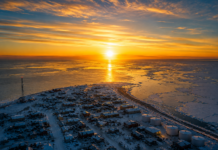
The Sun has officially set in Utqiaġvik (Barrow), Alaska — the northernmost settlement of the United States located at 71.3° N latitude. For the next ~65 days, the Sun will not rise above the horizon, marking the beginning of an extreme seasonal phenomenon known as Polar Night.
? Why Utqiaġvik Goes Dark for 65 Days
Earth’s axis is tilted by 23.5°, and during the Northern Hemisphere winter, the Arctic region tilts away from the Sun.
Any location above the Arctic Circle (66.5° N) can experience periods where the Sun stays completely below the horizon.
Utqiaġvik lies nearly 500 km north of the Arctic Circle — deep inside the region where solar angles become too shallow for sunlight to break the horizon.
Even at local noon, the Sun’s maximum solar elevation angle stays between –0.5° and –3°, which means sunlight never reaches the surface.
? What the Sky Looks Like:
Despite the lack of direct sunlight, Utqiaġvik does not remain completely pitch black. Residents experience:
1. Astronomical Twilight
For several hours, the atmosphere scatters faint photon streams from below the horizon, creating a deep navy-blue glow.
2. Enhanced Aurora Activity
Utqiaġvik sits directly beneath the Auroral Oval, where charged solar particles funnel into Earth’s magnetic field.
As a result, the long night becomes a canvas for intense auroras, sometimes stretching across the entire sky.
3. Moonlit Landscape
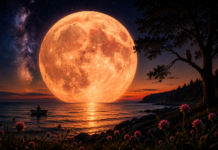
During full moon phases, the landscape can appear brighter than expected, because snow and ice reflect up to 80–90% of incoming light — a phenomenon called high-albedo reflection.
?️ Environmental and Biological Impacts
-
Temperature drops commonly reach –25° to –35°C.
-
Wind chill around the Arctic Ocean can push conditions below –50°C.
-
Humans experience shifts in circadian rhythm due to lack of sunlight, altering melatonin and serotonin levels.
-
Wildlife such as Arctic foxes, snowy owls, and caribou adapt via seasonal metabolic changes.
? When Does the Sun Return?
The first sunrise will occur on January 22, 2026.
At that moment, the Sun will barely skim the horizon for a few minutes — an event celebrated locally as the “Return of the Sun”.
? A Reminder of Earth’s Cosmic Mechanics
The Polar Night is not a weather event but a geometric consequence of Earth’s orbital mechanics — a combination of axial tilt, latitude, and solar declination.
It is one of the most dramatic signs of how dynamic our planet truly is.