In a rare and remarkable observation, the Hubble Space Telescope has captured a comet breaking apart in real time, offering scientists an unprecedented look into the fragile nature of these ancient cosmic travelers.
? An Unexpected Discovery
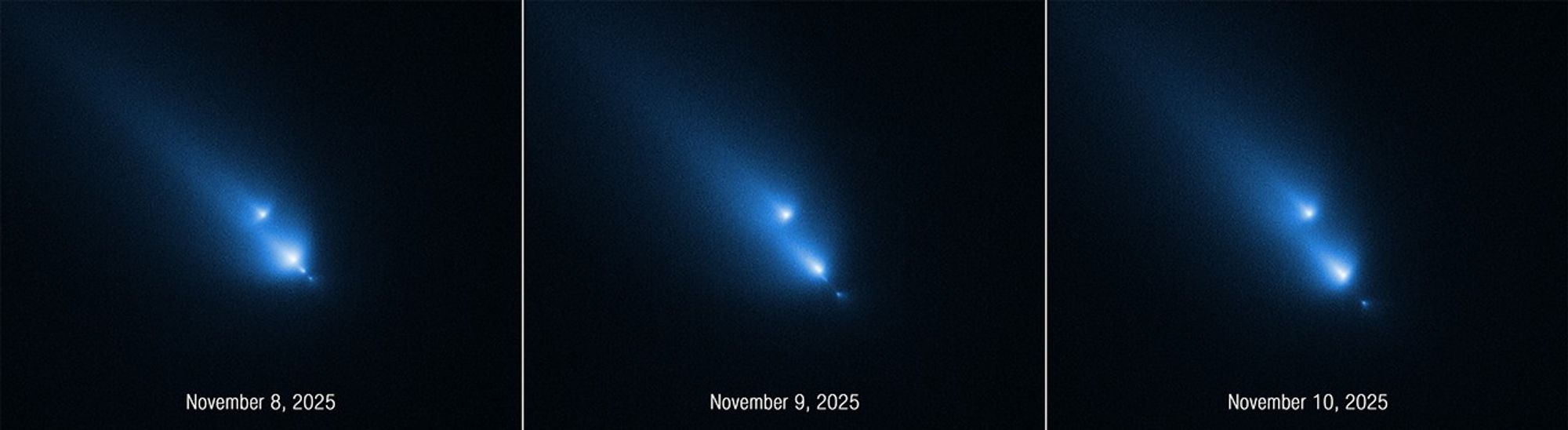
What began as a routine observation quickly turned into a significant scientific moment. While monitoring a distant comet, astronomers witnessed it suddenly begin to fragment — a process that is rarely observed as it happens.
Located roughly 250 million kilometers from Earth, the comet started to split into multiple pieces. High-resolution images revealed distinct fragments drifting apart, each leaving behind a glowing trail of dust and gas.
? Why This Matters
Comets are often described as “time capsules” of the early solar system, composed of ice, dust, and rocky material that has remained largely unchanged for billions of years.
However, despite their ancient origins, comets are incredibly fragile.
This event provides scientists with valuable insight into:
- how comets structurally weaken over time
- what triggers sudden fragmentation
- how dust and gas are released into space
Understanding these processes helps researchers piece together the life cycle of comets — from their formation to their eventual destruction.
? What Causes a Comet to Break Apart?
There are several possible reasons why a comet may begin to disintegrate:
- Thermal stress: As a comet approaches the Sun, rapid heating can cause internal pressure to build up
- Rotational instability: Uneven outgassing can increase the comet’s spin rate until it breaks apart
- Structural weakness: Internal fractures or loosely bound material can lead to collapse
In many cases, it’s likely a combination of these factors.
?️ A Rare Glimpse Into a Dynamic Universe
Most comet breakups are detected only after the fact — once fragments have already separated. Capturing the process as it unfolds is extremely rare and scientifically valuable.
The observations made by Hubble provide a real-time look at a dynamic and violent transformation, reminding us that space is far from static.
? The Bigger Picture
Even though comets are among the oldest objects in our solar system, they are not eternal. Events like this highlight the constant change happening throughout the universe — from distant galaxies to icy bodies drifting through our own cosmic neighborhood.
As technology improves and telescopes become more advanced, astronomers hope to capture even more of these fleeting moments.
Because sometimes, the most important discoveries happen when something falls apart.
? Source
NASA
https://science.nasa.gov/missions/hubble/nasas-hubble-unexpectedly-catches-comet-breaking-up/