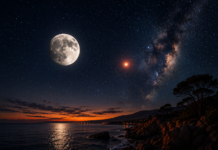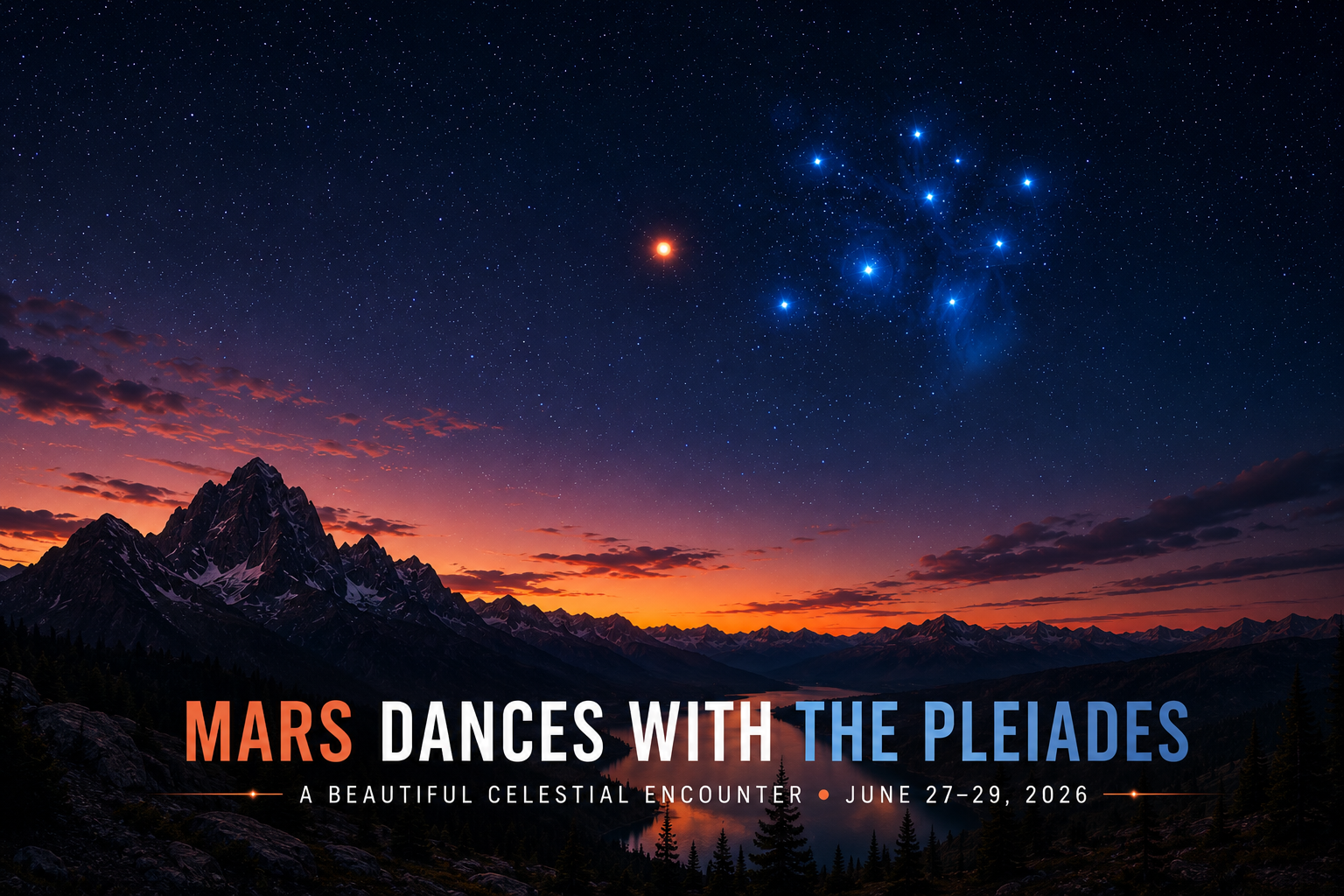
As June draws to a close, skywatchers around the world will have the chance to witness one of the month’s most beautiful celestial pairings. Between June 27 and June 29, the bright red planet Mars will appear remarkably close to the famous Pleiades star cluster, creating a striking contrast of fiery orange and brilliant blue in the evening sky.
Although the two objects are separated by hundreds of light-years in reality, they will seem to meet from our viewpoint on Earth—an effect astronomers call a close conjunction or apparent close approach.
A Dance Across the Night Sky
Mars is often called the Red Planet, glowing with a warm orange-red color because of iron oxide covering its surface. The Pleiades, meanwhile, are among the youngest and brightest open star clusters visible to the naked eye.
As Mars slowly moves eastward along its orbit around the Sun, it occasionally passes near well-known stars and star clusters. This year, that journey brings it alongside the dazzling Pleiades, producing one of the most photogenic sky events of the summer.
The close pairing creates a beautiful visual contrast:
- The deep orange glow of Mars.
- The icy blue sparkle of the Pleiades.
- The fading colors of evening twilight.
For photographers and casual observers alike, it is an unforgettable combination.
What Are the Pleiades?
The Pleiades, also known as Messier 45 (M45) or the Seven Sisters, are one of the nearest open star clusters to Earth.
Located about 444 light-years away in the constellation Taurus, the cluster contains hundreds of young stars that formed from the same giant cloud of gas and dust roughly 100 million years ago.
Most people can easily see six or seven stars without optical aid, but binoculars reveal dozens, while telescopes uncover many more shimmering blue suns surrounded by faint reflection nebulae.
For thousands of years, civilizations around the world have looked to the Pleiades as seasonal markers and cultural symbols.
Mars: The Wanderer
Unlike the stars, Mars changes position from night to night because it orbits the Sun.
Ancient astronomers noticed this wandering motion long before modern telescopes existed, giving rise to the Greek word planetes, meaning “wanderer.”
The encounter with the Pleiades is simply one chapter in Mars’ continuous journey across the zodiac.
How to Observe the Event
The conjunction is visible shortly after sunset.
For the best experience:
- Find a location with dark skies.
- Allow your eyes about 20 minutes to adapt.
- Use binoculars to reveal dozens of stars within the cluster.
- A small telescope will make the contrast even more spectacular.
Even without equipment, Mars and the Pleiades will create an eye-catching pairing.
A Photographer’s Dream
This event is especially attractive for astrophotographers.
Wide-angle lenses can capture:
- Mountain silhouettes.
- Lakes and forests.
- Twilight colors.
- Mars shining beside the brilliant blue Pleiades.
Longer focal lengths reveal the delicate reflection nebulosity surrounding the cluster, while Mars provides a warm color contrast rarely matched elsewhere in the night sky.
An Illusion of Distance
Although Mars appears close to the Pleiades, the two are unimaginably far apart.
- Mars is only tens to hundreds of millions of kilometers from Earth, depending on its orbit.
- The Pleiades lie roughly 444 light-years away.
The apparent meeting exists only because both objects line up from our perspective, reminding us that the night sky is a three-dimensional universe projected onto a two-dimensional canvas.
Why You Should Look Up
Events like this remind us that astronomy doesn’t always require expensive equipment.
Sometimes, all it takes is stepping outside after sunset and looking toward the western sky.
For three evenings, the ancient Seven Sisters and our neighboring Red Planet will appear to share the same corner of space—a brief celestial dance that won’t look exactly the same again for years.
If the skies are clear, don’t miss this beautiful meeting of two of the night sky’s most recognizable objects.
From June 27–29, Mars dances beside the Pleiades—and the universe puts on another unforgettable show.