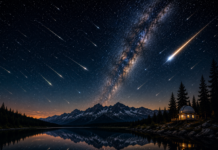
The Orionids Meteor Shower, one of the annual gifts left behind by Halley’s Comet, reaches its peak on November 28. Although this stream is not among the most prolific meteor showers of the year, the Orionids are scientifically fascinating: their meteors are extremely fast, remarkably bright, and often leave long-lasting ionized trails that drift in the upper atmosphere.
? Where Do the Orionids Come From?
Every 76 years, Halley’s Comet swings through the inner Solar System, shedding dust-sized particles along its orbit.
Earth intersects this debris stream twice each year:
-
In May, creating the Eta Aquariids
-
In October–November, creating the Orionids
Each tiny grain of comet dust enters Earth’s atmosphere at nearly 66 km/s (148,000 mph) — making Orionid meteors among the fastest of all known showers.
? What to Expect This Year?
While the Orionids can occasionally produce 20–25 meteors per hour under perfect conditions, this year’s activity will be far more modest:
-
Meteor rate: ~3 meteors per hour (northern hemisphere)
-
Radiant: Near the constellation Orion, close to Betelgeuse
-
Moon illumination: ~54%, setting around midnight, improving visibility after lunar set
The combination of fewer particles in this year’s stream and mid-level lunar brightness means the display will be subtle — but still scientifically intriguing.
? Why Orionids Are Still Special
Even in low-activity years, Orionid meteors are notable for:
-
Extreme speeds → long glowing trails
-
High-energy impacts → bright flashes
-
Persistent trains that can linger for seconds as Earth’s magnetic field distorts the ionized gas
These features make each individual meteor more dramatic, even when the overall hourly rate is low.
? How to Watch
For the best visibility:
-
Observe after midnight once the Moon has set.
-
Look toward the southeast, where Orion rises.
-
Choose a dark-sky location away from city lights.
-
Allow your eyes 20–30 minutes to adapt to the darkness.
Even a single Orionid can be spectacular thanks to its velocity and luminous trail.
? A Cosmic Connection to Halley’s Comet
One of the most fascinating aspects of the Orionids is their lineage.
Every meteor you see on November 28:
-
Is a fragment of Halley’s Comet
-
Released thousands of years ago
-
Now vaporizing in Earth’s atmosphere in a brilliant flash
Each streak of light is literally a moment of cosmic history burning up overhead.
? Final Thoughts — A Quiet but Meaningful Show
While this year’s Orionids will not deliver a strong meteor storm, they remain a beautiful reminder of our Solar System’s dynamic nature. Even a low-rate shower can provide unforgettable moments for observers — especially when the meteors originate from one of the most iconic comets in human history.
Chaosmos News will continue to follow all major sky events — stay tuned for more.