Mount Everest today stands as the highest point on Earth, rising 8,848 meters above sea level. But hidden within its summit lies one of the most astonishing geological truths ever discovered:
Everest was once part of an ancient ocean floor.
? Ancient Fossils at the Top of the World
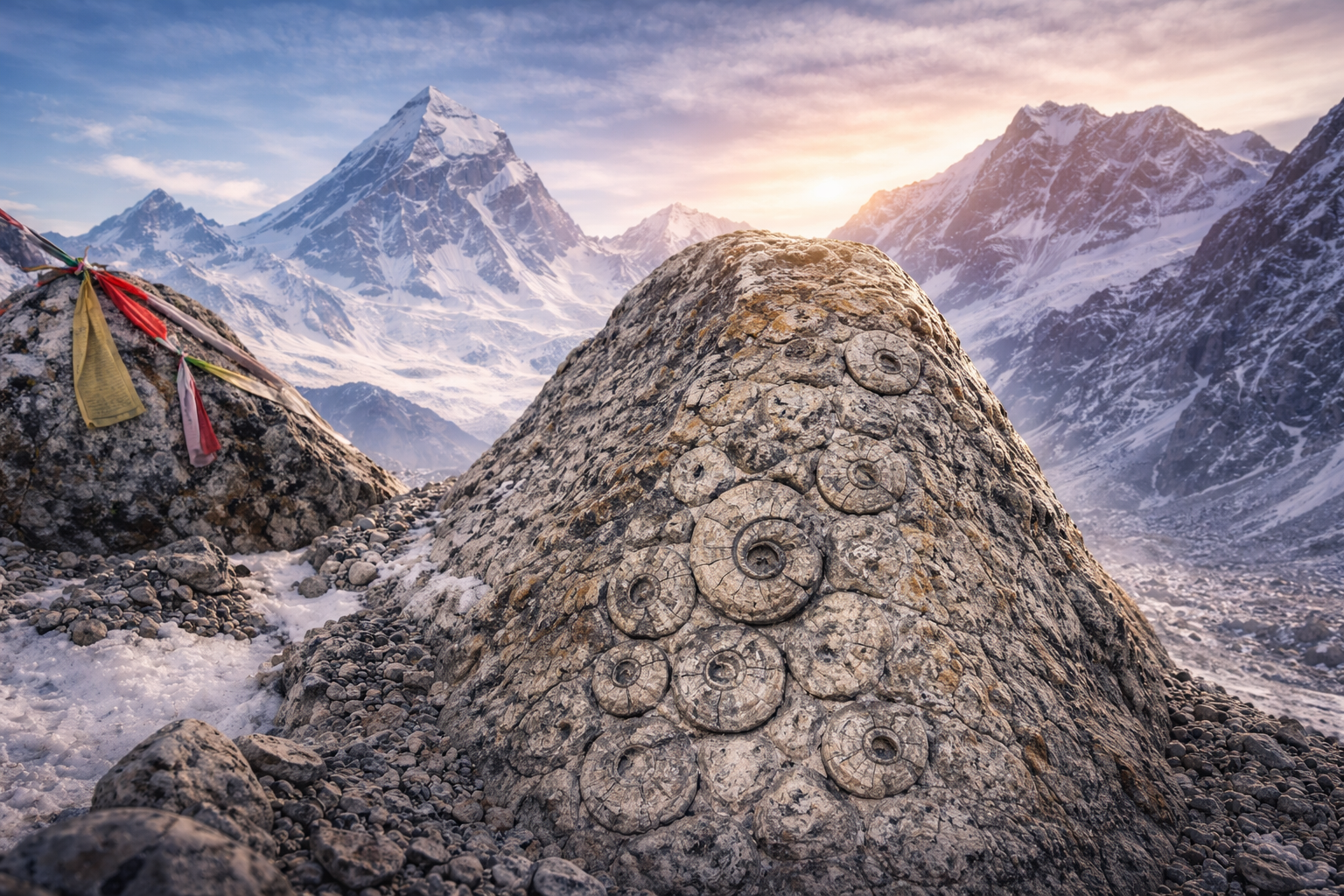
Near the summit of Everest, scientists have found marine fossils dating back around 450 million years. These include remains of ancient sea creatures such as:
- Trilobites
- Brachiopods
- Crinoids
These fossils are embedded in a type of rock known as limestone, a sedimentary rock that forms almost exclusively in marine environments.
In fact, the very top of Everest is made of a formation called the Qomolangma Limestone, which contains these fossilized remains of ancient ocean life.
? The Lost Ocean: Tethys
Hundreds of millions of years ago, long before the Himalayas existed, this entire region was submerged beneath a vast body of water known as the Tethys Ocean.
During this time:
- Marine organisms lived and died in shallow tropical waters
- Their shells and skeletons accumulated on the seabed
- Over time, these layers hardened into sedimentary rock
This process created the fossil-rich limestone that now forms the summit of Everest.
?️ From Ocean Floor to Sky
The transformation from ocean floor to the highest mountain on Earth is the result of one of the most powerful geological processes: plate tectonics.
Around 50–55 million years ago:
- The Indian tectonic plate collided with the Eurasian plate
- Instead of sinking, the crust crumpled and pushed upward
- This collision formed the Himalayan mountain range
As a result, ancient seabed layers were lifted thousands of meters into the sky.
⛰️ A Mountain Still Rising
Everest is not a static structure. It is still growing.
- The Himalayas continue to rise due to ongoing tectonic pressure
- The region remains geologically active
- Earth’s crust is constantly reshaping the landscape
This means Everest is not just a mountain — it is an ongoing geological process in motion.
? What This Discovery Really Means
The presence of marine fossils at nearly 9,000 meters above sea level tells a powerful story:
- Earth’s surface is constantly changing
- Oceans can become mountains
- Time scales of millions of years reshape entire continents
When we look at Everest, we are not just seeing rock and ice…
We are looking at a piece of an ancient ocean, frozen in time and lifted into the sky.
? Conclusion
Mount Everest is more than the highest point on Earth — it is a geological archive.
Its summit preserves evidence of a world that existed hundreds of millions of years ago, when this towering peak lay beneath a warm, shallow sea.
And that makes Everest not just the roof of the world…
But also a reminder that even the greatest mountains were once at the bottom of the ocean.