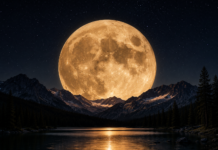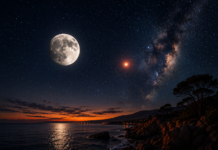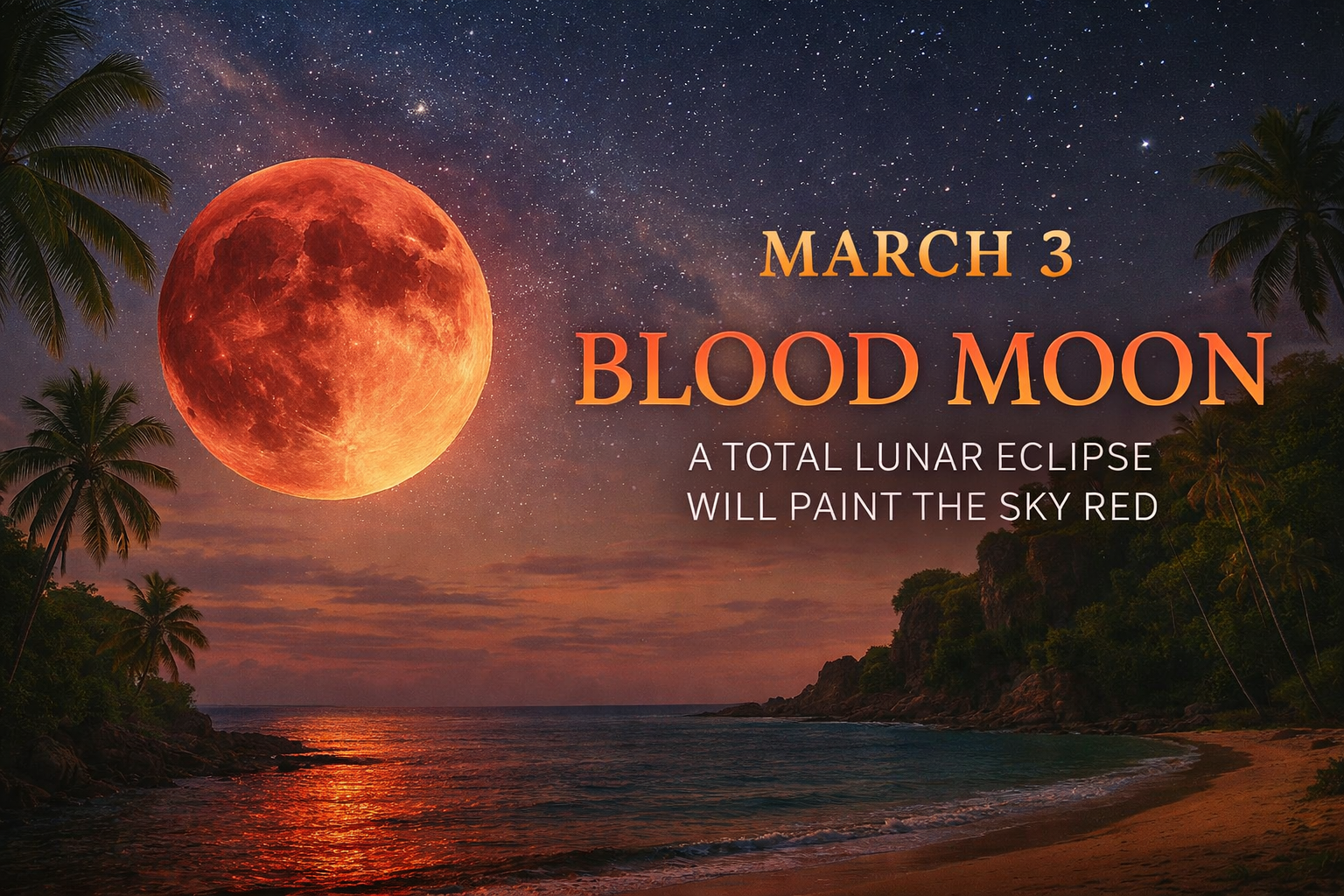
On March 3, the night sky will transform in one of nature’s most dramatic celestial performances — a Total Lunar Eclipse, widely known as a Blood Moon.
For several hours, Earth will move precisely between the Sun and the Moon. Our planet’s shadow will slowly climb across the lunar surface, turning the familiar silver disk into a deep copper-red sphere suspended in darkness.
This is not rare because it is unpredictable.
It is rare because alignment at this precision is extraordinary.
And on March 3, that alignment happens.
? What Is a Blood Moon — Scientifically?
A Blood Moon occurs during a total lunar eclipse, when:
Sun → Earth → Moon
Earth completely blocks direct sunlight from reaching the Moon.
But the Moon does not vanish.
Instead, it glows red.
Why?
Because Earth’s atmosphere bends sunlight around the planet. Shorter blue wavelengths scatter away (the same reason our daytime sky appears blue), while longer red wavelengths pass through and refract into Earth’s shadow.
In effect:
The Moon is illuminated by the combined light of every sunrise and sunset occurring on Earth at that moment.
It is the color of global dawn and dusk projected onto the lunar surface.
? The Phases of the Eclipse
The March 3 event will unfold in stages:
1️⃣ Penumbral Phase
The Moon enters Earth’s outer shadow.
A subtle dimming begins — often barely noticeable.
2️⃣ Partial Eclipse
The Moon moves into the umbra (Earth’s dark central shadow).
A curved “bite” appears as Earth’s shadow becomes visible.
3️⃣ Totality
The entire lunar disk sits within the umbra.
The Moon turns shades of deep red, copper, or burnt orange.
Totality typically lasts between 60 and 90 minutes, depending on orbital geometry.
4️⃣ Exit Phases
The Moon gradually brightens as it leaves the shadow.
The entire event can span several hours.
? Why Every Blood Moon Is Different
No two total lunar eclipses are identical.
The exact shade of red depends on Earth’s atmospheric conditions:
-
Volcanic dust
-
Wildfire smoke
-
Seasonal humidity
-
Global pollution levels
-
Stratospheric particle density
After major volcanic eruptions, eclipses can appear darker or even brownish.
Clearer atmospheres produce brighter, more luminous red tones.
Each Blood Moon is essentially a live atmospheric report of our planet.
It is Earth’s fingerprint projected onto the Moon.
? The Physics Behind the Red Glow
The phenomenon responsible is called Rayleigh scattering.
This is the same physical process that makes:
-
Sunsets red
-
Sunrises orange
-
The daytime sky blue
During a total lunar eclipse, sunlight passes through Earth’s atmosphere at a low angle, filtering out blue light and allowing red wavelengths to dominate.
The result:
A global sunset beam wrapping around Earth and softly illuminating the Moon.
It is celestial optics on a planetary scale.
? Viewing the March 3 Eclipse
Unlike solar eclipses, lunar eclipses are completely safe to watch with the naked eye.
No filters required.
For best viewing:
-
Choose a dark location away from city lights
-
Allow your eyes 15–20 minutes to adapt
-
Use binoculars for crater detail
-
Use a tripod for photography (long exposure recommended)
During totality, the Moon becomes significantly dimmer than a normal Full Moon, making stars around it more visible.
The sky will feel deeper. Quieter. More cosmic.
? Cultural & Historical Meaning
Throughout history, Blood Moons have been interpreted as:
-
Omens
-
Warnings
-
Divine signs
-
Portents of change
Ancient civilizations feared them because the bright, constant Moon suddenly darkened and reddened.
Modern science explains the mechanism —
but it does not remove the emotional weight of the sight.
When the Moon turns red, people still stop and look up.
Across continents.
At the same time.
? Why This Eclipse Matters
Astronomically, it is predictable.
Emotionally, it is profound.
A total lunar eclipse reminds us that:
-
We live inside a dynamic gravitational system.
-
Our planet casts a measurable shadow in space.
-
Even darkness can create beauty.
For a brief window on March 3, Earth will visibly interact with the Moon.
We will see our planet’s presence written across its surface.
That is not common.
That is cosmic alignment.
? Event Summary
Event: Total Lunar Eclipse
Common Name: Blood Moon
Date: March 3
Visibility: Regions experiencing nighttime during peak eclipse
Safety: Safe to view without protection
? Final Word
The Blood Moon is not destruction.
It is geometry.
It is light bending through atmosphere.
It is precision orbital choreography.
On March 3, Earth, Moon, and Sun will align perfectly.
And the sky will turn red.
Look up.