Here’s what’s really happening — and why the internet is getting part of it wrong
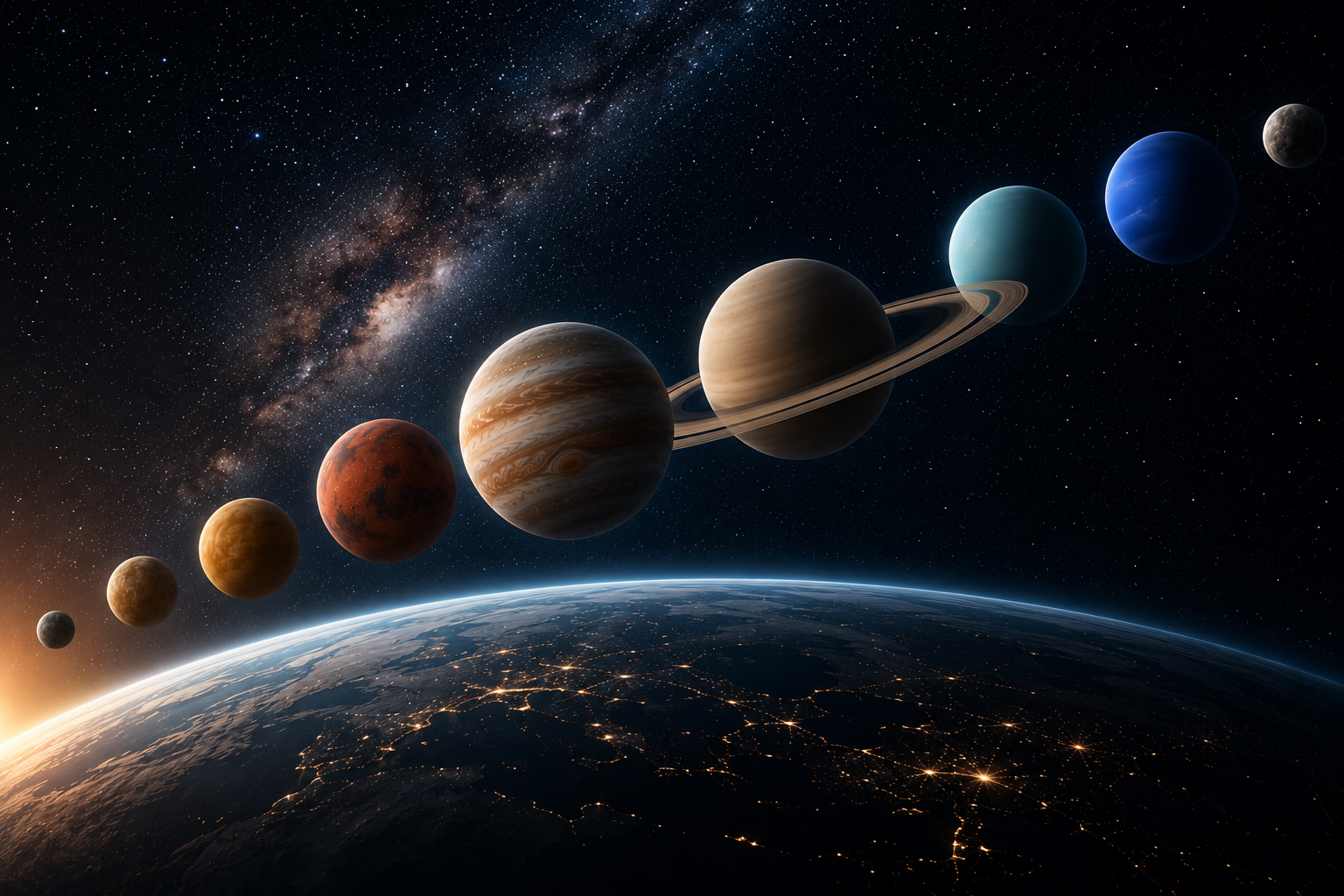
Over the past few weeks, social media has exploded with dramatic posts claiming that “all planets will align” in May 2026. Stunning visuals showing the planets stacked perfectly in a straight line have gone viral across Facebook, Instagram, and TikTok.
But what’s the real story?
The truth is that a genuine and beautiful planetary parade is coming — just not exactly in the way many viral posts suggest.
In astronomy, a “planetary parade” happens when several planets appear in the same region of the sky from Earth’s perspective. This occurs because the planets orbit the Sun along roughly the same plane, called the ecliptic. While they won’t form a perfect line in space, they can appear grouped together across the sky, creating an impressive celestial display.
? Will “All Planets Align”?
Not perfectly.
Despite many viral graphics, the planets will not line up in a flawless straight row across space. That type of alignment is essentially impossible in reality.
Instead, several planets will appear along the same arc of the sky when viewed from Earth. Astronomers refer to this as an apparent alignment — a perspective effect caused by our viewing angle inside the Solar System.
So while the internet versions are heavily stylized, the actual event is still very real and worth watching.
? Which Planets Will Be Visible?
During May 2026, skywatchers should be able to spot multiple planets across the pre-dawn and evening skies, including:
- Mercury
- Venus
- Mars
- Jupiter
- Saturn
These brighter worlds may be visible to the naked eye under good conditions.
Meanwhile:
- Uranus
- Neptune
could also participate in the lineup, though binoculars or a telescope will likely be needed to see them clearly.
Visibility will vary depending on your location, local weather, and light pollution.
? When to Watch
The best viewing opportunities are expected:
? Before sunrise
and in some cases
? Shortly after sunset
throughout parts of May 2026.
A dark viewing location with a clear eastern horizon will offer the best chance of seeing several planets together.
Allow your eyes around 20–30 minutes to adjust to the darkness for the best experience.
? What Will the Sky Look Like?
The sky will change throughout the month as the planets slowly shift positions.
Some highlights may include:
- Brilliant Venus glowing low before dawn
- Saturn rising in the morning sky
- Mars appearing as a reddish point of light
- Jupiter shining brightly near the horizon
- Thin crescent Moon pairings with some planets during parts of the month
Rather than a perfectly straight line, expect a graceful arc of planets stretched along the ecliptic — the same path followed by the Sun and Moon across the sky.
? Why This Event Matters
Planetary parades are not extremely rare, but they are always exciting because they visually reveal the architecture of our Solar System.
Events like this remind us that the planets are constantly moving around the Sun in a vast cosmic dance — and occasionally, from Earth’s point of view, several worlds seem to gather together in the same sky.
For photographers, amateur astronomers, and casual skywatchers alike, May 2026 could offer some unforgettable mornings.
? How to Photograph the Event
To capture the planetary parade:
- Use a tripod
- Find a dark location away from city lights
- Shoot during twilight for the best balance between planets and landscape
- Include mountains, lakes, deserts, or silhouettes for scale
- A wide-angle lens will work best for capturing multiple planets together
Even smartphone cameras may be able to capture Venus, Jupiter, and the Moon under the right conditions.
✨ Final Thoughts
The internet may exaggerate the phrase “all planets align,” but the real event is still something special.
This May, several worlds of the Solar System will share the same sky, offering a rare reminder of our place within a constantly moving cosmic system.
Look up — the Solar System is preparing a beautiful show.