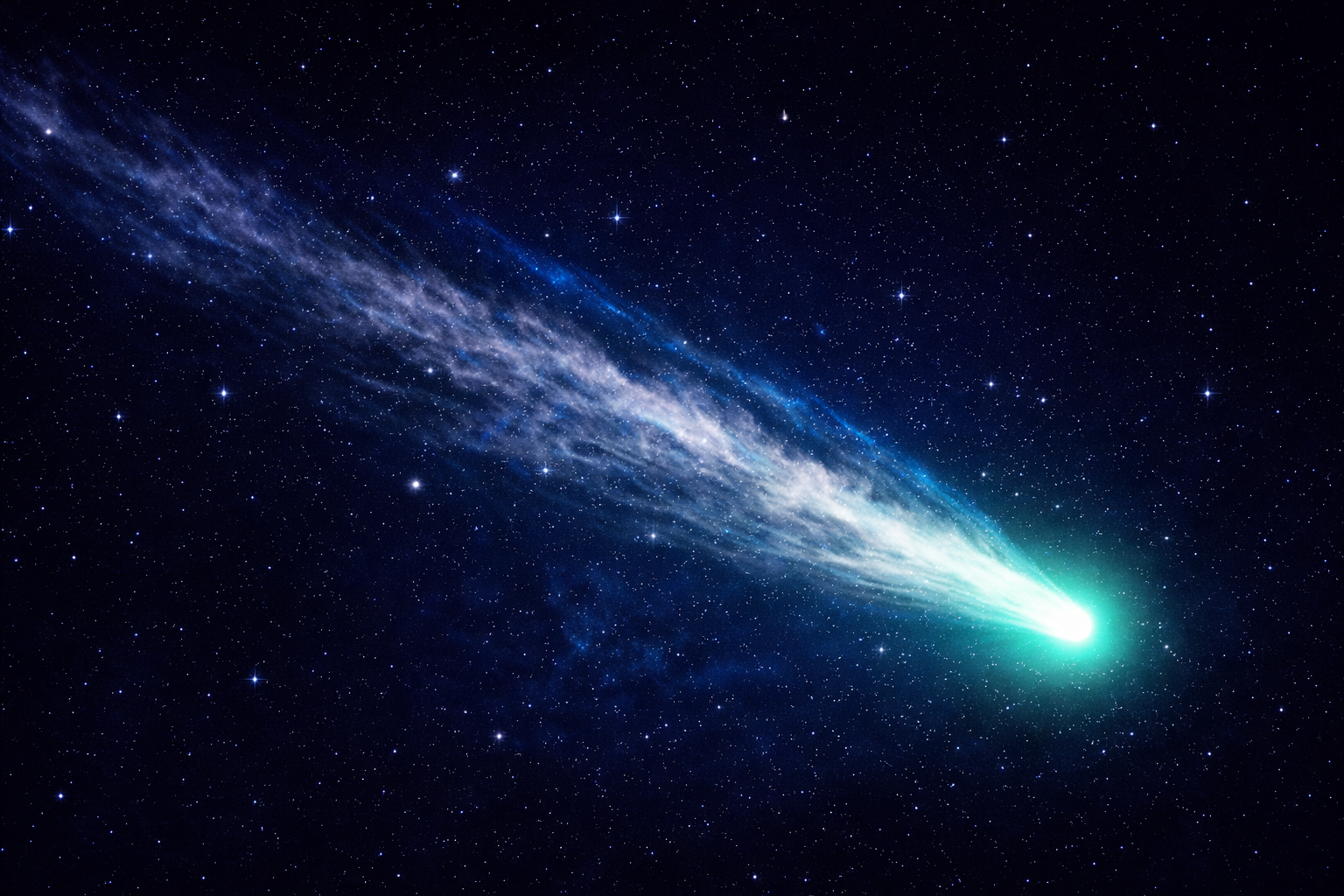
For the first time in around 170,000 years, a comet that last passed through our cosmic neighborhood when early humans still roamed the Earth is returning to our skies.
Known as Comet C/2025 R3 (PanSTARRS), this icy traveler from the outer reaches of the solar system is now making a rare journey inward — offering modern observers a fleeting glimpse of a relic from the distant past.
This is not just another comet.
This is a once-in-a-civilization event.
? Key Dates to Watch
- April 19, 2026 — Closest approach to the Sun (perihelion)
- April 26, 2026 — Closest approach to Earth (~45.5 million miles / 73 million km)
During this time, the comet is expected to brighten as solar radiation heats its surface, causing gas and dust to stream outward — forming its iconic glowing tail.
? Where and How to See It
The comet is already becoming visible in the early morning sky, particularly just before sunrise.
- ? Location: Near the Great Square of Pegasus
- ⏰ Best time: Pre-dawn hours
- ? Visibility:
- Possible with binoculars
- Potentially visible to the naked eye under dark skies
As it approaches the Sun, its brightness may increase significantly — making it easier to spot for observers around the world.
? What Makes This Comet Special?
Comet C/2025 R3 is believed to originate from the Oort Cloud, a distant spherical region of icy bodies surrounding our solar system.
Because of its extremely elongated orbit:
- It spends most of its time in deep space
- It only visits the inner solar system once every ~170,000 years
- No recorded human civilization has ever observed this comet before
The last time it passed by Earth, Homo sapiens were still in the Stone Age.
☄️ A Brief Window in Cosmic Time
Despite its ancient origins, the comet’s visit will be brief.
After reaching its closest points to the Sun and Earth, it will begin its long journey back into the darkness of deep space — disappearing from view and not returning for another 170 millennia.
For us, this moment is rare.
For the universe, it is just a passing whisper.
? Why It Matters
Events like this remind us of our place in the cosmos.
We are witnessing something that:
- Predates recorded history
- Connects us to the earliest humans
- Will not be seen again for longer than the span of modern civilization
It is a powerful reminder that the universe moves on timescales far beyond our own.
? Final Thought
If the skies are clear in the coming days, step outside before sunrise and look toward the eastern horizon.
You might just catch a glimpse of something extraordinary —
a silent traveler from the age of stone, returning briefly to say hello.
Look up.
? Source
Minor Planet Center (2026). Orbit and Observations of Comet C/2025 R3 (PanSTARRS).
International Astronomical Union.