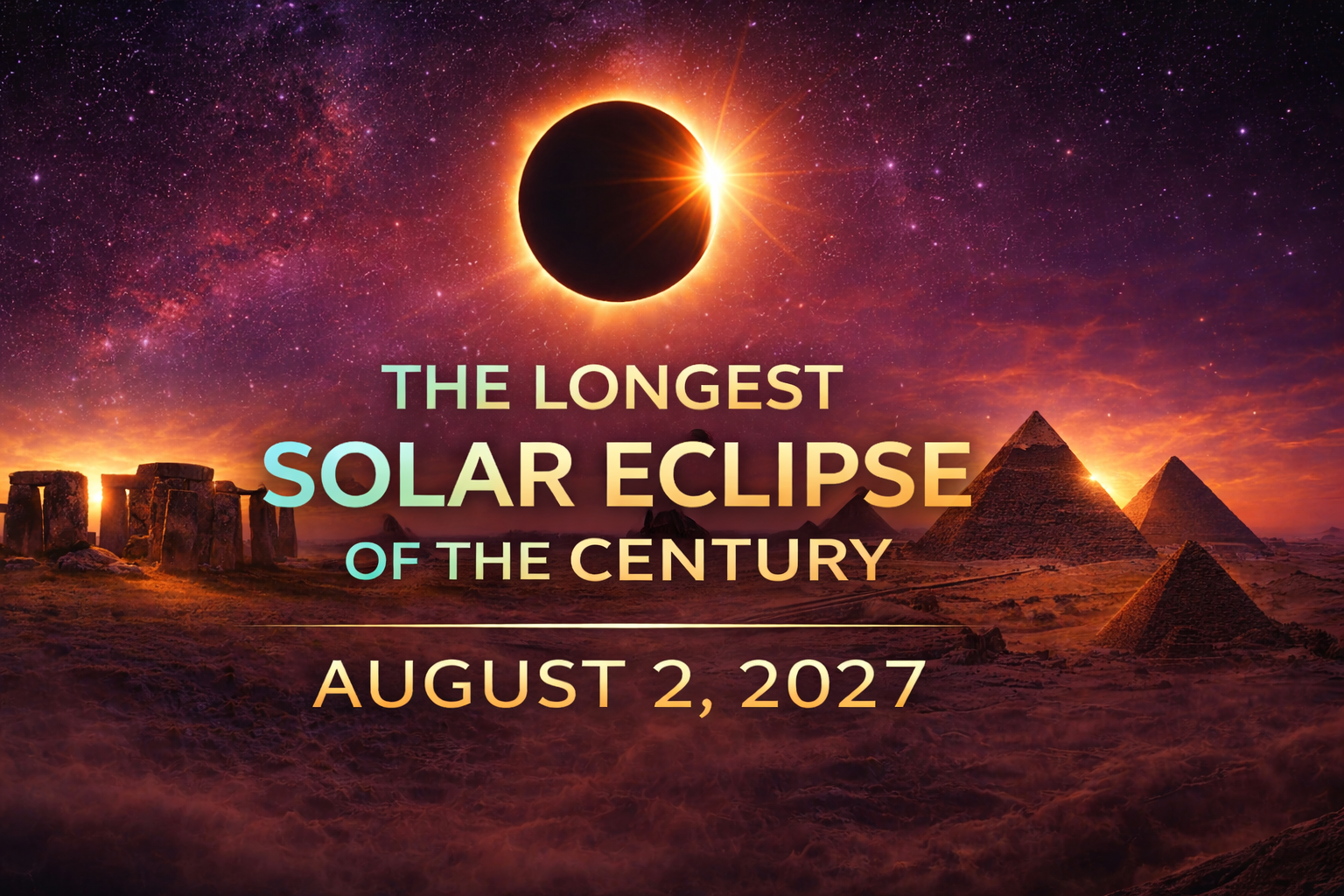
On August 2, 2027, the world will witness one of the most extraordinary astronomical events of our time — the longest total solar eclipse of the 21st century. For a breathtaking 6 minutes and 23 seconds, the Moon will completely cover the Sun, plunging parts of Earth into an eerie twilight in the middle of the day.
This rare celestial event will stretch across three continents, offering millions of people the chance to experience one of nature’s most dramatic spectacles.
For astronomers, skywatchers, photographers, and travelers alike, this eclipse is already being described as one of the greatest sky events of the century.
What Is a Total Solar Eclipse?
A total solar eclipse occurs when the Moon moves directly between Earth and the Sun, perfectly aligning so that the Moon completely blocks the Sun’s bright disk.
When this happens, the sky suddenly darkens, temperatures drop slightly, and the Sun’s outer atmosphere — known as the corona — becomes visible as a glowing halo around the Moon.
Unlike partial eclipses, a total eclipse transforms the sky in a way that feels almost otherworldly. Bright stars and planets may appear, animals become confused, and the horizon glows with a strange twilight light.
But what makes the 2027 eclipse truly special is its extraordinary duration.
Why the 2027 Eclipse Is So Long
Most total solar eclipses last only 2 to 3 minutes.
The upcoming eclipse in 2027 will last more than twice as long, reaching a maximum totality of 6 minutes and 23 seconds.
This happens because several astronomical conditions align perfectly:
• The Moon will be relatively close to Earth, appearing slightly larger in the sky.
• Earth will be near aphelion, the point where it is farthest from the Sun, making the Sun appear slightly smaller.
• The eclipse path will pass near the equator, where the Moon’s shadow moves more slowly across Earth’s surface.
Together, these factors create an unusually long eclipse — something that happens only a few times in a century.
Where the Eclipse Will Be Visible
The path of totality — the narrow region where the eclipse will be seen as completely total — will cross several regions of the world.
The eclipse will begin over the Atlantic Ocean before moving across southern Europe, North Africa, and the Middle East.
Some of the best viewing locations include:
Spain
Gibraltar
Morocco
Algeria
Tunisia
Libya
Egypt
Saudi Arabia
Yemen
Somalia
Among these, Egypt will experience one of the longest durations of totality, making it one of the most sought-after destinations for eclipse chasers.
Imagine standing near the ancient monuments of Egypt, watching the sky darken as the Sun disappears behind the Moon — a moment that connects modern science with humanity’s ancient fascination with the sky.
What Will the Eclipse Look Like?
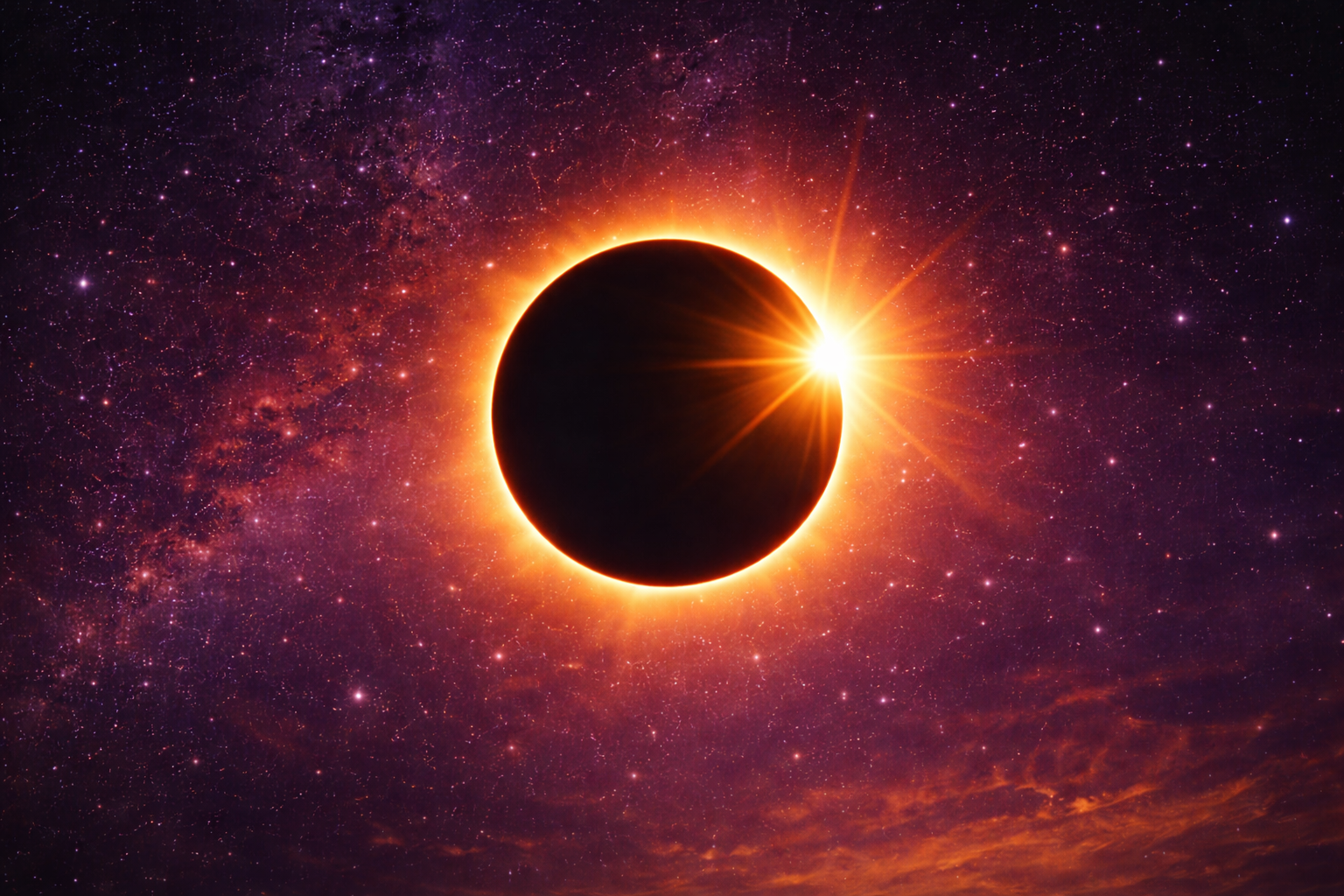
During the peak moment of totality, the Sun will vanish completely, revealing the delicate, glowing solar corona surrounding the dark disk of the Moon.
Just before and after totality, observers will see the famous “diamond ring effect,” when a single bright point of sunlight shines from the edge of the Moon like a brilliant jewel.
For a few unforgettable minutes, the sky will appear like deep twilight, even though it is daytime.
Bright stars and planets may become visible, and the landscape will take on a surreal, almost dreamlike atmosphere.
Why This Eclipse Is So Important for Scientists
Solar eclipses provide rare opportunities for scientists to study the Sun’s outer atmosphere.
The solar corona is extremely difficult to observe under normal conditions because the Sun’s brightness overwhelms it.
But during totality, researchers can examine:
• Solar magnetic fields
• Plasma structures in the corona
• Solar wind formation
• Coronal heating mysteries
Eclipses have historically led to major discoveries — including the first confirmation of Einstein’s General Relativity in 1919, when scientists measured how the Sun’s gravity bends starlight.
Preparing to Watch the Eclipse
If you plan to observe the 2027 eclipse, preparation will be important.
Unlike the brief totality phase, the partial phases before and after the eclipse require proper eye protection.
Observers should always use certified solar eclipse glasses or solar filters.
However, during the brief period of totality, when the Sun is completely covered, it is safe to look directly at the eclipse without protection — and this is when the most spectacular views appear.
Photographers, travelers, and astronomy enthusiasts around the world are already planning trips to witness this event.
A Rare Moment in Our Lifetime
Events like the 2027 total solar eclipse remind us how dynamic and beautiful our universe truly is.
For a few magical minutes, the motions of Earth, Moon, and Sun will align perfectly — turning day into twilight and revealing the hidden atmosphere of our nearest star.
Whether you watch it from a desert in North Africa, a coastline in Spain, or a city in the Middle East, this eclipse promises to be one of the most unforgettable celestial moments of the century.
The countdown has already begun.
August 2, 2027.
Look up — and witness history in the sky.