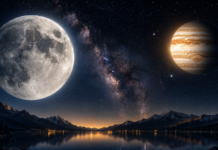
The night sky does not always announce its most meaningful moments with brilliance or spectacle. Sometimes, its most powerful scenes unfold quietly — almost unnoticed — for those willing to pause and look up. One such moment occurs when the Moon and Saturn appear close together in the sky, sharing the same line of sight.
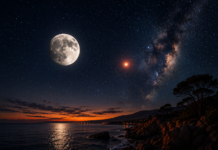
At first glance, the scene is simple: a glowing Moon and a calm, star-like point nearby. Yet behind this quiet pairing lies a profound contrast between two very different worlds.
Two Worlds, Vastly Different
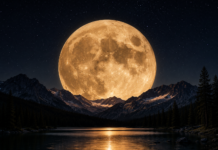
The Moon is Earth’s nearest cosmic neighbor. It is dynamic, familiar, and ever-changing — cycling through phases that have shaped calendars, tides, and human perception of time for millennia. Its surface reflects sunlight strongly, revealing craters, shadows, and texture even to the naked eye.
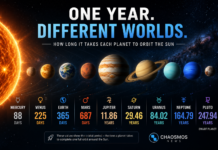
Saturn, on the other hand, is a distant giant. Orbiting the Sun far beyond Earth, it completes a single revolution roughly every 29 years. From our perspective, Saturn moves slowly, almost patiently, against the background of stars — a symbol of endurance and scale within the solar system.
When these two bodies appear side by side, the contrast is striking: closeness versus distance, motion versus stillness, change versus permanence.
An Illusion of Proximity
Despite their apparent closeness, the Moon and Saturn are separated by an immense gulf of space. The Moon orbits just 384,000 kilometers from Earth, while Saturn resides more than a billion kilometers away.
This visual meeting is the result of a conjunction — an alignment created by perspective. From Earth, both objects temporarily occupy the same region of the sky, even though they are nowhere near each other in physical space. Our eyes flatten the cosmos into a two-dimensional view, allowing distant worlds to appear momentarily connected.

Why Saturn Looks Like a Star
Saturn often surprises observers by how subtle it appears. Unlike stars, its light does not flicker. As a planet, Saturn reflects sunlight steadily, producing a soft, golden glow that feels calm and constant.
Its iconic rings — vast enough to stretch hundreds of thousands of kilometers — remain invisible to the naked eye. What we see instead is a single, quiet point of light, distinguished not by brightness, but by stillness.
Beside it, the Moon’s partially illuminated surface reveals depth and shadow, emphasizing its nearness and texture.
A Moment of Cosmic Balance
Encounters like these are not rare, yet they feel meaningful. They remind us that the night sky is not static — it is a living geometry shaped by motion, gravity, and perspective.
There is no dramatic explosion, no sudden flare of light. Just alignment. Just balance.
In these moments, the universe offers a gentle lesson: vast distances do not prevent harmony from appearing — even if only briefly, and only from a single point of view.
? A nearby companion
? A distant giant
? One quiet alignment in the sky