For decades, the open ocean has been understood as a place ruled by efficiency and survival. Predators hunt, prey escapes if it can, and every movement is shaped by evolution’s unforgiving logic. In this system, interference is rare. Intervention is costly. And altruism, at least as humans define it, should not exist.
Yet over the last decade, marine scientists have documented a pattern that challenges these assumptions.
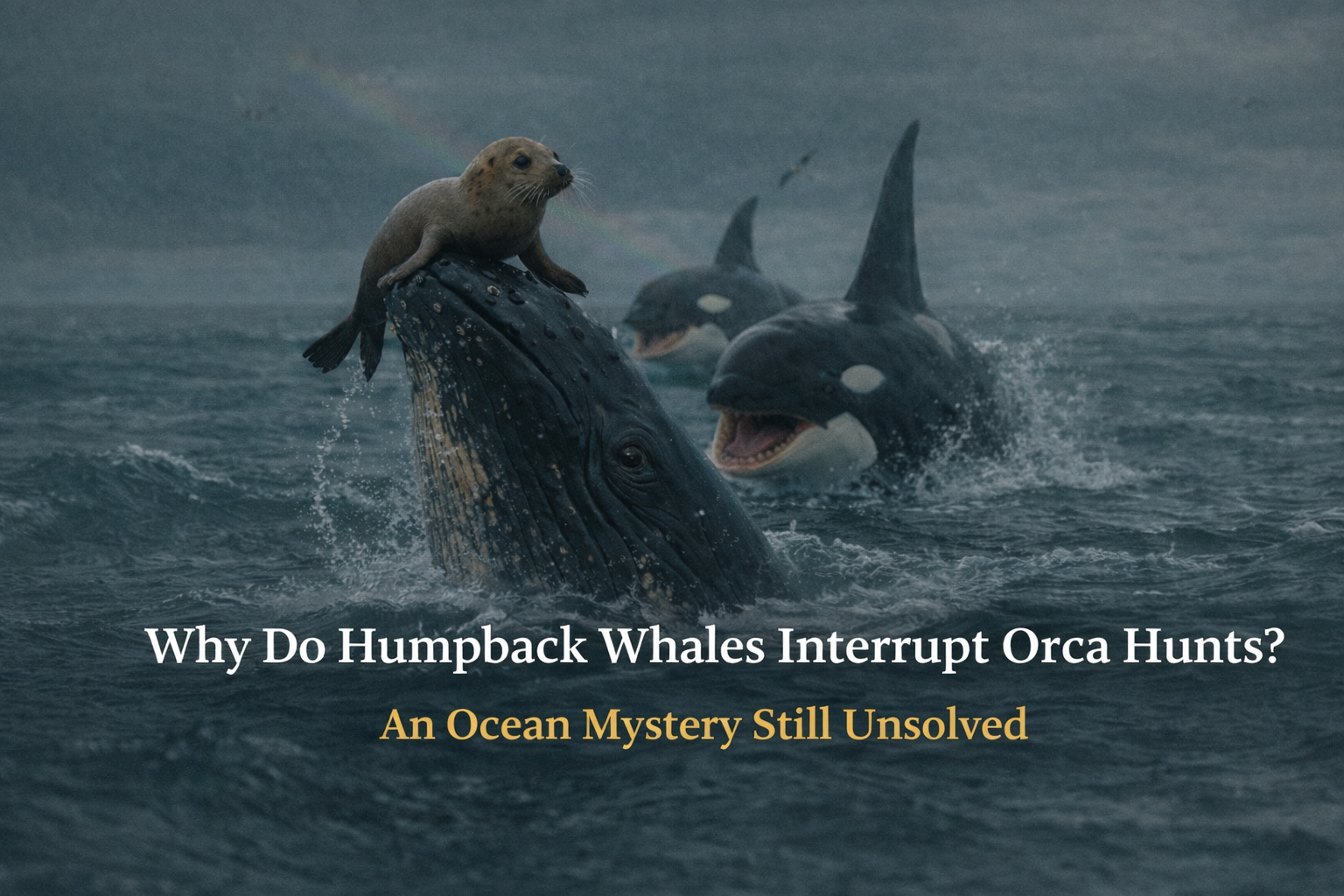
Again and again, humpback whales have been observed interrupting orca hunts — often placing themselves directly between predators and prey. Even more puzzling, the animals being protected are frequently not humpback calves, but seals, dolphins, and even the young of entirely different whale species.
To date, more than 100 confirmed cases of this behavior have been recorded across multiple oceans.
And no one can fully explain why.
A Predator Unlike Any Other
Orcas, also known as killer whales, are among the most intelligent and efficient predators on Earth. They hunt in coordinated groups, use complex vocal communication, and employ learned strategies passed down through generations. When an orca hunt begins, it is usually swift and decisive.
Very few animals are capable of disrupting an orca attack.
Humpback whales are not competitors for the same prey. They gain no food, no territory, and no direct advantage from interfering. From an evolutionary perspective, their involvement makes little sense.
And yet, they intervene.
What the Encounters Look Like
The behavior follows a strikingly consistent pattern. During an active orca hunt, a humpback whale approaches the scene rather than fleeing. Instead of attacking the orcas directly, the humpback positions its massive body between predator and prey.
Researchers have documented humpbacks:
-
Slapping the water with enormous pectoral fins
-
Blocking orca movement
-
Creating turbulence and confusion
-
Remaining near the prey long after the orcas retreat
In several cases, humpbacks were observed staying for hours, effectively guarding the victim even after the immediate danger had passed.
This is not accidental behavior. It is deliberate.
The Most Puzzling Detail: Who Is Being Protected
When humpbacks intervene to protect their own calves, the behavior is understandable. Maternal defense is common across many species.
But the mystery deepens when humpbacks intervene on behalf of completely unrelated animals.
Seals.
Dolphins.
Calves of other whale species.
These animals share no genetic bond with humpbacks. Protecting them provides no clear survival benefit. In fact, intervention carries risk — orcas are powerful, coordinated hunters capable of inflicting serious injury.
Evolution typically discourages such costly behavior.
Yet the pattern persists.
Scientific Explanations — And Their Limits
Marine biologists have proposed several hypotheses.
One leading theory suggests misdirected maternal instinct. Orca hunting vocalizations may resemble the distress calls of humpback calves, triggering an automatic protective response.
Another hypothesis focuses on learned or cultural behavior. Humpbacks are highly social animals, capable of learning and transmitting behaviors across generations. It is possible that intervention has become a culturally reinforced response.
However, neither explanation fully accounts for all documented cases — especially those involving unrelated species and prolonged post-hunt guarding behavior.
The data suggests something more complex than instinct alone.
The Controversial Possibility: Empathy
The idea of empathy in non-human animals has long been controversial. Traditionally, empathy was considered a uniquely human trait.
But humpback whales challenge this assumption.
They possess large, complex brains.
They communicate through elaborate songs.
They maintain long-term social bonds and exhibit advanced problem-solving abilities.
Some scientists now cautiously consider the possibility that humpbacks may recognize distress — not just within their own species, but across species boundaries.
If true, this would fundamentally reshape our understanding of animal intelligence and emotional awareness.
A Reminder of How Little We Know
The ocean covers more than 70% of Earth’s surface. Yet much of its behavior remains undocumented, unseen, and poorly understood. Many of these encounters occur far from shore, without human witnesses.
What scientists have recorded may represent only a fraction of what actually happens beneath the surface.
The consistent nature of humpback interventions suggests intentional behavior — not random coincidence. But intention does not always come with explanation.
Some patterns exist before we understand them.
An Unfinished Story
Humpback whales do not hunt orcas.
They do not dominate them.
They do not gain from intervening.
Yet again and again, they rise from the depths — placing themselves between predator and prey.
Not to hunt.
Not to compete.
But to stop something.
Why they do it remains one of the ocean’s most compelling unsolved mysteries.
And perhaps, for now, the mystery itself is the answer.
ChaosmosNews
Exploring the hidden intelligence of nature, where science meets the unknown.
İstersen sonraki adımda: