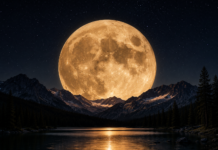
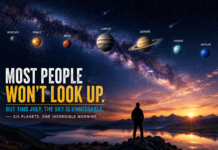
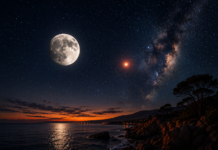
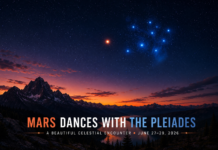
Tonight, the sky hosts a quiet but breathtaking performance: the crescent Moon drifts close to Regulus, the brightest star in the constellation Leo. One glows warm and golden, reflecting sunlight from just 384,000 km away; the other is a blue-white giant blazing from 79 light-years across the galaxy. For a brief moment, the two appear side by side in Earth’s night sky — a perfect blend of science and cosmic poetry.
This celestial pairing is more than a beautiful sight. It’s a window into the structure of our solar system, the nature of massive stars, and the ancient history of human skywatching.
⭐ What Makes Regulus So Special?
Regulus, also known as Alpha Leonis, is no ordinary star.
It is:
A blue-white B-type giant
About 4 times the size of the Sun
More than 300 times as luminous
Located roughly 79 light-years from Earth
Spinning at an extreme speed — so fast that it is noticeably flattened at its poles
This astonishing rotation rate puts Regulus close to the limit of breaking apart. Its equator bulges outward from centrifugal force, creating a distinct oblate shape.
For thousands of years, astronomers and ancient cultures recognized Regulus as “The King’s Star”, linking it to royalty, power, and protection. In Babylonian texts, it was one of the four “Royal Stars.” Persian astronomers considered it a guardian of the heavens. In astrology, it was believed to bring courage and leadership.
Even today, Regulus maintains its status as one of the most iconic stars in the night sky.
? Why Does the Moon Pass Near Regulus?
The Moon travels along a narrow path in the sky known as the ecliptic, the same plane in which most planets orbit.
Regulus sits remarkably close to this line.
As a result, every month, the Moon passes near Regulus — but the visibility of this close approach varies depending on:
The Moon’s phase
The brightness of the sky
Local viewing conditions
How close the Moon gets in angular distance
A thin crescent phase, like tonight’s, creates the most dramatic visual contrast: the Moon’s warm light and Regulus’ icy glow complement each other perfectly.
? What You’ll See Tonight
If you step outside after sunset and look east or southeast (depending on your location), you’ll see:
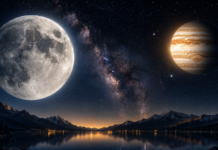
A luminous crescent Moon, golden along the sunlit edge
The faint but beautiful Earthshine glowing on the Moon’s dark side
The brilliant blue-white point of Regulus nearby
A soft band of the Milky Way rising behind them in darker skies
With minimal light pollution, this scene becomes even more cinematic: a meeting of two worlds separated by unimaginable distances but visually united from Earth.
? How to Observe the Moon–Regulus Encounter
You don’t need equipment to enjoy this event — the naked eye works perfectly.
But for enhanced viewing:
With Binoculars:
The crescent’s sharp terminator line becomes stunningly clear
Earthshine is easier to see
Regulus stands out more sharply against the background sky
With a Telescope:
The Moon’s craters near the illuminated edge reveal intricate shadow patterns
Regulus will appear as a pinpoint jewel beside the Moon’s vast disk
Photography Tips:
Use a tripod
ISO 800–1600
1 to 3 seconds of exposure
A 35mm to 85mm lens captures the scene well
Shoot before the Moon gets too low on the horizon
? Regulus in Mythology and History
Cultures across centuries built stories around Regulus:
Babylonians: The “King Star,” a guardian of the four corners of the sky
Persians: One of the four Royal Stars representing the seasonal guardians
Greeks: The heart of Leo, the lion slain by Hercules
Astrologers: A symbol of nobility, courage, and cosmic authority
Its reputation as a “royal” star adds poetic weight to tonight’s meeting with the Moon: the traveler of the sky visiting the celestial throne.
? Why Events Like This Matter
Astronomy is more than data — it’s perspective.
A Moon–Regulus encounter reminds us:
The sky is dynamic, not static
Enormous objects separated by light-years can appear close together
Human eyes can witness cosmic geometry in real time
Beauty and science often overlap in the night sky
Tonight’s alignment is a chance to reconnect with the universe above us — a rare moment of stillness and wonder.
✨ Conclusion: A Dance Across Space
When the Moon meets Regulus, we see more than a bright star next to a glowing crescent.
We witness:
A star that has burned for hundreds of millions of years
A Moon shaped by ancient impacts
A dance created by orbital mechanics
A visual poem written in light
For a few hours, the heart of Leo and Earth’s closest neighbor share the same patch of sky — and all you have to do is look up.