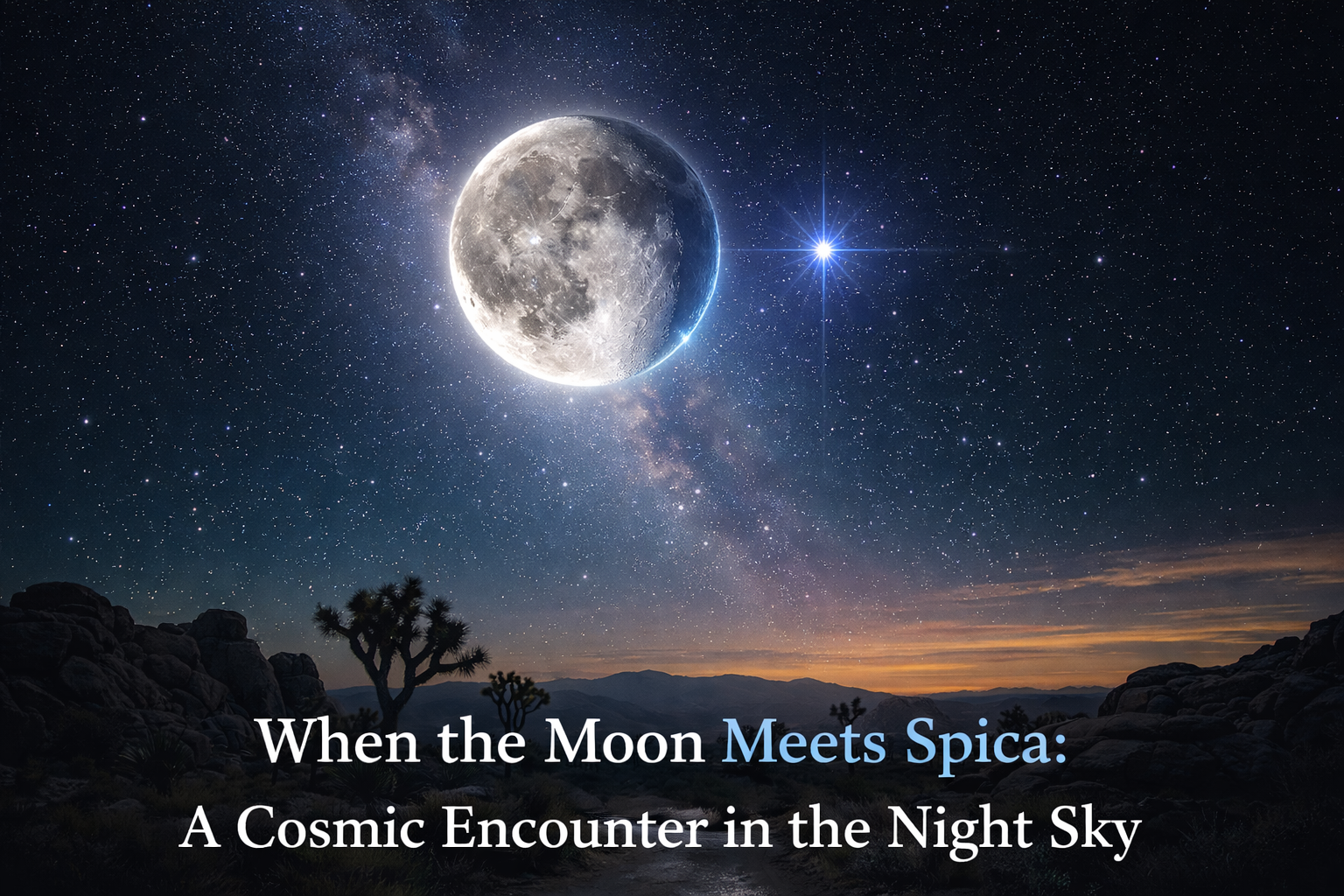
On the night of March 6, 2026, skywatchers around the world will witness a graceful celestial pairing as the waning gibbous Moon glides past Spica, the brightest star in the constellation Virgo.
While the Moon dominates the sky with its brilliant glow, the real star of this encounter—both literally and scientifically—is Spica, a fascinating and powerful stellar system located far beyond our solar system.
This event offers a rare chance not only to admire a beautiful sight, but also to reflect on the incredible scale of our universe.
⭐ Spica: The Brilliant Heart of Virgo
Spica is the brightest star in the constellation Virgo and one of the 20 brightest stars in the entire night sky.
Located about 250 light-years from Earth, Spica shines with a striking blue-white color, a sign of its extremely high surface temperature.
But Spica is not just a single star.
It is actually a binary star system composed of two massive stars orbiting each other at incredible speed. These stars circle one another every four days, so closely that their shapes are slightly distorted by each other’s gravity.
The primary star in the system is estimated to be about 11 times more massive than our Sun, while its companion is around 7 times the Sun’s mass.
Together, they produce a luminosity nearly 20,000 times greater than the Sun, making Spica one of the most powerful stellar beacons visible to the naked eye.
? A Star Used for Navigation for Thousands of Years
For ancient civilizations, Spica was more than just a point of light in the sky.
The star’s name comes from the Latin word for “ear of grain”, referring to a sheaf of wheat held by Virgo in classical star maps.
In ancient cultures:
-
Babylonians associated Spica with harvest cycles
-
Greek astronomers linked it with the goddess Demeter
-
Arab astronomers used it as an important celestial marker
Because of its brightness and position near the ecliptic—the path of the Sun, Moon, and planets—Spica frequently appears near the Moon and planets, making it a familiar companion in the night sky.
? The Moon’s Close Approach on March 6, 2026
During this event, the 91% illuminated waning gibbous Moon will pass close to Spica in the sky.
Although the Moon is only 384,000 km from Earth, Spica lies an astonishing 250 light-years away.
This means the beautiful pairing we see in the sky is actually an illusion of perspective.
In reality:
-
The Moon is our closest cosmic neighbor
-
Spica is an immense stellar system far across our galaxy
Yet for one night, they appear side by side.
This contrast highlights one of astronomy’s greatest wonders: objects separated by unimaginable distances can appear to share the same stage in the sky.
? How to Find Spica
Finding Spica is easier than many people think.
A classic trick used by astronomers is called “Arc to Arcturus, then Spike to Spica.”
-
Follow the curve of the Big Dipper’s handle
-
Continue the arc to reach Arcturus
-
Extend the line further to arrive at Spica
On March 6, however, there will be an even easier guide: the Moon itself, shining just beside the star.
? Why Events Like This Matter
Astronomical pairings like the Moon and Spica remind us how dynamic and interconnected the sky truly is.
While stars appear fixed to the naked eye, the Moon constantly moves across the sky along the ecliptic, regularly passing planets and bright stars along its path.
Each of these encounters is a reminder that our sky is not static—it is alive with motion, alignment, and cosmic rhythm.
? A Moment of Perspective
When you look up at the Moon beside Spica, you are seeing two objects separated by a distance almost impossible to comprehend:
-
The Moon: 1.3 light-seconds away
-
Spica: 250 light-years away
Yet both lights reach your eyes at the same moment.
That simple fact captures the essence of astronomy:
the universe is vast, but the night sky connects it all.
✨ On March 6, step outside after sunset and look up.
For a brief moment, the Moon and Spica will share the same stage—offering a quiet reminder of the immense scale and beauty of the cosmos.