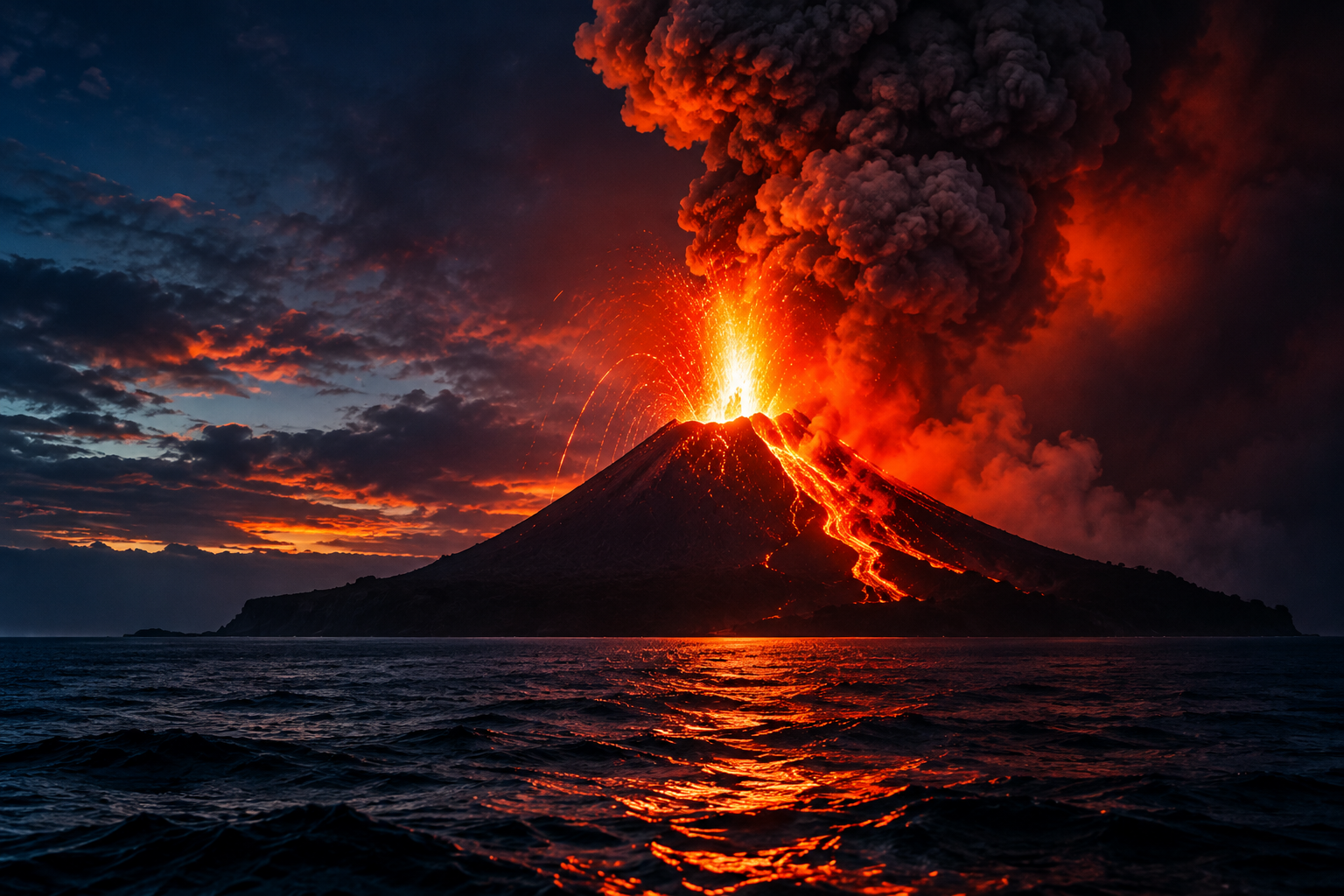
Indonesia’s Anak Krakatau has erupted repeatedly after one of its most intense episodes in recent years, keeping the volcano at Level III alert and reminding the region why the Sunda Strait remains one of the most closely watched volcanic zones on Earth.
Indonesia’s Anak Krakatau erupted multiple times again on Tuesday, September 8, 2026, extending a remarkable period of activity that began several days earlier with a continuous eruption lasting approximately 25 hours.
By 11:34 a.m. local time on September 8, monitoring instruments had recorded four separate eruptions during the day, according to Indonesian reports citing the Center for Volcanology and Geological Hazard Mitigation (PVMBG).
The renewed explosions came only days after Anak Krakatau produced sustained lava fountains, ash emissions and powerful booming sounds during an eruption episode that began late on September 4.
The volcano remains at Level III — Siaga, or Alert — Indonesia’s second-highest volcanic alert level. Authorities continue to prohibit people from entering an area within 3 kilometers (1.9 miles) of the active center.
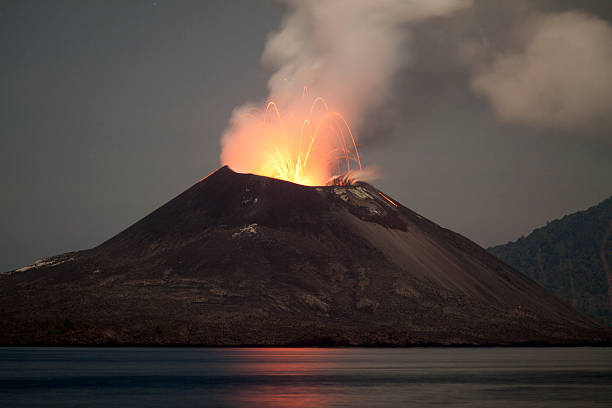
Four Eruptions Recorded on September 8
The first eruption on Tuesday was detected at 05:08 WIB, Indonesia’s western time zone.
Seismic instruments recorded a maximum amplitude of approximately 47 millimeters, with the eruption lasting around 15 seconds.
Only 26 minutes later, another eruption occurred at 05:34 WIB. That event reached a maximum seismic amplitude of approximately 44 millimeters and lasted about 10 seconds.
A third eruption followed at 07:49 WIB, producing a maximum recorded amplitude of 48 millimeters and continuing for approximately 19 seconds.
Then, at 11:34 WIB, monitoring equipment detected a fourth eruption. It registered a maximum amplitude of approximately 50 millimeters and lasted about 17 seconds.
Despite the seismic evidence, observers could not determine the height of the eruption columns during these events because weather conditions and fog obscured the volcano. This is important when interpreting images circulating online: dramatic photographs or videos claiming to show these specific September 8 explosions should not automatically be assumed to depict the events.
It Follows a Remarkable 25-Hour Eruption
The September 8 explosions are part of a much larger volcanic episode.
According to Indonesia’s Ministry of Energy and Mineral Resources, instruments began recording a continuous eruption episode at 23:07 WIB on September 4.
The activity continued until 00:04 WIB on September 6, meaning Anak Krakatau remained in a sustained eruptive phase for roughly 25 hours.
During this period, observers recorded glowing red eruptive material at night and darker emissions during daylight hours.
PVMBG described the phenomenon as resembling a lava fountain, in which jets of incandescent molten rock are thrown above the volcanic vent. Lava flows were also associated with the activity.
After the continuous episode ended, another Strombolian eruption was detected at 03:53 WIB on September 6, lasting roughly 30 seconds. Further Strombolian explosions followed as the volcano transitioned away from the prolonged eruptive episode.
Officials have stressed that the end of continuous eruption does not mean the volcano has returned to normal.
PVMBG’s assessment stated that the probability of further eruptions remained high.
Volcanic Ash Disrupted Air Travel
The consequences extended far beyond the small volcanic island itself.
Ash from Anak Krakatau resulted in major aviation disruption, with Indonesian authorities temporarily closing several airports. Nearly 3,000 flights were disrupted and roughly 340,000 travelers were affected, according to AP and Reuters reports.
Jakarta’s main Soekarno-Hatta International Airport and several other airports subsequently reopened as winds dispersed the ash and conditions improved.
But Tuesday’s renewed eruptions meant authorities continued monitoring the situation closely.
Volcanic ash represents a particular danger to aircraft because fine particles can damage engines and other systems. Even an eruption far from an airport can therefore produce significant disruption when winds carry an ash cloud across major flight corridors.
Satellite analysis cited by Indonesian media also indicated volcanic ash extending up to around 6,000 feet (1.8 kilometers) in some areas, moving generally south-southwest toward the Indian Ocean northwest of Banten early on September 8.
What Is Anak Krakatau?
Anak Krakatau occupies one of the most historically significant volcanic locations on the planet.
Its name translates approximately to “Child of Krakatau.”
The island lies in the Sunda Strait between Java and Sumatra, within the volcanic system associated with Krakatau — the volcano responsible for one of the most famous eruptions in recorded history.
In 1883, Krakatau underwent a catastrophic eruption that destroyed much of the volcanic island complex and generated devastating tsunamis.
But the volcanic system did not disappear.
Decades later, renewed submarine eruptions began constructing a new volcanic island inside the old caldera. This emerging volcano eventually rose above the sea and became known as Anak Krakatau.
It has continued growing and erupting ever since.
The Deadly Lesson of 2018
Anak Krakatau’s modern history contains another major disaster.
On December 22, 2018, part of the volcano collapsed during an eruptive period. The collapse displaced seawater and generated a tsunami that struck coastlines around the Sunda Strait.
More than 430 people were killed in Java and Sumatra.
The disaster demonstrated that volcanoes located in or beside the ocean can produce hazards beyond lava and ash.
For this reason, any major episode at Anak Krakatau naturally raises questions about tsunami risk.
However, Indonesian geological authorities have specifically addressed those concerns during the current activity.
PVMBG’s September 5 assessment said the volcanic structure rebuilt following the 2018 collapse remains relatively small and was not considered capable at that time of undergoing a collapse large enough to generate a tsunami.
Authorities nevertheless continue monitoring changes in the volcano’s morphology and activity.
Officials have also urged communities along the Banten and Lampung coasts not to believe unverified tsunami rumors and instead follow information from official agencies.
Why Does Anak Krakatau Keep Erupting?
Anak Krakatau exists within one of Earth’s most geologically active regions.
Indonesia sits along the Pacific Ring of Fire, a vast zone where tectonic plates interact around much of the Pacific basin.
Around Indonesia, the Indo-Australian Plate is being forced beneath portions of the Eurasian/Sunda Plate system. This process — known as subduction — contributes to magma generation beneath the region.
That magma can rise through Earth’s crust and feed volcanic systems.
The result is the extraordinary chain of volcanoes stretching across Indonesia.
More than 120 active volcanoes are found across the country, making Indonesia one of the world’s most volcanically active nations.
Anak Krakatau is therefore not an isolated geological anomaly. It is part of a much larger tectonic system continually reshaping the Indonesian archipelago.
Scientists Are Watching the Volcano From Several Angles
Modern volcano monitoring goes far beyond simply watching for smoke above a crater.
PVMBG uses seismic instruments, visual and CCTV observations, deformation measurements and other monitoring systems to track Anak Krakatau.
One important measurement is RSAM — Real-time Seismic Amplitude Measurement — which provides scientists with an indication of changing seismic energy.
During the recent episode, RSAM increased on September 5 before declining again on September 6.
Tiltmeters have also provided evidence about deformation of the volcano. The Tanjung station had shown an inflationary trend since early August, while another monitoring station showed comparatively stable behavior.
No single measurement can predict exactly when the next eruption will occur. Instead, volcanologists combine multiple datasets to determine whether magma movement, gas pressure and seismic activity indicate an increasing or decreasing probability of eruption.
The Danger Has Not Passed
PVMBG’s September 7 evaluation made clear that Anak Krakatau remained dynamically active even after the 25-hour continuous eruption ended.
Potential hazards include incandescent volcanic projectiles, heavy ashfall, lava flows and pyroclastic activity.
People, tourists and climbers have been instructed not to enter the 3-kilometer exclusion zone around the active center.
Those affected by volcanic ash have also been advised to reduce unnecessary outdoor activity or use masks to limit respiratory exposure.
The situation remains fluid.
Anak Krakatau can alternate between quieter periods and sudden explosive activity, meaning the absence of a towering visible ash column does not necessarily indicate that the volcanic system has settled.
A Volcano Still Building Itself
Perhaps the most remarkable thing about Anak Krakatau is that scientists are effectively watching a volcano construct itself within the remains of one of history’s most destructive volcanic systems.
It was born from the remnants of Krakatau.
It grew out of the sea.
It partially collapsed in 2018.
And it began rebuilding again.
The September 2026 eruption sequence is another chapter in that continuing geological process — a reminder that on human timescales a landscape can appear permanent, while on geological timescales Indonesia’s islands are still being actively created, destroyed and reshaped.
For now, Anak Krakatau remains at Level III (Siaga), and Indonesian authorities continue to monitor the volcano around the clock.
Sources: Indonesia’s Ministry of Energy and Mineral Resources (ESDM), Geological Agency/PVMBG, MAGMA Indonesia, Reuters and Associated Press.