On June 29, 2026, skywatchers around the world will witness the rise of the Strawberry Moon, one of the most beloved full moons of the year. Despite its colorful name, this celestial event has nothing to do with the Moon turning pink or red. Instead, the story of the Strawberry Moon begins here on Earth—in forests, fields, and the seasonal rhythms that have guided human life for thousands of years.
The name “Strawberry Moon” originates from Indigenous peoples of North America, particularly Algonquin-speaking communities, who used the full moons of each month to track seasonal changes. The June full moon coincided with the short but important season when wild strawberries ripened and were ready to harvest. Long before modern calendars existed, the Moon served as a natural clock, helping communities organize planting, harvesting, hunting, and ceremonies.
This connection between the sky and the land is a reminder that astronomy was once deeply woven into everyday survival. The Moon was not merely an object in the night sky—it was a guide, a calendar, and a symbol of nature’s cycles.
Why Does the Moon Sometimes Look Pink or Orange?
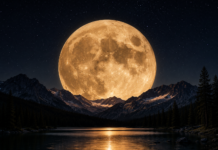
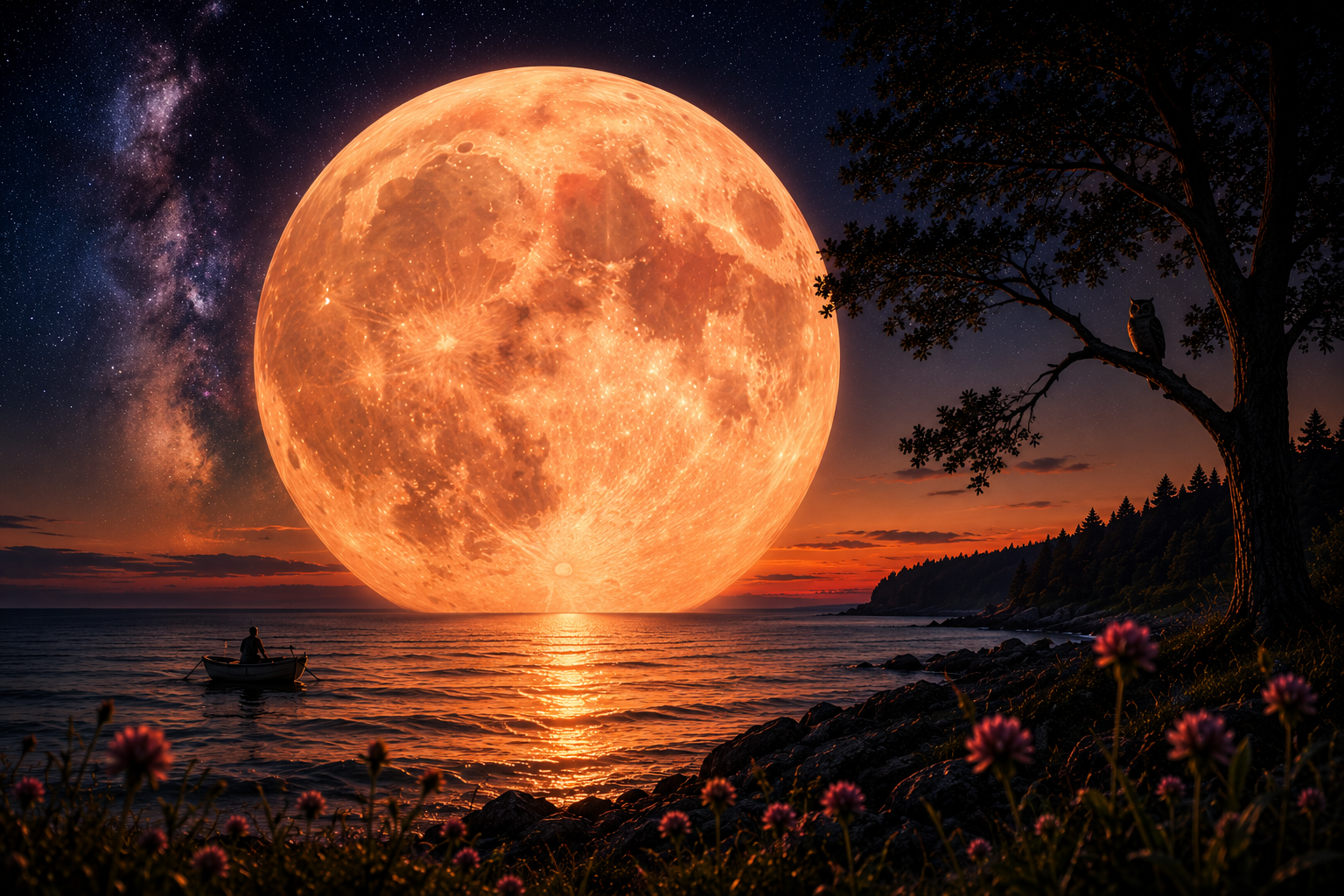
Although the Strawberry Moon is not actually pink, observers often notice that it appears golden, orange, or even reddish when it rises near the horizon.
This effect is caused by Earth’s atmosphere. As moonlight travels through a thicker layer of air near the horizon, shorter blue wavelengths are scattered away while longer red and orange wavelengths continue toward our eyes. The result is a warm, glowing Moon that can appear dramatically larger than when it is high overhead.
This phenomenon, known as the “Moon Illusion,” makes the Moon seem enormous when viewed alongside trees, mountains, buildings, or the distant horizon. In reality, its size remains unchanged.
A Moon That Connects Cultures
The June full moon has carried many names across civilizations.
In Europe, it was often called the Rose Moon because it coincided with the blooming of roses. Some traditions referred to it as the Honey Moon, associated with summer harvests and the historical timing of weddings. Other cultures linked the Moon to fertility, abundance, and the beginning of warmer seasons.
Across continents and centuries, people looked up at the same Moon and found meaning in its arrival. While the names differed, the connection between humanity and the night sky remained universal.
The Science Behind the Beauty
The Moon itself is an airless world approximately 384,400 kilometers (238,855 miles) from Earth. Its surface is covered with ancient impact craters, vast plains of hardened lava, and mountains formed billions of years ago.
Every full moon occurs when Earth lies between the Sun and the Moon, allowing the lunar hemisphere facing Earth to become fully illuminated by sunlight.
The Strawberry Moon of 2026 is another reminder that even familiar celestial events are part of a grand cosmic dance involving gravity, orbital mechanics, and the constant motion of our planet through space.
Looking Up
In a world dominated by screens, schedules, and artificial light, the Strawberry Moon offers something increasingly rare: a reason to pause.
For a few moments, millions of people across the globe will share the same experience—watching a brilliant full moon rise above the horizon, just as countless generations did before them.
Its name may come from strawberries, but its significance reaches far beyond a seasonal harvest.
The Strawberry Moon is a reminder that the sky still keeps time, and that humanity remains connected to rhythms far older than civilization itself.
As darkness falls on June 29, look toward the eastern horizon.
A familiar Moon will rise.
And with it, an ancient story.