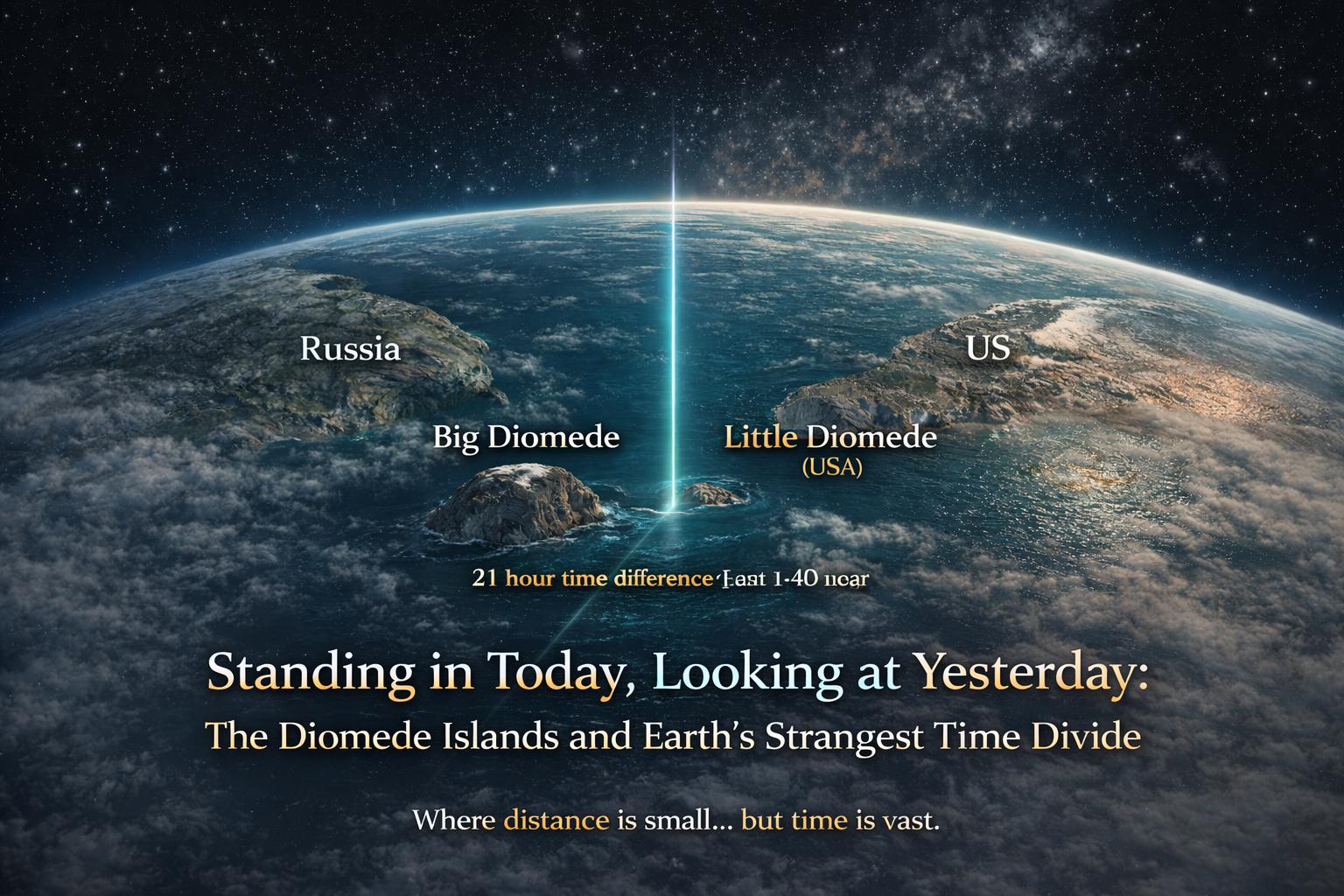
In one of the coldest and most remote corners of the planet lies a place where time behaves in a way that feels almost unreal. Two rocky islands sit quietly in the icy waters of the Arctic, separated by just 2.4 kilometers, yet divided by nearly 21 hours in time.
This is the story of the Diomede Islands — one of the most extraordinary geographical curiosities on Earth.
Where Are the Diomede Islands?
The Diomede Islands are located in the Bering Strait, the narrow body of water that separates Russia from the United States.
There are two islands:
-
Big Diomede (Russia)
-
Little Diomede (USA)
On clear days, the islands are easily visible from one another. The distance between them is shorter than many city commutes. Yet despite this physical closeness, they exist in different days.
The Invisible Border That Splits Time
Running between Big Diomede and Little Diomede is one of the most powerful imaginary lines humans have ever created: the International Date Line.
Unlike longitude lines that neatly wrap around the globe, the International Date Line bends and zigzags to avoid splitting countries and island chains. At the Diomede Islands, it cuts directly between two small pieces of land.
Crossing this line does not change where you are —
it changes when you are.
Move east across the line, and you go back nearly a full day.
Move west, and you jump forward into tomorrow.
This makes the Diomede Islands one of the few places on Earth where you can literally look across the water and see yesterday.
A 21-Hour Time Difference — Just Kilometers Apart
Although the islands are neighbors, their clocks are dramatically different:
-
Big Diomede (Russia) operates almost a full day ahead
-
Little Diomede (USA) remains nearly a day behind
The result is a 21-hour time difference between two islands that are closer than many towns are to their suburbs.
This is why Big Diomede is often nicknamed “Tomorrow Island,” while Little Diomede is sometimes called “Yesterday Island.”
Life at the Edge of Time
Today, Big Diomede is uninhabited. During the Cold War, its Indigenous population was relocated, and the island became a restricted military zone. It now stands silent — a frozen land marked by wind, ice, and history.
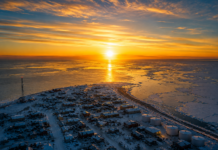
Little Diomede, on the other hand, is still home to a small Inupiat community. Life there is shaped by extreme weather, isolation, and the constant presence of international borders just beyond the horizon.
There are no bridges connecting the islands. No ferries run between them. In winter, when the sea freezes, the ice sometimes creates a temporary natural pathway — but political borders and time zones remain firmly in place.
Why the Diomede Islands Matter
The Diomede Islands are not important because of their size or population. They matter because they reveal something fundamental about our world:
Time is not purely natural. It is organized.
The Sun rises and sets based on physics, but days, dates, and time zones are systems humans designed to bring order to the planet. At the Diomede Islands, this human-made structure becomes impossible to ignore.
Here, geography does not just divide land.
It divides time itself.
A Place That Feels Unreal — Yet Entirely Real
Standing at the Diomede Islands challenges our sense of reality. It forces us to confront the idea that “today” and “yesterday” are not universal experiences, but labels shaped by lines drawn across maps.
Few places on Earth demonstrate this truth so clearly.
Two islands.
Two nations.
Two different days.
All separated by a line you cannot see.
Where distance is small — but time is vast.
— ChaosmosNews