In the frozen extremes of the Arctic, survival depends on adaptation. Temperatures plunge far below zero, food is scarce, and perhaps most challenging of all, light itself becomes unpredictable. Some months bring endless daylight. Others sink the land into near-total darkness.
Among all Arctic animals, reindeer possess one of the most extraordinary biological solutions to this problem.
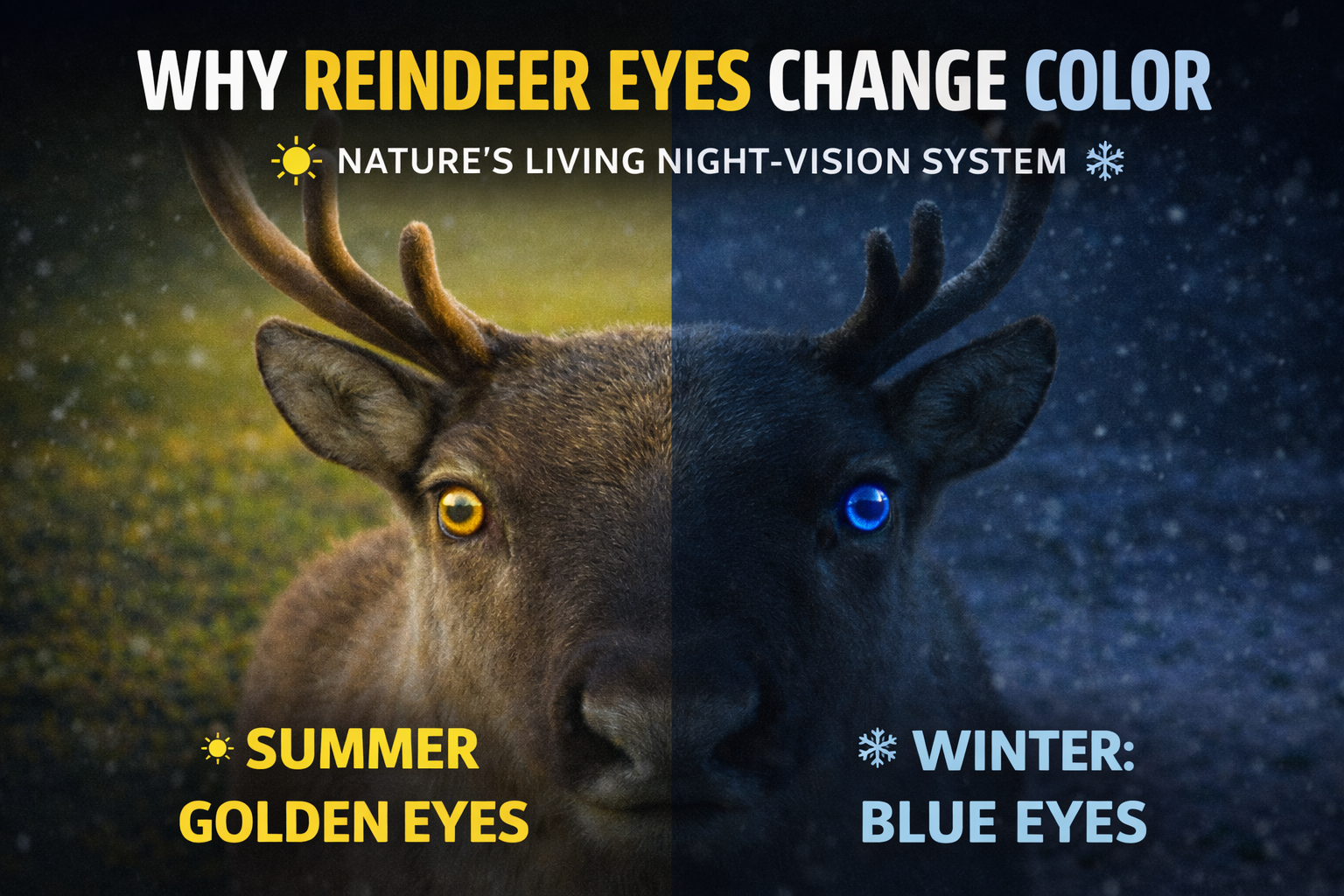
They are the only mammals known to change eye color with the seasons.
This is not a visual illusion, nor a genetic mutation. It is a precise, physical transformation inside the eye — driven by light, darkness, and evolutionary pressure.
Life at the Edge of Light
The Arctic is a world of extremes.
During summer, the Sun can remain above the horizon for nearly 24 hours a day. During winter, it may not rise at all for weeks or even months.
For most animals, such drastic changes in light would overwhelm the visual system. Too much brightness causes glare and loss of contrast. Too little light makes it nearly impossible to see predators, food, or terrain.
Reindeer solved this problem not by changing behavior — but by changing their eyes.
The Science Behind the Color Change
Inside the reindeer’s eye lies a reflective layer called the tapetum lucidum.
This layer sits behind the retina and reflects light back through it, increasing the amount of light available to photoreceptor cells.
Many animals have a tapetum lucidum — it’s why cats’ eyes glow at night.
But reindeer are unique in how this layer physically changes structure with the seasons.
Summer: Golden Eyes in Endless Daylight
During Arctic summer, constant sunlight creates a risk of visual overload. Too much reflected light can wash out detail and reduce clarity.
In summer months, the reindeer’s tapetum lucidum reflects golden-yellow wavelengths of light.
This golden reflection:
-
Reduces glare
-
Improves contrast
-
Protects the retina from continuous brightness
In effect, the reindeer’s eyes act like natural sunglasses, optimized for a world where night barely exists.
This is why reindeer eyes appear golden or amber during summer.
Winter: Blue Eyes for the Arctic Night
When winter arrives, darkness dominates the Arctic landscape. The Sun stays low or disappears entirely. Snow reflects faint blue light, and visibility becomes a matter of survival.
During this period, the reindeer’s pupils remain dilated for long stretches of time. This prolonged dilation increases pressure inside the eye.
That pressure physically alters the structure of the tapetum lucidum.
As a result, the eye begins reflecting blue light instead of gold.
Blue wavelengths scatter less and are more effective in low-light environments. This shift dramatically increases visual sensitivity.
Scientists estimate that winter-adapted reindeer vision can be up to 1,000 times more sensitive than human vision under similar conditions.
Why Blue Vision Matters
This enhanced sensitivity allows reindeer to:
-
Detect predators in near-darkness
-
See food beneath snow
-
Navigate icy terrain with minimal light
What appears almost pitch black to human eyes becomes a detailed visual landscape for them.
The Arctic night is not empty — and reindeer are perfectly equipped to see it.
Evolution’s Silent Engineering
This phenomenon is not the result of intelligence or conscious adaptation.
It is the product of natural selection, refined over thousands of years.
Reindeer that could better adapt to seasonal light survived longer, reproduced more successfully, and passed on these traits. Over time, nature engineered a living night-vision system — without technology, without electronics, and without artificial enhancement.
Nature’s Lesson
While humans develop night-vision goggles, infrared cameras, and optical sensors, nature solved the same problem long ago — using biology alone.
Reindeer eyes remind us that evolution is not just about survival.
It is about optimization.
In the Arctic, vision itself becomes seasonal.