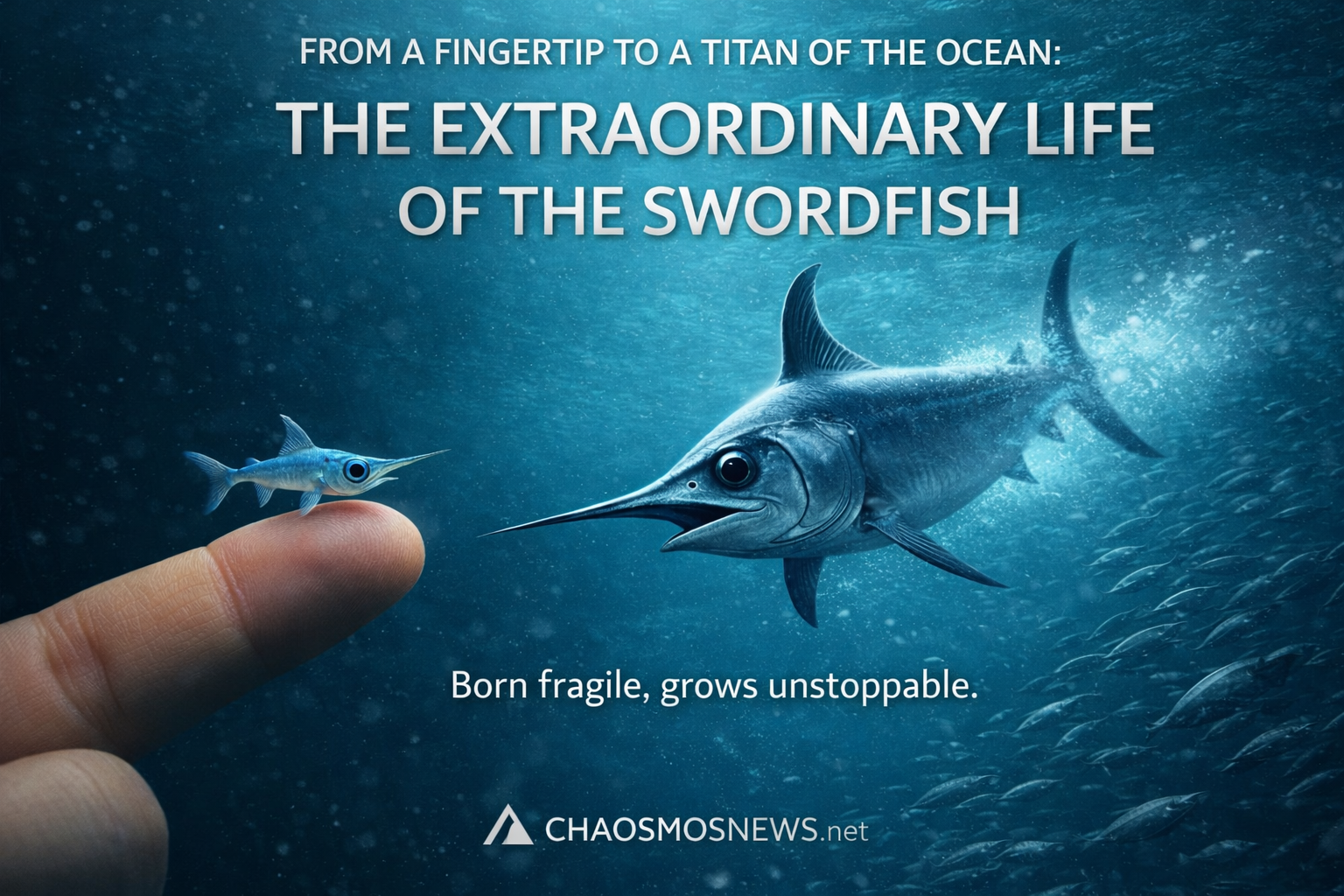
In the vast openness of the world’s oceans, some of nature’s most powerful predators begin life in a form almost too small to notice. The swordfish (Xiphias gladius) is one of them. Born fragile, translucent, and measuring only a few centimeters, this species undergoes one of the most dramatic transformations in the marine world — from near invisibility to dominance.
Born into Uncertainty
Swordfish spawn in warm, open oceans where currents carry their eggs and larvae across immense distances. At birth, swordfish larvae are extremely vulnerable. They drift among plankton, lacking the speed, size, or strength needed to defend themselves.
Mortality rates at this stage are staggering. Millions are born, yet only a tiny fraction survive their earliest days. Predation, temperature changes, and shifting currents eliminate most before they ever mature.
Survival, at this stage, is a matter of chance.
Rapid Growth and Evolutionary Design
For the few that endure, growth happens fast. Swordfish are built for efficiency. Their bodies elongate, muscle density increases, and their once-delicate structure becomes hydrodynamic and powerful.
Unlike many fish species, swordfish lack scales and have a stiff, streamlined body optimized for speed. This design allows them to cut through water with minimal resistance — an evolutionary advantage refined over millions of years.
The Sword: More Than a Weapon
Perhaps the most iconic feature of the swordfish is its elongated bill, often mistaken as a simple spear. In reality, this “sword” is a sophisticated hunting tool.
Rather than stabbing prey directly, swordfish use rapid lateral slashes to injure and stun entire schools of fish. This technique allows them to hunt efficiently, expending less energy while increasing success. The bill also reduces drag and improves hydrodynamics during high-speed pursuits.
It is not brute force — it is precision.
Speed, Depth, and Endurance
Fully grown swordfish can exceed 4 meters (13 feet) in length and are capable of reaching speeds close to 100 kilometers per hour (60 mph), making them one of the fastest swimmers in the ocean.
Their abilities are not limited to speed alone. Swordfish routinely dive to depths exceeding 600 meters (2,000 feet), entering the ocean’s twilight zone where pressure is extreme and light barely penetrates. Specialized tissues and adaptations allow them to regulate temperature around their eyes and brain, maintaining sharp vision even in cold, dark waters.
Few predators can match this combination of speed, depth, and endurance.
From Fragile Beginnings to Ocean Titan
What makes the swordfish remarkable is not just its power — but the scale of its transformation. A creature that begins life smaller than a human fingertip grows into a solitary apex predator, capable of dominating open waters across the globe.
This journey is a reminder of nature’s unforgiving balance. In the ocean, size at birth offers no guarantee. Survival depends on adaptation, efficiency, and relentless selection.
Every giant begins small.
Only the strongest stories continue.