For most of the year, Death Valley represents one of Earth’s most extreme environments. With summer temperatures frequently exceeding 50°C (122°F) and some areas receiving less than 50 millimeters of rain annually, it is widely known as the hottest and driest place on the planet.
At first glance, the landscape appears lifeless — cracked earth, salt flats, and barren mountains shaped by relentless heat. But beneath this harsh surface lies a hidden story of patience, adaptation, and resilience.
And when rain finally arrives, that story comes alive.
A Desert Built on Extremes
Death Valley’s climate is defined by extremes. Its low elevation, surrounding mountain ranges, and intense solar radiation create a natural heat trap. Moisture-carrying clouds are often blocked by mountains, leaving the valley floor dry for months — sometimes years — at a time.
Yet life has adapted to these conditions in extraordinary ways.
Many desert plants do not rely on constant water. Instead, they depend on rare, short-lived rain events, waiting silently until conditions are just right.
Seeds That Wait for Years
Hidden beneath the desert soil are countless dormant seeds — some capable of surviving for years or even decades without water. These seeds are biologically programmed to remain inactive until a precise combination of moisture and temperature triggers their growth.
When rainfall finally occurs, the response is rapid.
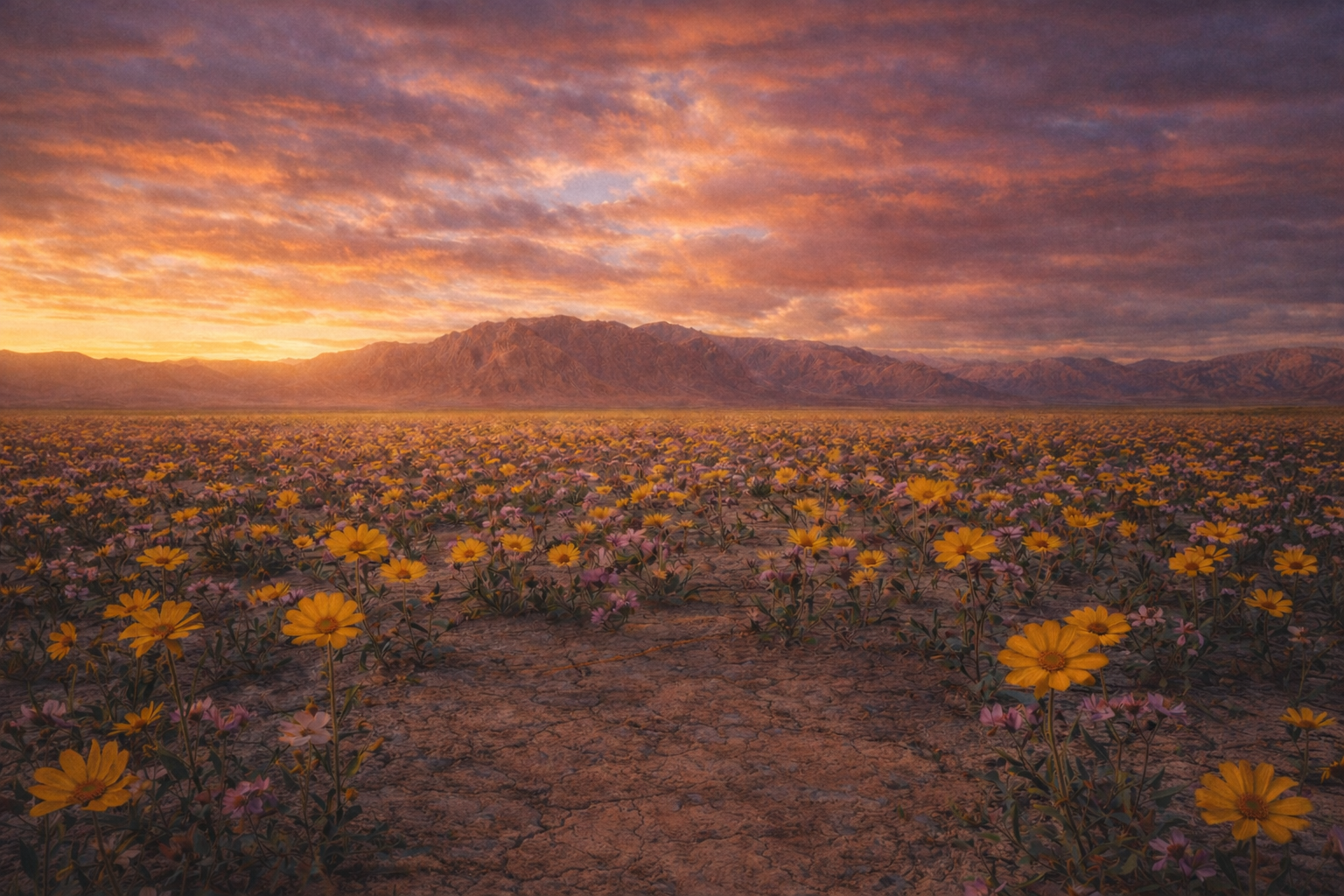
Within days, the once-barren landscape begins to change. Tiny green shoots emerge from cracked earth, followed by bursts of color as wildflowers bloom across the valley floor.
This phenomenon is known as a superbloom.
The Science Behind a Superbloom
A superbloom is not guaranteed after every rainfall. It requires a delicate balance of factors:
-
Sufficient rainfall spread over time
-
Cooler temperatures following precipitation
-
Limited wind erosion
-
Dormant seed availability from previous seasons
When these conditions align, Death Valley can transform into a vast field of wildflowers — yellows, purples, pinks, and whites stretching across the desert like a living tapestry.
But this transformation is fleeting.
Beauty That Exists Only Briefly
Superblooms can last just a few weeks, sometimes even days. As temperatures rise and moisture disappears, the flowers complete their life cycle quickly — producing seeds that fall back into the soil and return to dormancy.
The desert appears lifeless once again.
But life has not vanished.
It has simply learned to wait.
A Lesson Written in the Landscape
Death Valley’s rare blooms are more than a visual spectacle. They serve as a powerful reminder of nature’s resilience and adaptability.
Even in the most unforgiving environments, life does not disappear. It pauses. It conserves. It endures.
And when the moment is right, it returns — quietly, briefly, and beautifully.
The Desert Never Forgets
Death Valley does not bloom despite its harsh conditions — it blooms because of them.
Its silence holds memory.
Its soil holds life.
And when rain finally returns, the desert remembers exactly what to do.
Published by ChaosmosNews
Exploring Earth’s extremes, one story at a time.