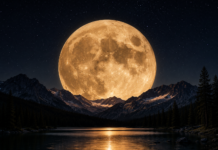
On January 3, 2026, the night sky welcomes the first full Moon of the year — a luminous winter presence known as the Full Wolf Moon. Rising over frozen landscapes and silent forests, this Moon has long been a symbol of survival, endurance, and the deep rhythms of nature.
For thousands of years, humans have looked to the Moon not only to measure time, but to understand their place within the natural world. The Wolf Moon stands at the threshold of the year, reminding us that winter is not merely a season of cold — but a season of resilience.
What Is the Wolf Moon?
The term “Wolf Moon” comes from early North American and European traditions. During the heart of winter, wolves were often heard howling outside villages, drawn closer by hunger and harsh conditions. While modern science tells us that wolves howl to communicate rather than in response to the Moon itself, the association endured — and the name remained.
This Full Moon marks the January full Moon, the first lunar culmination of the calendar year.

The Science Behind the Full Moon
A Full Moon occurs when the Sun, Earth, and Moon align, allowing the lunar surface to fully reflect sunlight toward Earth. During winter months in the Northern Hemisphere, the Full Moon often appears especially bright and high in the sky, tracing a long arc through the night.
The January Full Moon follows a path opposite the low winter Sun, which means it can remain visible for many hours — bathing snowy landscapes in pale, silver-blue light.
Why the Wolf Moon Feels So Powerful
Beyond astronomy, the Wolf Moon carries a powerful symbolic weight. It represents:
-
Survival through hardship
-
Community and communication
-
The wild instincts that persist beneath civilization
As the first Full Moon of the year, it also reflects beginnings — a reminder that even in the coldest, darkest moments, cycles continue and light returns.
How to Observe the Wolf Moon
The Wolf Moon can be enjoyed with the naked eye, requiring no special equipment. For the best experience:
-
Look for it shortly after sunset, when it rises large and golden near the horizon.
-
As the night deepens, its color shifts to a cooler white-blue glow.
-
Binoculars or a small telescope reveal subtle lunar surface details, including craters and maria.
Photographers may capture dramatic results by pairing the Moon with winter landscapes, trees, or silhouettes.
A Moon That Connects Past and Present
The light reaching your eyes from the Wolf Moon left the Sun just over eight minutes ago, reflected off a world more than 384,000 kilometers away. Yet its meaning stretches far deeper — linking ancient storytellers, early sky-watchers, and modern observers in a shared human experience.
As the Wolf Moon rises, it invites us to pause, look upward, and listen — not for the howl of wolves, but for the quiet voice of the cosmos itself.
Look up. The year’s first Full Moon is calling.