One of the most recognizable full moons of the year is approaching.
On September 26, 2026, the Full Moon will rise into the early autumn sky as the Harvest Moon, a name associated for centuries with the changing seasons, shorter days and the traditional harvest period across the Northern Hemisphere.
The Moon will officially reach its full phase at 16:49 UTC on September 26. In Türkiye, that corresponds to 19:49 local time. However, observers do not need to catch that exact moment. To the human eye, the Moon will appear essentially full around the night of September 26, making the evening an excellent opportunity to watch it rise above the eastern horizon.
And this year, another bright world will share the evening sky: Saturn will appear near the Harvest Moon, creating an especially attractive pairing for skywatchers.
Why Is It Called the Harvest Moon?
Unlike names that are permanently attached to a particular month, the Harvest Moon has an astronomical definition tied to the seasons.
It is the Full Moon occurring closest to the Northern Hemisphere’s autumnal equinox.
That means the Harvest Moon usually occurs in September, although in some years it can fall in early October.
The name is deeply connected with agriculture. Before electric lighting transformed farming, the bright Moon around harvest season provided valuable illumination after sunset. Farmers gathering crops at the end of summer and beginning of autumn could continue working into the evening under moonlight.
But there is also an interesting astronomical reason the Harvest Moon became so closely associated with extended evening light.
Something Unusual Happens to Moonrise Around the Harvest Moon
Normally, the Moon rises roughly 50 minutes later from one day to the next on average.
Around the Harvest Moon, however, that delay can become considerably shorter at many Northern Hemisphere locations.
The reason involves the geometry of the Moon’s path across the sky.
Near the autumn equinox, the ecliptic — the apparent path followed by the Sun and approximately by the Moon and planets — meets the evening horizon at a relatively shallow angle for Northern Hemisphere observers.
As a result, the Moon does not move as far below the horizon from one evening to the next as it does during many other parts of the year.
This means moonrise can occur at relatively similar times for several consecutive evenings.
The exact difference depends strongly on latitude. For example, calculations for September 2026 show that around the Harvest Moon the delay between successive moonrises can be around 25 minutes at the latitude of New York and dramatically smaller at some higher northern latitudes.
Historically, those closely spaced moonrises meant something very practical: several evenings in a row with bright moonlight arriving not long after sunset.
That extra light helped give the Harvest Moon its enduring agricultural reputation.
Will the Harvest Moon Actually Look Orange?
Possibly — particularly when it is rising.
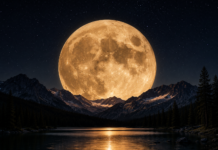
Despite the name and the way Harvest Moons are often depicted, the Moon itself does not suddenly become permanently orange or golden during this particular full moon.
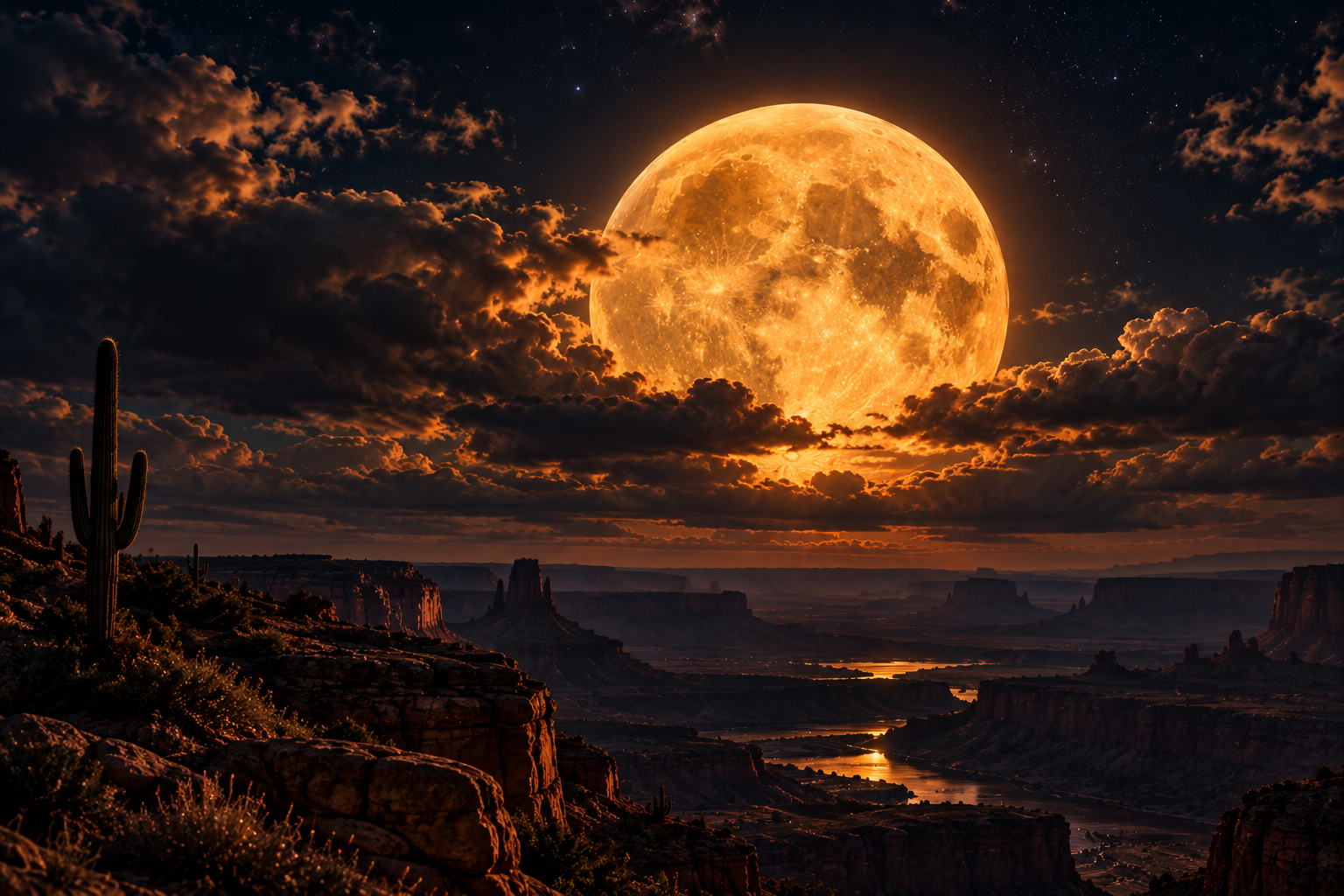
Instead, the spectacular color often associated with a Harvest Moon comes largely from Earth’s atmosphere.
When the Moon is close to the horizon, its light travels through a much longer path through the atmosphere before reaching an observer.
Shorter wavelengths of visible light, particularly blue light, are scattered more efficiently. More of the longer red, orange and yellow wavelengths can reach our eyes directly.
The result can be a Moon that appears:
golden, amber, orange, copper or occasionally deep reddish-orange.
Atmospheric dust, smoke, humidity and other local conditions can make these colors more pronounced.
As the Moon climbs higher into the sky, its light travels through less atmosphere and it generally returns to the familiar pale yellow-white appearance.
Why Does the Moon Look So Huge Near the Horizon?
The September Harvest Moon can also appear enormous when it first rises behind mountains, buildings, trees or distant landscapes.
But this apparent size increase is largely an illusion.
Known as the Moon illusion, the effect makes the Moon seem substantially larger near the horizon than when it is high overhead, even though its angular size has barely changed during those few hours.
Having familiar objects such as mountains, trees or buildings near the Moon gives the brain visual references that can exaggerate our perception of its size.
It is one reason moonrise photographs can look particularly dramatic.
Saturn Will Join the Harvest Moon
The Moon will not be the only interesting object in the sky on September 26.
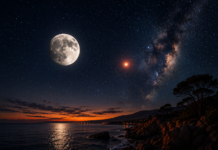
Saturn will appear near the Full Moon, with the two objects rising into the evening sky together.
The contrast should be easy to recognize: the Moon will overwhelmingly dominate the scene, while Saturn will resemble a bright, steady point of light nearby.
Saturn itself is visible to the naked eye, but its famous rings cannot be resolved without optical assistance. A small telescope can transform that bright point into one of the most recognizable sights in astronomy.
The Moon’s intense brightness may make faint surrounding stars more difficult to see, but Saturn should remain conspicuous enough to identify under reasonably clear conditions.
When Should You Look?
The most dramatic moment will not necessarily be the precise instant when the Moon becomes astronomically full.
Instead, try watching around local moonrise on September 26.
Find somewhere with a relatively unobstructed view toward the eastern horizon shortly around sunset. Beaches, elevated viewpoints, open countryside and locations overlooking distant mountains can provide particularly impressive views.
As twilight deepens, the Harvest Moon will climb above the horizon and gradually brighten against the darkening sky.
Because moonrise times depend on your exact location, observers should check a local astronomical calendar before heading outside.
The Moon will remain visible through the night, eventually setting toward the west around sunrise.
You Don’t Need a Telescope
One of the best things about a full moon is its accessibility.
No telescope, binoculars or special protective equipment are required to watch the Harvest Moon.
Unlike a solar eclipse, observing the Full Moon with the naked eye is safe.
Binoculars can reveal large lunar features, while a telescope can provide impressive views of craters and darker lunar plains. However, the extremely bright illumination around full moon reduces the long shadows that make crater relief especially dramatic during crescent and quarter phases.
For September 26, simply watching the Moon rise above the landscape may provide the most impressive experience.
The Harvest Moon Connects Astronomy With Human History
Humans have watched the seasonal movement of the Moon for thousands of years.
Long before clocks, electric lights or modern calendars, the sky provided a natural way to measure time and recognize the progression of seasons.
The Harvest Moon is a particularly striking example of how astronomy became intertwined with everyday human life.
Its importance was not simply symbolic.
The unusual sequence of relatively early evening moonrises around the autumn equinox genuinely provided additional natural illumination during one of the busiest periods of the agricultural year.
Modern technology has made that moonlight far less important for harvesting crops, but the celestial event remains unchanged.
The same orbital geometry continues to unfold above Earth every autumn.
September 26, 2026: Look East
On the evening of September 26, step outside around sunset and look toward the eastern horizon.
A bright Full Moon will rise into the autumn sky, potentially glowing orange or gold as its light passes through Earth’s atmosphere.
Nearby, Saturn will add another world to the scene.
The Harvest Moon may no longer determine how late farmers can work in their fields, but thousands of years after humans first began following seasonal cycles in the sky, it remains one of autumn’s most beautiful astronomical traditions.
September 26, 2026. Look east after sunset — the Harvest Moon is coming.