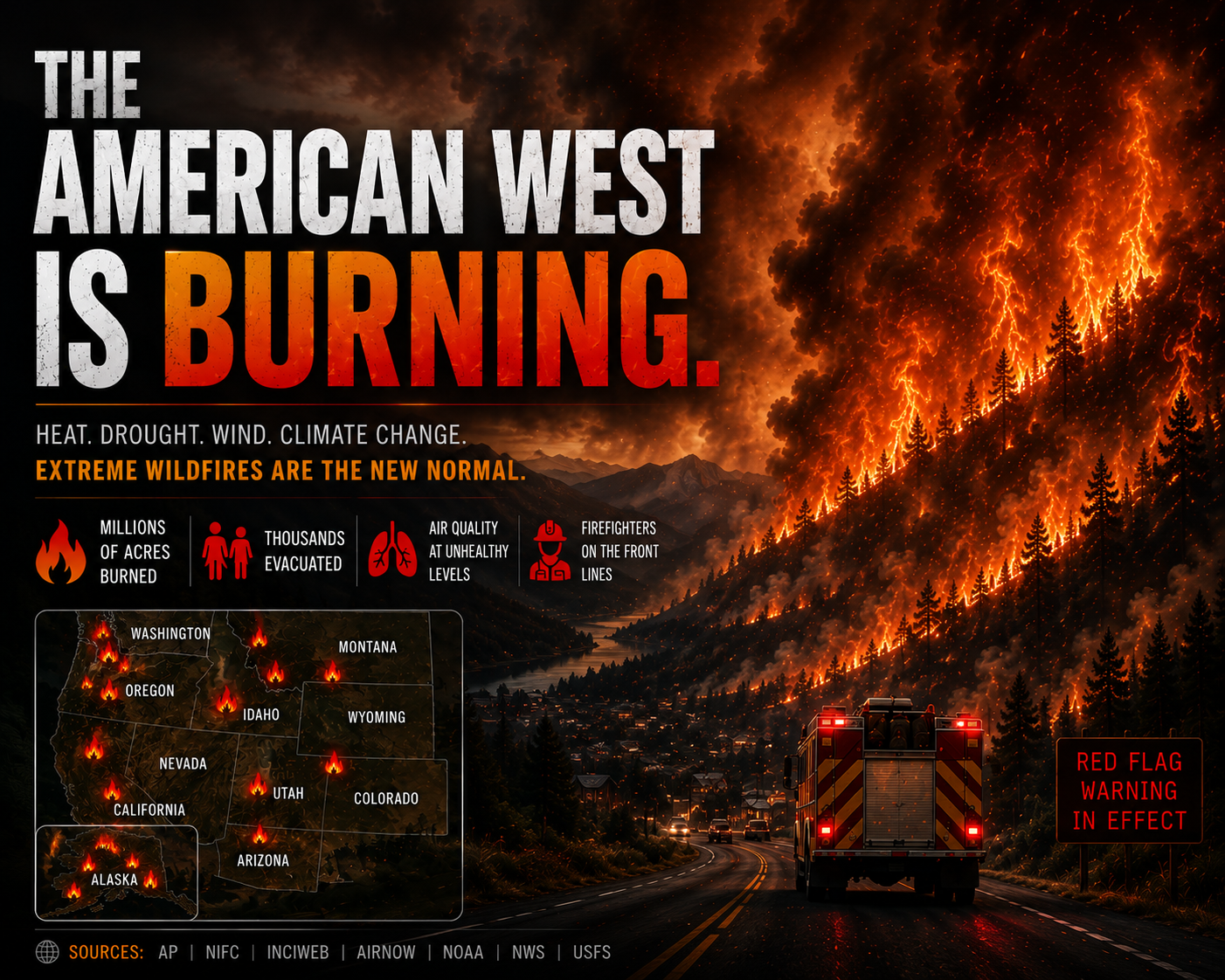
From the forests of Washington and Oregon to the mountains of Utah, Colorado, and even Alaska, large wildfires are once again sweeping across the American West. Thousands of firefighters are battling multiple active blazes as communities face evacuation orders, dangerous smoke, and rapidly changing fire conditions.
What was once considered a seasonal hazard has evolved into a nearly year-round challenge. Across much of the western United States, hotter temperatures, prolonged drought, and increasingly dry vegetation are creating ideal conditions for fires to ignite and spread with extraordinary speed.
A Region Under Fire
In recent weeks, numerous wildfires have burned simultaneously across several western states. Some have remained relatively small, while others have expanded into massive incidents that require hundreds—or even thousands—of firefighters to contain.
States experiencing significant wildfire activity include:
- Washington
- Oregon
- California
- Idaho
- Montana
- Utah
- Colorado
- Arizona
- Alaska
Authorities have issued evacuation orders in multiple communities, while smoke has reduced air quality across large portions of the region.
Millions of people have been affected either directly or indirectly by the fires, with transportation disruptions, power outages, and public health concerns becoming increasingly common.
Why Are These Fires So Intense?
Wildfires are a natural part of many western ecosystems. However, scientists say several factors are making today’s fires larger, faster, and more destructive.
Hotter Temperatures
Average temperatures across the western United States have increased significantly over recent decades. Warmer conditions dry out grasses, shrubs, and forests much earlier in the year.
Dry vegetation acts as fuel, allowing fires to spread rapidly once ignited.
Prolonged Drought
Many parts of the West continue to experience persistent drought conditions.
When soils lose moisture and forests become stressed, trees become more vulnerable to disease, insect infestations, and ultimately wildfire.
Strong Winds
High winds can transform a relatively small fire into a fast-moving wildfire within hours.
Burning embers may travel several kilometers ahead of the main fire, igniting entirely new blazes far beyond established containment lines.
Earlier Snowmelt
Mountain snowpack traditionally provides moisture well into summer.
Today, snow is melting earlier than it once did, extending the length of the wildfire season and leaving forests exposed to dry conditions for longer periods.
The Human Cost
Wildfires are not only environmental disasters—they are humanitarian emergencies.
Residents often receive evacuation notices with little warning.
Entire neighborhoods can be threatened within hours, while firefighters work around the clock to protect homes, infrastructure, and critical natural resources.
Smoke from large wildfires can also travel hundreds or even thousands of kilometers.
Even people living far from active fires may experience unhealthy air quality due to fine particulate pollution.
Health experts warn that wildfire smoke can increase the risk of:
- Asthma attacks
- Respiratory infections
- Heart complications
- Eye irritation
- Reduced visibility on roads
Children, older adults, and people with existing heart or lung conditions are especially vulnerable.
Alaska Is Burning Too
Many people associate wildfires with California, but Alaska has increasingly become a major wildfire hotspot.
Longer summers, warmer temperatures, and dry boreal forests have contributed to larger fire seasons in recent years.
Although Alaska has relatively few residents compared to other states, its fires can release enormous amounts of carbon into the atmosphere and affect ecosystems across vast regions.
Climate Change and Wildfires
Scientists emphasize that climate change does not directly ignite wildfires.
Most fires are still started by lightning or human activity.
However, climate change is increasing the likelihood that once a fire begins, it will spread farther, burn hotter, and become more difficult to control.
According to numerous climate studies, rising temperatures are:
- Drying vegetation more rapidly
- Extending wildfire seasons
- Increasing extreme heat events
- Reducing snowpack
- Creating more favorable fire conditions across western North America
Many researchers now describe wildfire as one of the clearest visible impacts of a warming climate.
Fighting Fire in a New Era
Modern firefighting has become increasingly complex.
Aircraft, helicopters, satellites, drones, infrared cameras, weather forecasting, and real-time mapping now play critical roles in wildfire response.
Yet despite technological advances, firefighters continue to face immense challenges as fires grow larger and weather conditions become more unpredictable.
Officials repeatedly stress that public cooperation remains essential.
Following evacuation orders, respecting fire restrictions, and monitoring official updates can save lives.
Looking Ahead
Experts expect wildfire activity to remain elevated throughout much of the fire season.
With forecasts calling for continued heat and dry conditions across many western states, emergency agencies remain on high alert.
While every wildfire has unique causes and behavior, one trend has become increasingly difficult to ignore:
The American West is entering an era where extreme wildfire seasons are becoming the new normal.
As communities adapt to this changing reality, investment in forest management, climate resilience, early detection systems, and emergency preparedness will be more important than ever.
Sources
- Associated Press (AP)
- National Interagency Fire Center (NIFC)
- InciWeb
- AirNow
- National Weather Service (NWS)
- U.S. Forest Service (USFS)
- National Oceanic and Atmospheric Administration (NOAA)
- NASA Earth Observatory
- Intergovernmental Panel on Climate Change (IPCC)