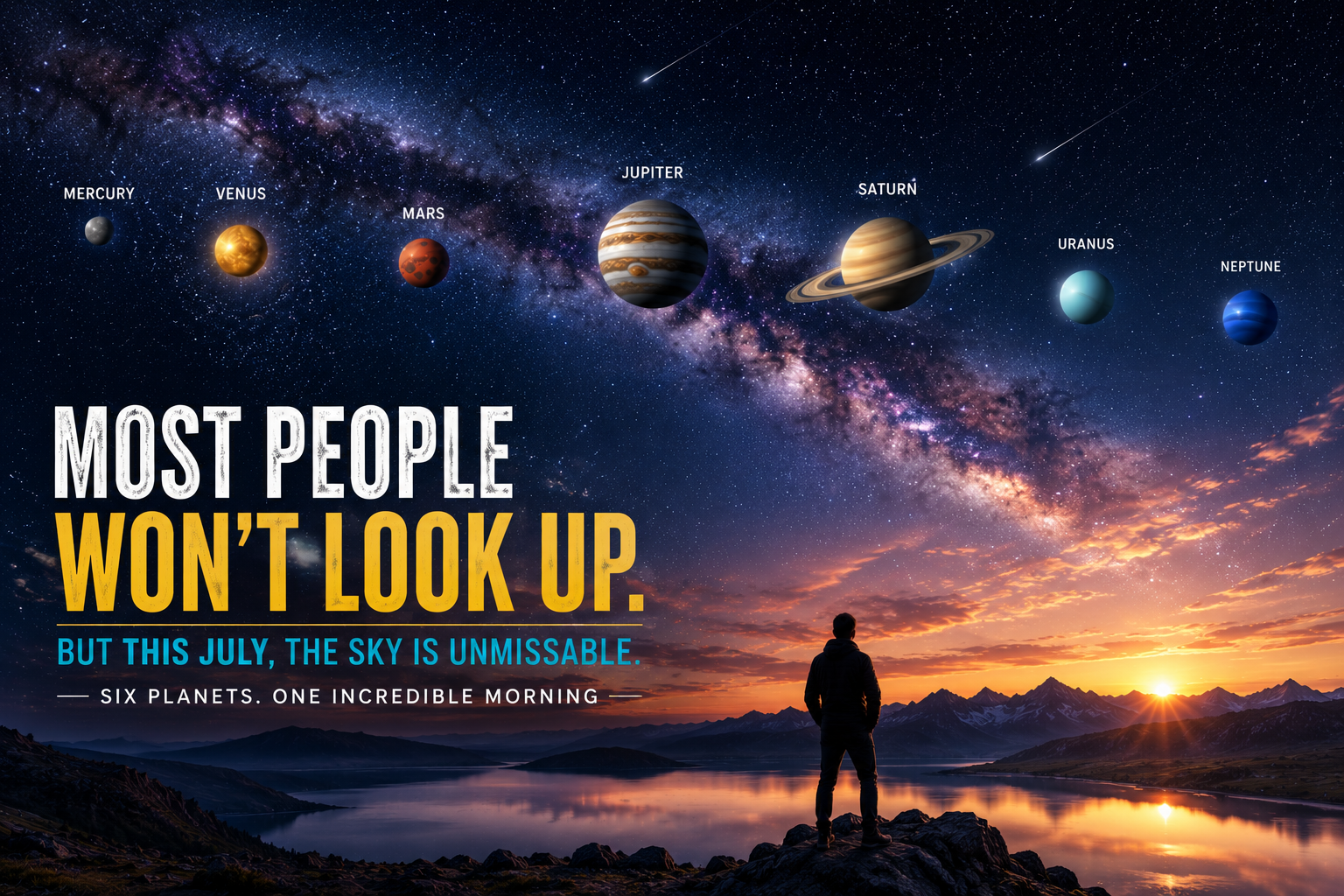
Every morning, long before most people wake up, something remarkable is happening above Earth.
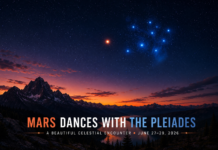
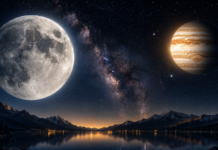
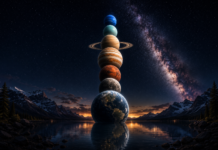
As darkness slowly gives way to dawn, several planets of our Solar System become visible together across the eastern sky. While planetary alignments are not perfectly straight lines in space, from our viewpoint on Earth they can appear arranged across the heavens, creating one of the most beautiful astronomical sights of the year.
For many people, these moments pass unnoticed.
But for those willing to step outside before sunrise, July offers an unforgettable opportunity to reconnect with the universe.
Why Are the Planets Appearing Together?
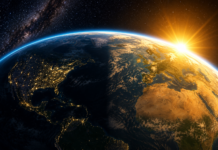
All of the planets orbit the Sun within nearly the same flat plane, known as the ecliptic plane.
Because of this shared orbital geometry, there are times when multiple planets appear along the same path across our sky. Although they remain separated by hundreds of millions—or even billions—of kilometers in space, perspective makes them appear grouped together from Earth’s point of view.
It’s one of astronomy’s most beautiful illusions.
Which Planets Can You See?
Depending on the date, your location, and local sky conditions, early observers may be able to spot several of these worlds:
- ☿ Mercury
- ♀ Venus
- ♂ Mars
- ♃ Jupiter
- ♄ Saturn
Under exceptionally dark skies and with optical aid such as binoculars or a small telescope, observers may also glimpse:
- ♅ Uranus
- ♆ Neptune
While Uranus can occasionally be seen with excellent eyesight under pristine conditions, Neptune almost always requires binoculars or a telescope.
The Best Time to Watch
The ideal viewing window is approximately:
60–90 minutes before local sunrise.
During this period:
- The sky remains dark enough for planets to stand out.
- Bright Venus often acts as an easy guide.
- Jupiter and Saturn become prominent.
- Mercury may be visible very low near the horizon depending on the date.
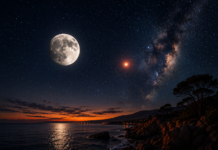
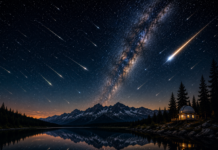
- The Milky Way may also stretch overhead in locations free from light pollution.
A clear eastern horizon significantly improves visibility.
Why Most People Never Notice
Modern life has dramatically changed our relationship with the night sky.
Artificial lighting, city skylines, busy schedules, and glowing phone screens keep many people indoors during the quiet hours when the universe is most impressive.
Ironically, one of the greatest astronomical displays of the year happens while millions of people are asleep.
You Don’t Need Expensive Equipment
One of the best things about this event is its accessibility.
Most of the brighter planets can be identified with the naked eye.
A pair of binoculars can reveal even more detail, while a small telescope transforms Jupiter into a world with visible cloud bands and Saturn into the iconic ringed planet that has fascinated observers for centuries.
Sometimes the best astronomical experiences require nothing more than curiosity.
A Reminder of Our Place in the Universe
Planetary gatherings remind us that Earth is only one small member of a much larger family.
Each visible planet is following its own journey around the Sun:
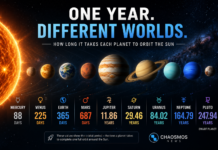
- Mercury races around the Sun every 88 days.
- Venus glows through its dense cloud-covered atmosphere.
- Mars continues to captivate scientists searching for signs of ancient water.
- Jupiter, the giant of our Solar System, contains more than twice the mass of all the other planets combined.
- Saturn’s rings remain one of the most recognizable sights in astronomy.
- Uranus rotates on its side, unlike any other major planet.
- Neptune circles the Sun from nearly 4.5 billion kilometers away.
Seeing them share the same sky is a powerful reminder of the scale and beauty of our cosmic neighborhood.
Looking Up Matters
Astronomy has always inspired wonder.
For thousands of years, civilizations navigated, farmed, and built entire calendars by observing the sky. Today, despite incredible technological advances, many people rarely take a moment to simply look upward.
Yet the universe continues its timeless dance every single night.
This July, before sunrise, that dance becomes especially beautiful.
Perhaps the rarest part of this event isn’t the planets themselves.
It’s remembering to stop, step outside, and look up.
Sources
- NASA – Solar System Exploration
- NASA Skywatching Guide
- Sky & Telescope Magazine
- EarthSky
- International Astronomical Union (IAU)
- Royal Observatory Greenwich