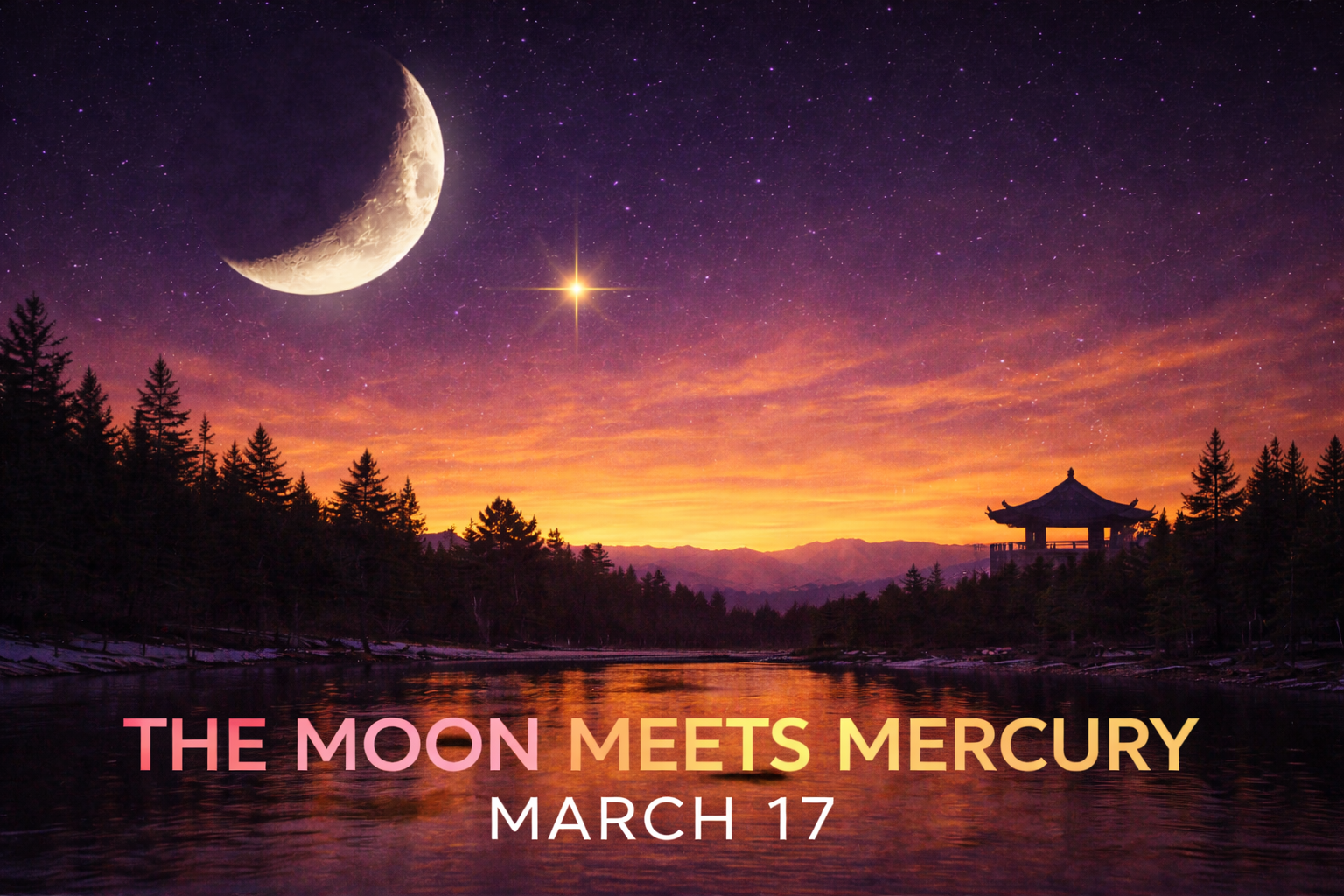
In the quiet hours before sunrise on March 17, skywatchers around the world will have the chance to witness a subtle yet beautiful cosmic alignment. A delicate crescent Moon will glide past Mercury, the innermost planet of our Solar System, creating a fleeting celestial pairing in the early morning sky.
Although not as dramatic as eclipses or meteor showers, events like this offer a rare reminder of the constant motion of the Solar System — a graceful dance unfolding silently above us.
A Meeting in the Predawn Sky
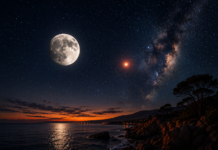
During the early morning hours, a razor-thin crescent Moon will appear low above the eastern horizon. Nearby, shining with a steady golden light, will be Mercury.
Mercury can be a challenging planet to observe. Because it orbits so close to the Sun, it rarely climbs high in the sky and is often lost in the Sun’s glare. For much of the year, the planet is nearly impossible to see with the naked eye.
However, on mornings like March 17, the geometry of the Solar System briefly works in our favor.
The Moon’s slender crescent will serve as a natural guidepost, helping observers locate Mercury just above the horizon before dawn.
Why Mercury Is So Hard to See
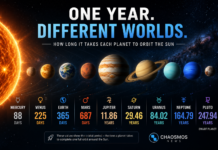
Mercury completes an orbit around the Sun in just 88 Earth days, making it the fastest planet in our Solar System. But its proximity to the Sun also means it is usually hidden in bright twilight.
Unlike planets such as Jupiter or Venus, Mercury never strays far from the Sun in our sky.
For this reason, the planet is typically visible only during short windows either:
• just after sunset, or
• shortly before sunrise
These brief viewing opportunities are known as greatest elongations, when Mercury appears farthest from the Sun from our perspective on Earth.
Even then, spotting the planet can require a clear horizon and careful timing.
The Beauty of a Crescent Moon
The Moon on March 17 will be in a waning crescent phase, meaning only a small portion of its surface will be illuminated by sunlight.
This delicate crescent shape creates one of the most elegant sights in the sky. Often, observers can also detect earthshine — a faint glow on the Moon’s dark side caused by sunlight reflecting off Earth and gently illuminating the lunar surface.
Combined with Mercury’s steady golden light, the scene becomes a quiet yet breathtaking moment of celestial harmony.
When and Where to Look
To observe the event:
• Date: March 17
• Time: Approximately 30–45 minutes before sunrise
• Direction: Look toward the eastern horizon
Because Mercury will appear relatively low in the sky, finding a location with a clear, unobstructed view of the horizon is important.
Urban light pollution may make Mercury harder to spot, but in darker locations the planet should appear as a bright star-like point near the Moon.
No telescope is required — the event is perfectly visible with the naked eye.
A Quiet Reminder of Our Place in the Universe
While dramatic cosmic events often capture headlines, subtle alignments like the Moon and Mercury pairing offer a more intimate connection to the rhythms of the Solar System.
These moments remind us that the universe is constantly in motion, with planets and moons tracing ancient paths through space.
And sometimes, all it takes is a glance toward the horizon before sunrise to witness a small part of that timeless dance.
On March 17, the sky will offer one of those quiet cosmic moments — brief, delicate, and unforgettable.
✦ Stay curious. Look up. The universe is always moving.
— ChaosmosNews