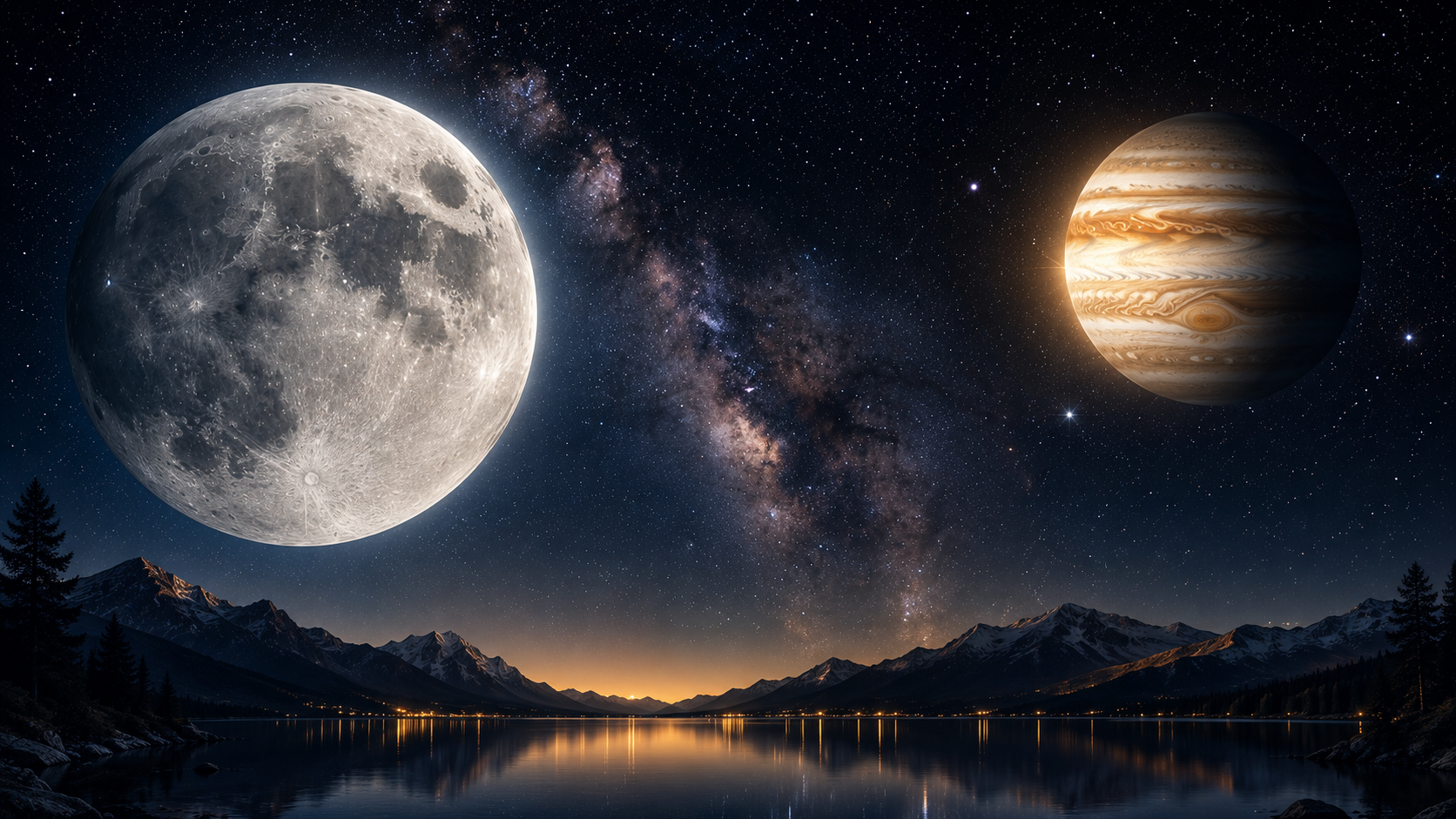
On some nights, the universe offers a spectacle that requires no telescope, no special equipment, and no scientific expertise to appreciate.
All it asks is that we look up.
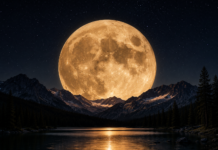
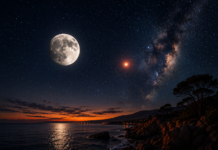
As twilight fades and the first stars begin to appear, the Moon and Jupiter — two of the brightest objects visible from Earth — will seem to draw close together in the evening sky, creating one of the most beautiful celestial pairings of the year.
At first glance, it may appear as though these two worlds are meeting in space. In reality, they remain separated by hundreds of millions of kilometers. Yet from our perspective on Earth, their paths briefly align, producing a striking visual encounter known as a conjunction.
A Meeting of Two Very Different Worlds
The Moon is Earth’s only natural satellite, orbiting our planet at an average distance of about 384,400 kilometers.
Jupiter, by contrast, is the largest planet in our Solar System. More than 1,300 Earths could fit inside it. Its immense gravity helps shape the architecture of the Solar System, influencing asteroids, comets, and even the orbits of neighboring worlds.
Despite their vastly different sizes and distances, both objects shine brilliantly in our sky. The Moon reflects sunlight from its rocky surface, while Jupiter appears bright because its massive cloud tops reflect enormous amounts of sunlight back into space.
When these two luminous worlds appear near each other, the result is a scene that captures attention even from light-polluted cities.
Why Do They Appear So Close?
The answer lies in perspective.
The night sky is a three-dimensional universe projected onto a two-dimensional dome above our heads. Objects that are actually separated by enormous distances can appear close together when viewed from Earth.
Astronomers call this an apparent conjunction. The Moon and Jupiter are not physically approaching one another. Instead, Earth’s changing viewpoint and the orbital motions of both bodies create the illusion of proximity.
These alignments occur regularly, but each one is unique because the Moon is constantly moving through the sky, changing position night after night.
Jupiter: The Giant Guardian
For centuries, Jupiter has fascinated observers.
Ancient civilizations associated it with kings, gods, and celestial power. Today, we understand it as a colossal gas giant dominated by powerful storms, colorful cloud bands, and an immense magnetic field.
Its most famous feature, the Great Red Spot, is a gigantic storm that has raged for centuries. Around it orbit dozens of moons, including Europa, Ganymede, and Io — worlds that may hold clues to some of the greatest mysteries in planetary science.
When you see Jupiter shining in the evening sky, you are looking at sunlight reflected from a planet hundreds of millions of kilometers away.
The light reaching your eyes began its journey long before you noticed it.
The Moon: Humanity’s Familiar Companion
Unlike Jupiter, the Moon feels close and familiar.
It has inspired myths, calendars, poetry, navigation, and scientific discovery throughout human history. It is the only world beyond Earth where humans have walked, yet it still holds mysteries waiting to be explored.
Every phase, eclipse, and conjunction reminds us that the Moon is not a static object. It is a dynamic world moving continuously through space alongside Earth.
Its presence beside Jupiter creates a striking contrast between the familiar and the immense, between our local cosmic neighborhood and the giant worlds farther out in the Solar System.
A Reminder to Look Up
Events like this are not rare because they are impossible.
They are rare because most people never notice them.
In an age dominated by screens, schedules, and city lights, celestial encounters often pass unnoticed overhead. Yet they continue to happen, just as they have for billions of years.
The Moon and Jupiter do not meet for us.
They do not perform for humanity.
Their motions are part of a cosmic dance that began long before humans existed and will continue long after we are gone.
For a brief moment, however, Earth’s orbit places us in exactly the right position to witness it.
And that is what makes it beautiful.
The universe is always moving.
Tonight, we simply have a chance to notice.