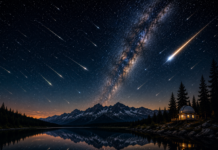
In April 2026, skywatchers may witness one of the most fascinating celestial displays in recent years — two comets appearing in the sky at the same time.
While comets are not uncommon, seeing two active comets sharing the sky simultaneously is rare. What makes this event even more intriguing is the dramatic contrast between them: one unpredictable and potentially brilliant, the other calm and steady.
☄️ The Two Comets: A Tale of Contrast
? C/2026 A1 (MAPS) — The Risky Sungrazer
The first comet, C/2026 A1 (MAPS), is classified as a sungrazer. These comets pass extremely close to the Sun, exposing them to intense heat and gravitational forces.
This makes their behavior highly unpredictable.
As it approaches the Sun, C/2026 A1 could:
- Rapidly brighten and become visible to the naked eye
- Develop a long, dramatic tail
- Or completely disintegrate before reaching peak visibility
Sungrazing comets are known for their “all or nothing” nature — they either become spectacular… or vanish entirely.
? C/2025 R3 (PanSTARRS) — The Stable Traveler
Following behind is C/2025 R3 (PanSTARRS), a much more stable and predictable comet.
Unlike its volatile counterpart, this comet is expected to:
- Remain intact during its journey
- Be visible through binoculars (and possibly faintly to the naked eye under dark skies)
- Move steadily across the night sky without sudden changes
While it may not produce a dramatic outburst, its quiet presence adds depth to this rare double-comet event.
✨ Why This Event Is Special
The true rarity of this event lies not just in the visibility of two comets — but in their timing and contrast.
- One comet may blaze brightly near the Sun
- The other will glide gently through darker skies
- Both could be visible within a similar timeframe
This creates a unique celestial narrative:
Two comets. Two destinies. One sky.
Such overlapping visibility windows do not happen often, making April 2026 a potentially memorable moment for both amateur stargazers and professional astronomers.
? When and How to Watch
While exact visibility will depend on each comet’s behavior, general observing tips include:
? Best Time:
- Shortly after sunset
- Or just before sunrise
? Best Conditions:
- Dark skies away from city lights
- A clear, unobstructed horizon
- Minimal atmospheric haze
? Equipment:
- Naked eye (if brightness increases)
- Binoculars for better detail
- A camera with long exposure for astrophotography
⚠️ A Note on Uncertainty
It’s important to remember that comets — especially sungrazers — are notoriously unpredictable.
C/2026 A1 (MAPS) could become one of the brightest comets of the year…
or it could fade before most people ever see it.
That uncertainty is part of what makes comet watching so exciting.
? A Moment Worth Looking Up For
In a world full of predictable cycles, events like this remind us that the universe still holds surprises.
Whether one comet shines brightly or both remain subtle, the possibility of seeing two ancient visitors crossing our sky at once is something special.
So as April approaches…
? Look up. You might witness something rare.