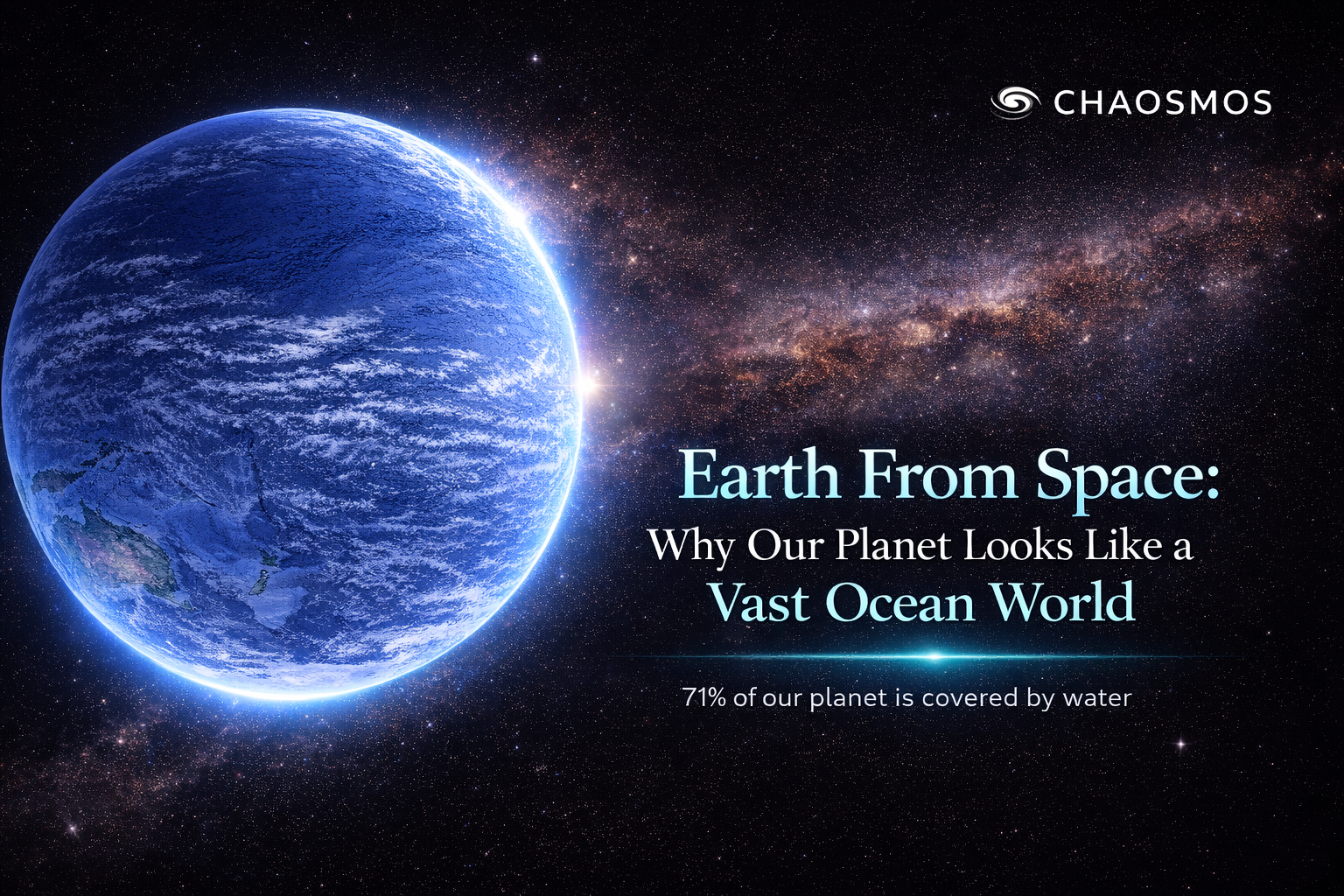
From certain angles in space, Earth appears almost entirely blue — a striking reminder that our world is dominated not by land, but by water. While we often think of continents, cities, and landscapes, the true identity of our planet is revealed only when viewed from afar: Earth is, above all, an ocean world.
? A Planet Defined by Water
Approximately 71% of Earth’s surface is covered by water, most of it contained within the global ocean — a continuous body that connects all major seas. The remaining 29% is land, scattered across continents and islands.
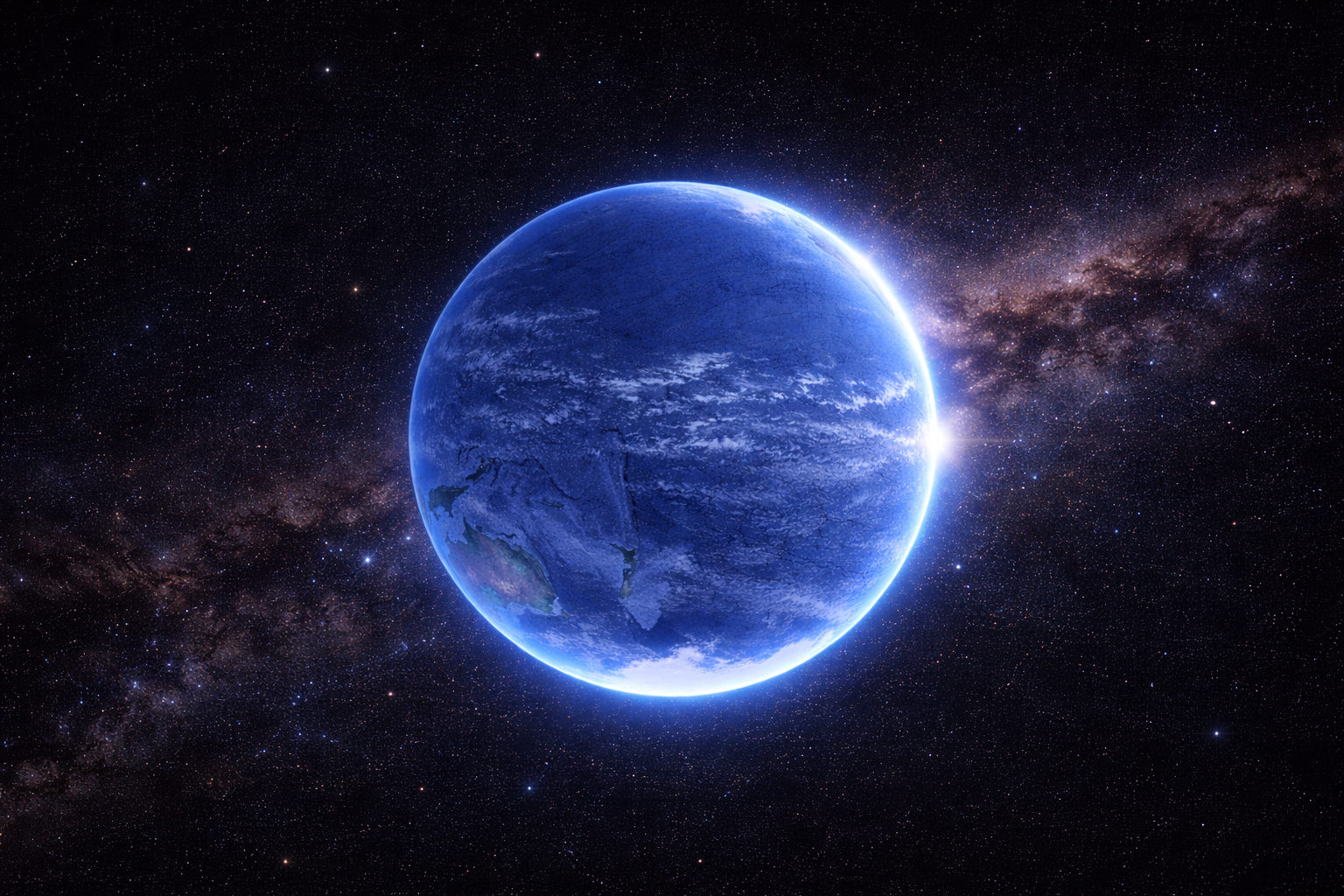
This imbalance becomes visually dramatic depending on the viewing angle. From regions over the Pacific Ocean — the largest ocean basin on Earth — land can nearly disappear from sight. In these moments, Earth looks like a deep blue sphere with only faint traces of continents, reinforcing the idea that water is the planet’s defining feature.
? The “Blue Marble” Perspective
When astronauts first photographed Earth from space during missions like Apollo 17, the world saw something unforgettable: a glowing blue planet suspended in darkness. This iconic view, often called the “Blue Marble,” changed how humanity perceives Earth.
From space:
- Oceans dominate the visual field
- Clouds swirl across vast blue expanses
- Landmasses appear relatively small and fragmented
This perspective highlights a powerful truth: our planet is less a “land world” and more a “water world.”
?️ Why So Much Water?
Earth’s abundance of water is not a coincidence — it is the result of a delicate combination of factors:
- Distance from the Sun: Earth lies in the habitable zone, where temperatures allow liquid water to exist
- Atmospheric pressure: Keeps water stable in liquid form
- Planetary formation: Water likely arrived via icy comets and asteroids early in Earth’s history
Unlike many other planets, Earth managed to retain its water over billions of years, creating the conditions necessary for life.
? The Pacific Effect: When Earth Becomes “All Ocean”
The Pacific Ocean alone covers about one-third of Earth’s surface. When Earth is viewed from an angle centered on the Pacific:
- Continents shrink to thin edges
- Vast uninterrupted ocean dominates the view
- The planet appears almost entirely blue
This is the exact illusion captured in visuals like the one above — where Earth seems to be nearly 100% ocean.
? Water: The Foundation of Life
Water is not just visually dominant — it is biologically essential.
- Every known life form depends on water
- Oceans regulate global temperature and climate
- Marine ecosystems produce a large portion of Earth’s oxygen
In fact, much of the oxygen we breathe comes from microscopic ocean organisms like phytoplankton.
? A Rare World in the Universe?
While scientists have discovered thousands of exoplanets, a world like Earth — with vast, stable oceans — appears to be rare.
Many planets are:
- Too hot (water evaporates)
- Too cold (water freezes permanently)
- Or lack the conditions to retain liquid water
This makes Earth’s global ocean not just beautiful, but extraordinarily special.
? A Fragile Blue Balance
From space, Earth looks calm, unified, and peaceful. But that thin blue layer — the oceans and atmosphere — is incredibly fragile.
Climate change, ocean warming, and pollution are all affecting this delicate system. The same water that defines our planet is also one of its most vulnerable resources.
✨ A New Way to See Our World
Seeing Earth as an ocean planet shifts perspective:
- Borders disappear
- Land becomes secondary
- The planet feels unified and interconnected
It reminds us that Earth is not divided — it is one continuous system, dominated by water, life, and balance.