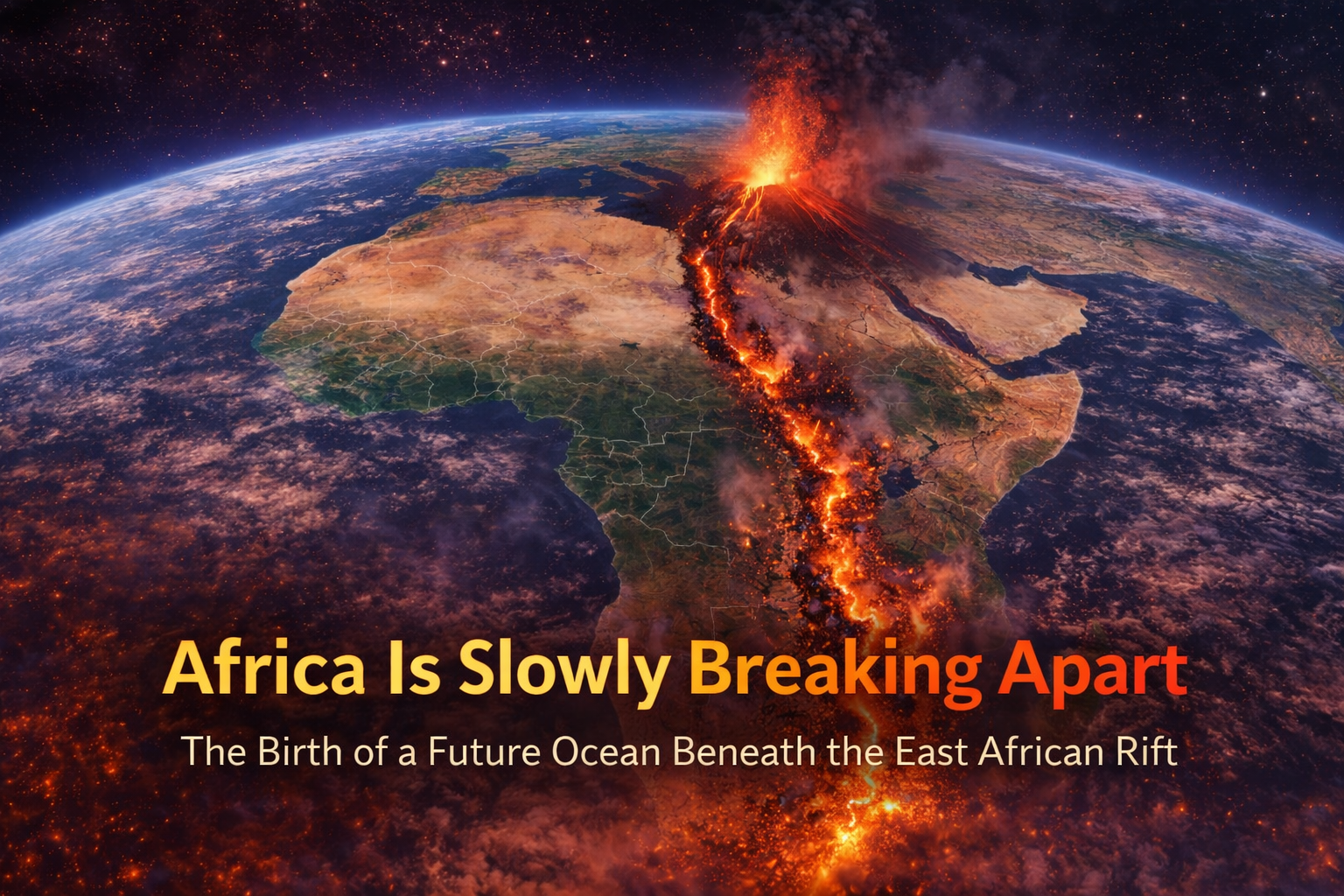
Earth is not static. It is alive — constantly reshaping itself over vast geological timescales. And right now, one of the most dramatic transformations on the planet is unfolding beneath our feet in eastern Africa.
The African continent is slowly breaking apart.
This is not a sudden catastrophe, nor something that will happen within years or even centuries. It is a process measured in millions of years. But it is real, measurable, and already underway.
What Is the East African Rift?
Stretching from the Red Sea down through Ethiopia, Kenya, Tanzania, and into Mozambique, the East African Rift is a massive tectonic boundary where the African Plate is splitting into two separate plates:
-
The Nubian Plate (western side)
-
The Somali Plate (eastern side)
These plates are gradually drifting away from each other at a rate of a few millimeters per year — roughly the speed at which your fingernails grow.
While that may sound insignificant, over millions of years, it is enough to reshape continents.
Why Is Africa Splitting?
The driving force lies deep within the Earth.
Beneath East Africa, hot mantle material is rising upward. This upwelling weakens and thins the continental crust, causing it to stretch. As it stretches, cracks form. Some of these cracks evolve into faults, earthquakes, and volcanic systems.
This is why the region is home to:
-
Frequent seismic activity
-
Active volcanoes
-
Large rift valleys
-
Deep freshwater lakes such as Lake Tanganyika and Lake Malawi
In fact, these lakes already occupy portions of the developing rift basin — early hints of what may eventually become a new ocean.
The Birth of a Future Ocean
If the separation continues for millions of years, the rift valley will widen further. Eventually, seawater from the Red Sea or Indian Ocean could flood into the expanding basin.
When that happens, eastern Africa — including parts of Ethiopia, Somalia, and Kenya — could detach from the rest of the continent, forming a new landmass surrounded by ocean.
This is not speculation. It is the same process that once split South America from Africa around 130 million years ago, creating the Atlantic Ocean.
We are witnessing the earliest stages of a similar transformation.
Evidence That the Rift Is Active
Scientists have observed several clear signs:
-
GPS measurements confirm plate separation.
-
Large ground fissures have appeared in parts of Kenya and Ethiopia.
-
Volcanic eruptions continue along the rift system.
-
The Afar region shows some of the thinnest continental crust on Earth.
In 2005, a dramatic rifting event in Ethiopia opened a 60-kilometer-long crack in just days — a rare glimpse into how continental breakup begins.
How Long Will It Take?
Geological processes operate on immense timescales.
The formation of a full ocean basin could take 5 to 10 million years or more. Humanity will not witness the final separation — but the process has already started.
We are living during the opening chapter of a continental transformation.
Earth Is Always Changing
Mountains rise. Oceans form. Continents drift.
What feels permanent to us is temporary in geological time.
Africa is not breaking apart tomorrow.
It is breaking apart geologically.
And deep beneath the East African Rift, a future ocean is beginning to form.