Some trees grow tall.
Some trees grow old.
Sequoias do both — on a scale that defies human imagination.
Sequoia trees are among the largest and longest-living organisms on Earth. They are not simply trees; they are living monuments that connect modern humanity with thousands of years of planetary history. Standing beneath a sequoia is not just a visual experience — it is a reminder of how small a single human lifetime truly is.
What Are Sequoia Trees?
Sequoias belong to a rare group of coniferous trees native primarily to the western United States. There are two main types commonly referred to as sequoias:
-
Giant Sequoias, famous for their immense volume and massive trunks
-
Coast Redwoods, the tallest tree species on Earth
While their forms differ, both share extraordinary traits: immense size, extreme longevity, and an unmatched ability to survive environmental challenges that would destroy most other trees.
Unimaginable Size and Scale
Sequoias challenge our understanding of scale.
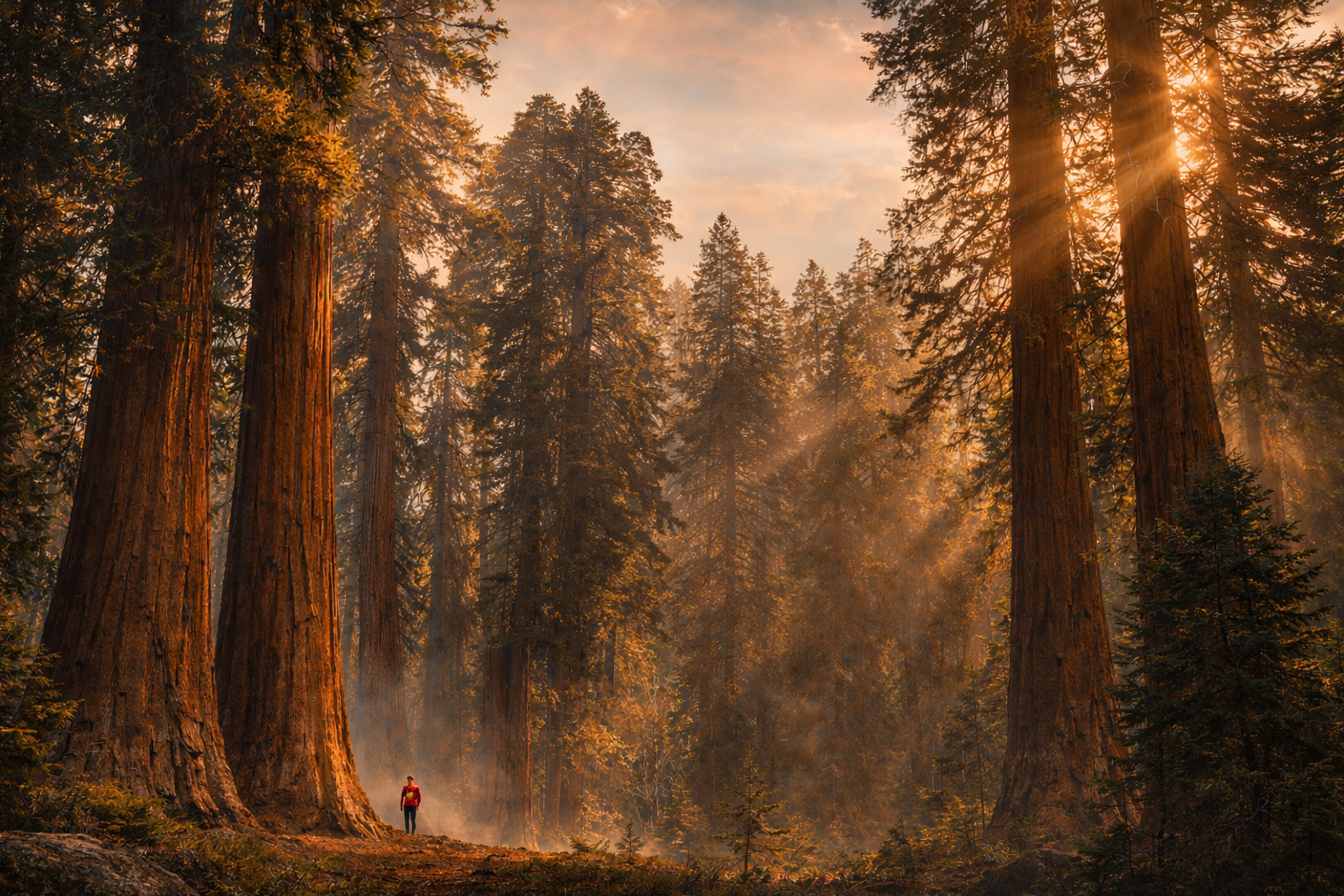
Coast redwoods can grow taller than 115 meters (380 feet) — higher than a 30-story building. Giant sequoias, while slightly shorter, are the most massive trees by volume ever to exist on Earth. Some trunks are so wide that several people holding hands cannot wrap their arms around them.
When humans, cars, or buildings are placed beside sequoias, the comparison feels almost unreal. These trees do not simply occupy space — they dominate it, redefining the landscape around them.
Ancient Survivors: Living for Millennia
One of the most astonishing features of sequoias is their age.
Many sequoias are over 2,000 years old, and some exceed 3,000 years. These trees were already ancient when the Roman Empire was expanding. They stood tall before medieval cities, before modern nations, and long before the industrial world emerged.
Each growth ring inside a sequoia records a year of Earth’s history — droughts, wet seasons, volcanic events, and climate shifts preserved in wood. In this sense, sequoias are living archives of the planet itself.
Fire: Not an Enemy, but an Ally
Unlike most forests, sequoia ecosystems depend on fire.
Sequoias possess extraordinarily thick, fibrous bark that can resist intense heat. Low-intensity forest fires clear competing vegetation, recycle nutrients into the soil, and even help sequoia cones open and release their seeds.
Without periodic fires, young sequoias struggle to grow. Fire, when natural and controlled, is not destruction — it is renewal. This relationship between flame and forest highlights nature’s complexity and balance.
Roots Without Depth, Strength Without Equal
Despite their massive size, sequoias do not have deep taproots. Instead, they rely on wide-spreading root systems that intertwine with neighboring trees. This underground network creates stability through cooperation rather than isolation.
Sequoias literally stand together. Their strength comes not only from size, but from connection — a powerful metaphor rooted in biology.
Climate Change and Modern Threats
For centuries, sequoias survived ice ages, earthquakes, and natural climate cycles. Today, however, they face unprecedented challenges.
Rising global temperatures, prolonged droughts, and increasingly intense wildfires threaten even these ancient giants. Climate stress weakens trees, making them more vulnerable to disease and extreme heat events that were once rare.
Human activity has also drastically reduced sequoia forests. What remains today is only a fraction of their original range.
Why Sequoias Matter
Sequoias are more than natural wonders.
They store enormous amounts of carbon, helping regulate Earth’s climate. They support entire ecosystems, providing habitat for countless species. Most importantly, they serve as living reminders of long-term thinking — something modern civilization often lacks.
Protecting sequoias is not about preserving the past alone. It is about safeguarding the future.
A Lesson Written in Wood
Sequoias teach us patience.
They teach resilience.
They teach humility.
In a world that moves faster every year, these trees stand still — reminding us that endurance, balance, and cooperation are the foundations of survival.
As long as sequoias continue to rise toward the sky, Earth’s ancient heartbeat can still be heard.