Before dawn, when the sky is at its calmest and human activity fades into silence, subtle celestial events unfold above us. One such moment occurs when the Moon passes close to Antares — the red supergiant star that marks the heart of the Scorpius constellation.
This encounter is not dramatic in motion, yet profound in meaning. It is a meeting shaped by perspective, distance, and time.
The Moon: A World of Reflection
The Moon is Earth’s nearest cosmic companion, orbiting our planet at an average distance of about 384,000 kilometers. Unlike stars, the Moon produces no light of its own. Every phase, every glow, is the result of reflected sunlight.
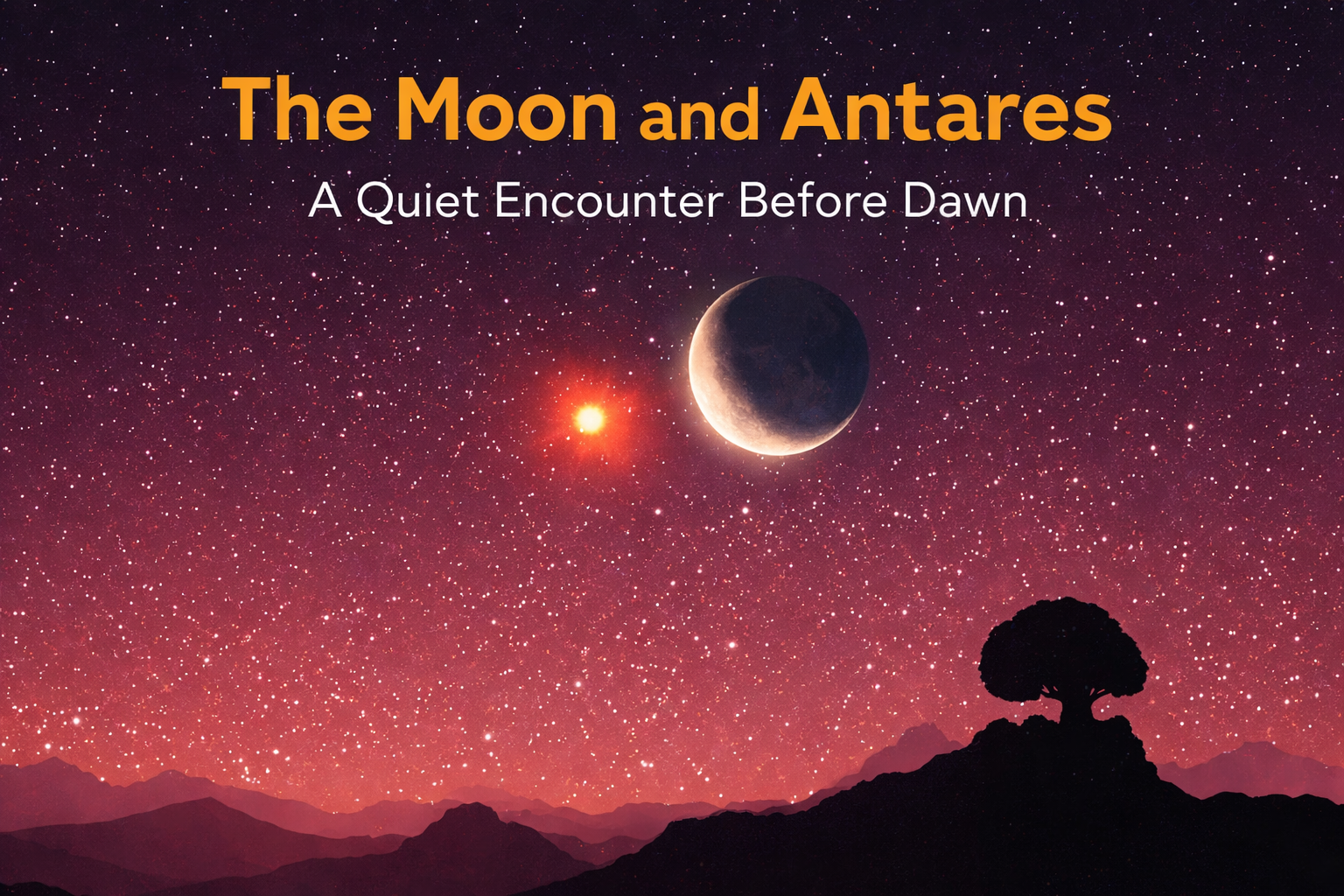
During this event, the Moon appears as a thin crescent. Its illuminated edge shines brightly, while the rest of its surface is softly visible through earthshine — sunlight reflected from Earth back onto the Moon. This gentle glow highlights the Moon’s quiet role in the night sky: not as a source of fire, but as a mirror.
The Moon’s rapid orbital motion causes it to change position noticeably from hour to hour, making encounters like this brief and fleeting.
Antares: The Dying Heart of Scorpius
Near the crescent Moon shines Antares, a red supergiant star located approximately 600 light-years from Earth. Antares is nearing the final stages of its stellar life. Having exhausted much of its hydrogen fuel, the star has expanded enormously, cooling and reddening as it grows unstable.
To grasp its scale, imagine Antares replacing our Sun — its outer layers would extend beyond the orbit of Mars. The crimson light we see tonight began its journey centuries ago, long before modern science existed to explain its origin.
Antares is a reminder that stars are not eternal. They live, evolve, and eventually die, enriching the universe with heavy elements that form future stars, planets, and life itself.
An Illusion of Closeness
When the Moon and Antares appear side by side in the sky, they seem almost connected. In reality, their proximity is purely visual.
The Moon lies within our immediate cosmic neighborhood, while Antares exists at an almost unimaginable distance. This apparent alignment is created by the Moon’s motion across the sky combined with Earth’s viewpoint — a moment where vastly different scales briefly overlap.
Such alignments offer a powerful lesson in astronomical perspective: what appears close in the sky may, in truth, be separated by hundreds of trillions of kilometers.
Motion and Stillness in a Single Frame
This event captures two opposing rhythms of the universe.
The Moon moves swiftly, its position changing night by night as it orbits Earth. Antares, by contrast, appears fixed — not because it is motionless, but because its evolution unfolds over millions of years.
In a single frame, we witness both motion and stillness: a fast-moving satellite passing a slow-burning stellar giant.
Why These Moments Matter
Celestial encounters like this do not alter the universe, but they change how we perceive it. They remind us that the night sky is dynamic, layered, and deeply interconnected.
For a brief time before sunrise, reflection meets fire. Stone meets plasma. The near meets the incomprehensibly distant.
These moments invite us to slow down, look up, and remember that we exist within a vast and evolving cosmos.
When and Where to Look
This encounter occurs before dawn, low in the eastern sky. A clear horizon and dark skies will enhance visibility. No telescope is required — the Moon and Antares are visible to the naked eye, though binoculars can enrich the experience.
Final Thought
The Moon will move on.
Antares will continue to burn toward its inevitable end.
But for a short moment, from our small vantage point on Earth, their paths appear to cross — offering a quiet reminder of the scale, beauty, and patience of the universe.