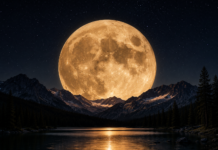
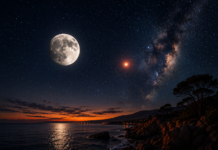
The Cold Moon, the final full moon of each calendar year, occurs when the Moon’s orbit places it opposite the Sun during early winter in the Northern Hemisphere. While its name has deep cultural roots, the Cold Moon also offers astronomers key insights into lunar orbital mechanics, seasonal solar angles, atmospheric optics, and long-term climate cycles. This article examines the Cold Moon in scientific depth, exploring its orbital origin, visual characteristics, seasonal significance, and the physics behind its unusually bright winter appearance.
? 1. What Is the Cold Moon?
The term Cold Moon refers to the December full moon, rising during the onset of winter in the Northern Hemisphere.
Astronomically, a full moon occurs when:
-
the Moon is at opposition (180° from the Sun),
-
fully illuminated from Earth,
-
and near its highest nightly arc due to winter’s steep ecliptic angle.
The Cold Moon typically appears between December 3–12, depending on the lunar cycle.
? 2. Why Winter Full Moons Look Brighter
The Cold Moon often appears larger, crisper, and brighter, and the reasons are scientific:
2.1 Higher Altitude on the Sky
During December, the ecliptic is high at night.
That means:
-
the full Moon rises higher,
-
suffers less atmospheric scattering,
-
and shines with greater visual clarity.
2.2 Low Atmospheric Humidity
Cold winter air contains:
-
fewer dust particles,
-
less humidity,
-
reduced atmospheric turbulence.
This increases lunar contrast, making craters and maria appear sharper.
2.3 Rayleigh Scattering
With the atmosphere less dense and cleaner, shorter blue wavelengths scatter more efficiently.
The Moon, being rich in white-yellow light, appears more luminous.
? 3. The Orbital Mechanics Behind the December Full Moon
The Moon’s orbit is:
-
tilted 5.145° relative to Earth’s orbital plane,
-
slightly elliptical (eccentricity ~0.0549),
-
and takes 29.53 days to complete a synodic cycle.
During December:
-
the Moon is near its highest declination,
-
rising earlier and staying visible longer,
-
thus dominating winter nights.
In some years, the Cold Moon may coincide with:
✔ perigee → becoming a Supermoon
✔ lunar standstill cycles
✔ lunar libration peaks
These effects can dramatically enhance its visual size and brightness.
❄️ 4. Seasonal Science: Why the Cold Moon Defines Winter
The Cold Moon arrives shortly before or after the Winter Solstice, when:
-
Earth’s axial tilt (23.5°) turns the Northern Hemisphere away from the Sun,
-
days become shortest,
-
nights longest,
-
and temperatures plunge due to reduced solar heating.
This seasonal alignment means the Cold Moon appears during peak darkness, increasing its visual impact.
?️ 5. Temperature, Snow, and Lunar Illumination
Snow-covered landscapes dramatically amplify moonlight through albedo reflection.
-
Fresh snow reflects up to 90% of incoming light.
-
Lunar illumination on snowy terrain can reach 0.25 lux, enough to cast clear shadows.
-
This makes winter full moons appear almost daylight-bright in rural or high-latitude regions.
This effect is strongest under the Cold Moon.
? 6. Astronomical Observations During the Cold Moon
Because of its height and brightness, the Cold Moon is ideal for:
6.1 Crater Studies
High contrast improves visibility of:
-
Tycho
-
Copernicus
-
Plato
-
Mare Imbrium
-
Mare Serenitatis
6.2 Libration Windows
The angle of lunar libration in December often reveals:
-
the eastern limb
-
additional maria
-
highland structures
6.3 Occultations
The Moon passes in front of:
-
stars in Taurus,
-
parts of the Hyades cluster,
-
occasionally even bright objects like Aldebaran (in some years).
? 7. Cultural and Historical Origins of the Cold Moon
Ancient civilizations named the December full moon after environmental conditions.
-
Native American tribes: “Cold Moon” due to freezing temperatures
-
Anglo-Saxon traditions: “Moon Before Yule”
-
Celtic astronomy: “Night of Long Shadows”
-
Anatolian cultures: winter’s threshold marker
-
Chinese calendar: close to the Winter Festival moon
The Cold Moon symbolized the beginning of hardship — and the eventual return of light.
? 8. The Cold Moon in Modern Science
Today, researchers use winter full moons to study:
-
nighttime albedo feedback
-
Earth’s brightening during snow cover
-
long-term climate patterns via lunar illumination
-
nocturnal wildlife behavior
-
light pollution effects
Even climate scientists analyze how winter moonlight interacts with snowpack and ice surface reflectivity.
✨ 9. Observing the Cold Moon
Best viewing conditions:
-
Clear, dry, cold nights
-
High altitude or rural regions
-
Snow-covered ground (for maximum reflection)
Recommended tools:
-
Binoculars (10×50 ideal)
-
Small telescopes (90–130mm)
-
Telephoto lenses for photography (200–600mm)
High lunar altitude provides superb detail for observers.
? Conclusion
The Cold Moon is far more than a winter full moon.
It represents a convergence of:
-
lunar orbital mechanics,
-
Earth’s axial tilt,
-
atmospheric physics,
-
reflective winter landscapes,
-
and ancient cultural heritage.
Its brilliant glow marks the symbolic heart of winter —
a reminder that even in the longest nights,
light still returns, illuminating the frozen world below.