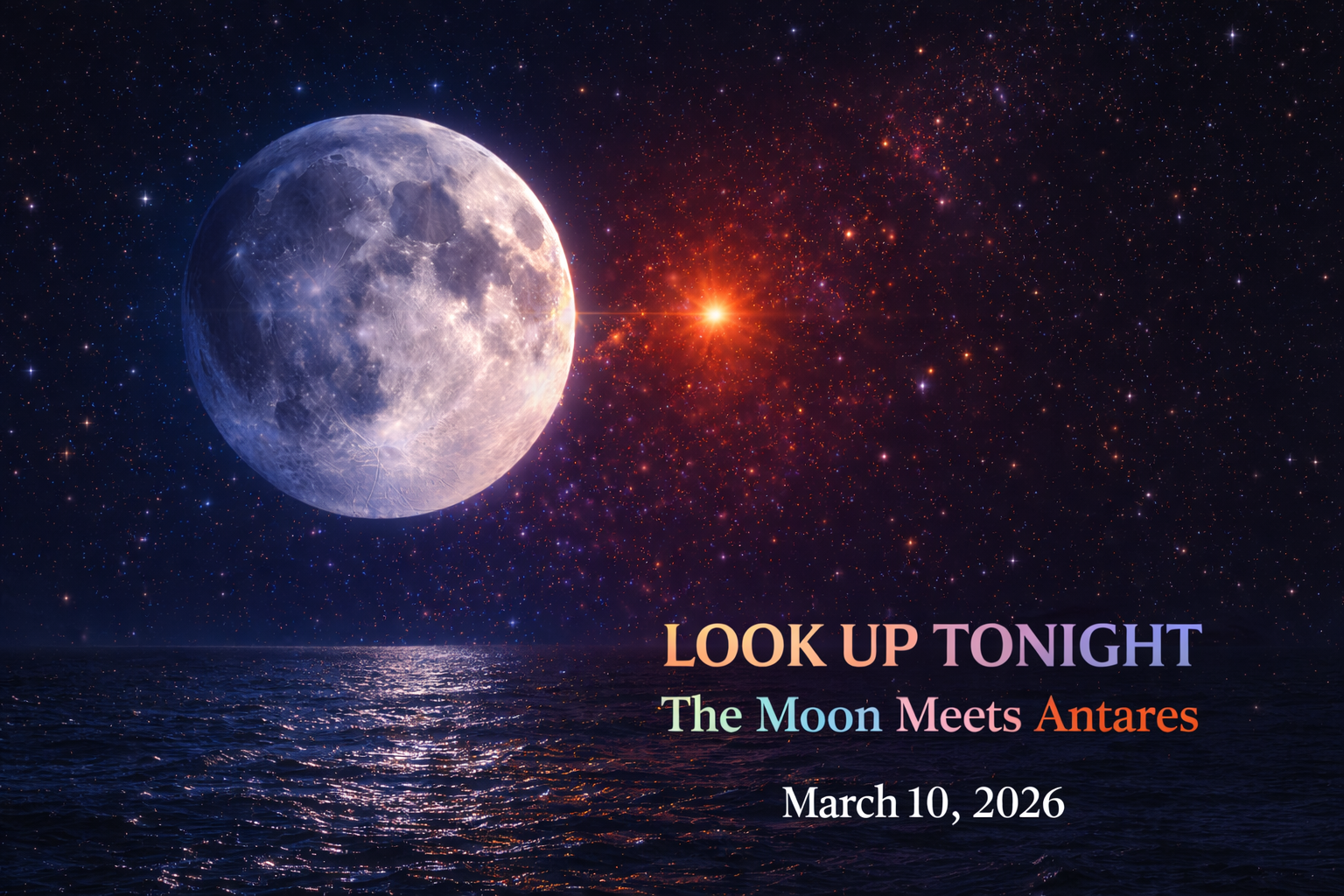
On the night of March 10, 2026, skywatchers around the world will have a chance to witness a striking celestial sight as the Moon appears close to Antares, the brilliant red heart of the Scorpius constellation.
Events like this are known as lunar conjunctions, when the Moon passes near a bright star or planet in the sky. While these alignments are common in astronomical terms, they can create beautiful and memorable scenes for anyone looking up at the night sky.
A Contrast of Light in the Night Sky
What makes this pairing special is the contrast between the two objects.
The Moon, Earth’s closest cosmic neighbor, shines with a cool silvery glow as it reflects sunlight from about 384,000 kilometers away.
Antares, on the other hand, is a massive red supergiant star located roughly 550 light-years from Earth. It is one of the largest stars visible to the naked eye and glows with a deep reddish-orange color that has fascinated skywatchers for centuries.
Its name comes from ancient Greek and means “rival of Mars,” because its fiery color closely resembles that of the red planet.
When the Moon passes near Antares, the pairing creates a stunning contrast between the soft white light of the Moon and the warm crimson glow of the star.
Where to Look
Antares lies within the constellation Scorpius, one of the most recognizable star patterns in the southern sky. On March 10, the Moon will appear close to this bright star, making it easier for observers to locate Antares.
To see the event:
• Look toward the southern sky after nightfall
• Find the bright Moon first
• The reddish star nearby will be Antares
No telescope is required — the pairing will be visible with the naked eye, though binoculars can enhance the view.
A Star of Extraordinary Size
Antares is not just any star. It is a red supergiant, meaning it has expanded to an enormous size during the late stages of its life.
If Antares were placed at the center of our Solar System, its surface would extend beyond the orbit of Mars.
Stars like Antares are also unstable and constantly losing material into space, creating glowing clouds of gas and dust around them.
These massive stars live fast and dramatic lives, and astronomers believe that Antares will eventually end its life in a spectacular supernova explosion millions of years from now.
A Quiet Moment of Cosmic Beauty
While this conjunction is not a rare event in astronomical terms, it offers something that many people rarely experience — a moment to pause and reconnect with the sky above us.
The Moon and Antares will appear close together for just a short time, creating a simple but beautiful reminder of the vast cosmic distances and movements unfolding above Earth every night.
Sometimes the most remarkable sights in the universe are also the easiest to see.
So on March 10, step outside, look up, and enjoy a brief meeting between our Moon and one of the sky’s most famous red stars.