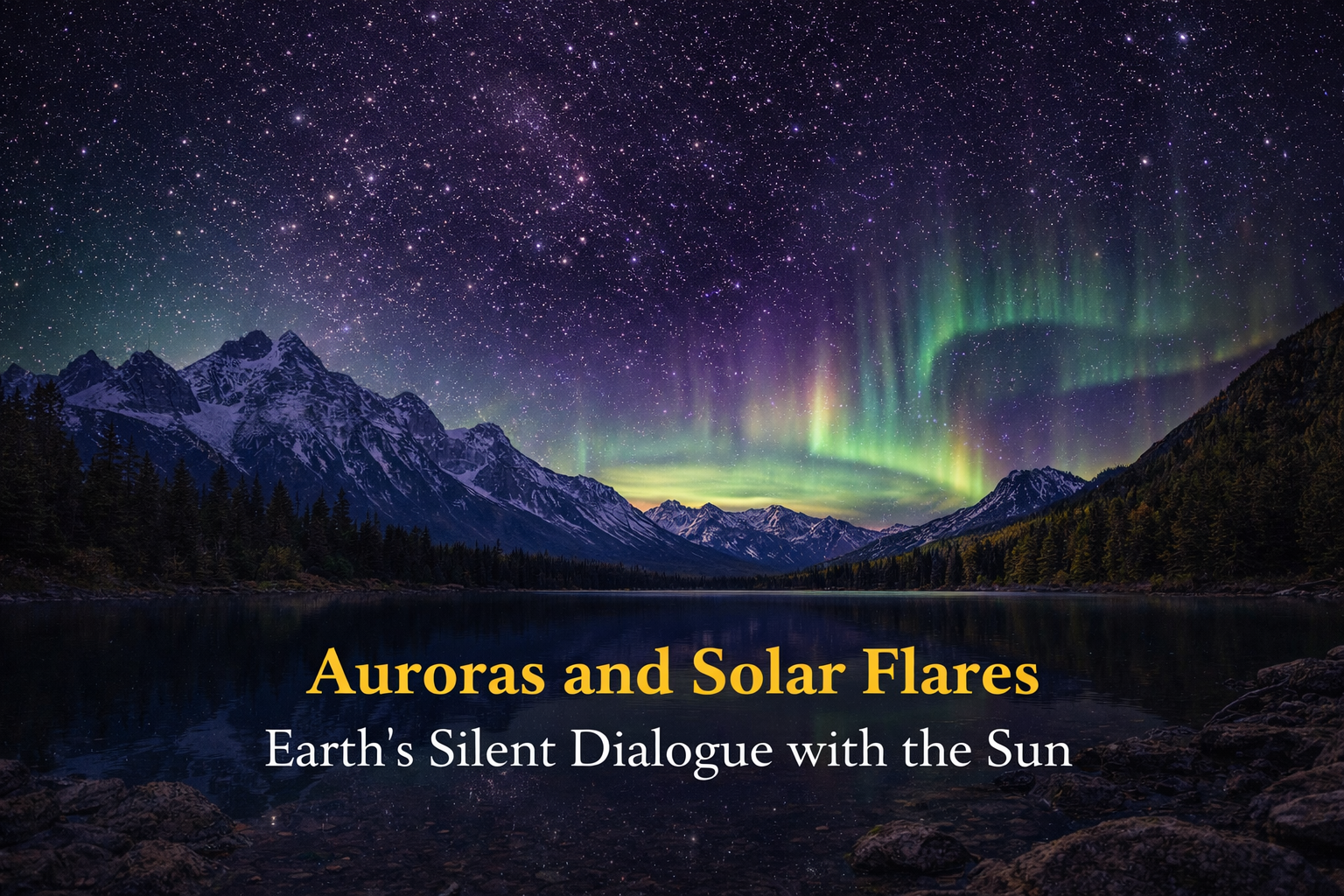
For centuries, auroras have captured human imagination. Ancient civilizations saw them as omens, spirits, or messages from the gods. Today, science reveals a far more fascinating truth: auroras are the visible signature of a continuous and powerful interaction between Earth and the Sun.
These luminous curtains of green, red, and violet light are not atmospheric weather phenomena. They are born in space — shaped by solar energy, magnetic forces, and the invisible architecture of Earth’s magnetic field.
The Sun: A Dynamic and Restless Star
The Sun is not a calm sphere of light. It is a massive ball of superheated plasma, governed by intense magnetic fields that twist, stretch, and reconnect across its surface.
As the Sun rotates, these magnetic fields store enormous amounts of energy. When that energy is suddenly released, a solar flare occurs — an explosive burst of radiation emitted from the Sun’s atmosphere.
Solar flares release energy equivalent to millions of nuclear bombs detonating simultaneously. Although the radiation from most flares is absorbed by Earth’s atmosphere, they often signal periods of increased solar activity that can have deeper effects across the solar system.
Coronal Mass Ejections: Solar Storms in Space
Many strong solar flares are accompanied by coronal mass ejections, or CMEs.
A CME is a vast cloud of charged particles — primarily electrons and protons — launched into space at millions of kilometers per hour.
When a CME is directed toward Earth, it can interact with our planet’s magnetic environment, triggering what scientists call space weather. Unlike weather on Earth, space weather unfolds across magnetic fields and plasma streams, shaping conditions far beyond the atmosphere.
Earth’s Magnetic Shield
Earth is protected by an invisible but powerful force: the magnetosphere.
Generated deep within the planet’s core, this magnetic field acts as a shield against the constant flow of charged particles from the Sun, known as the solar wind.
When a CME reaches Earth, the magnetosphere absorbs and redirects much of its energy. Instead of striking the planet directly, charged particles are guided along magnetic field lines toward the polar regions.
Without this magnetic shield, Earth’s atmosphere would slowly erode under the Sun’s influence — a fate believed to have affected Mars billions of years ago.
How Auroras Are Born
Auroras form when charged solar particles enter Earth’s upper atmosphere and collide with atmospheric gases.
These collisions excite atoms of oxygen and nitrogen, causing them to release energy in the form of light:
-
Oxygen produces green and red auroras
-
Nitrogen creates blue and purple hues
The flowing shapes and shifting patterns of auroras reflect the dynamic nature of Earth’s magnetic field and the ever-changing conditions of space weather.
Each auroral display is unique — shaped by solar activity, atmospheric composition, and magnetic geometry.
Where Auroras Are Seen
Auroras are most commonly visible at high latitudes, near Earth’s magnetic poles. Regions such as Canada, Alaska, northern Europe, and Antarctica lie beneath the auroral oval — a ring-shaped zone of frequent auroral activity.
During periods of heightened geomagnetic activity, this oval can expand, allowing auroras to be seen farther south, including across parts of the northern United States and similar latitudes worldwide.
Visibility depends on multiple factors, including geomagnetic intensity, atmospheric conditions, and light pollution.
Why Space Weather Matters
Auroras are the most beautiful expression of space weather, but they are only one part of a larger system.
Strong solar activity can influence:
-
Satellites and spacecraft operations
-
GPS and navigation systems
-
Radio communications
-
Power grids and electrical infrastructure
For this reason, space agencies and observatories around the world continuously monitor the Sun, tracking solar flares and CMEs to better understand and anticipate space weather events.
A Quiet Cosmic Connection
Auroras remind us that Earth is not isolated in space.
Our planet exists within a dynamic system shaped by the Sun’s energy and magnetic forces.
Every arc of light in the night sky tells a story written far beyond Earth — a story of plasma, magnetism, and the delicate balance that allows life to exist on a protected world.
In the silence of the aurora, we witness a dialogue between a restless star and a shielded planet — a dialogue that has been unfolding for billions of years.
ChaosmosNews
Exploring the universe through science, nature, and cosmic perspective.