Introduction
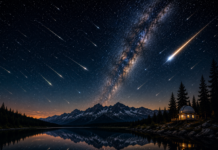
Every December, Earth passes through one of the most dazzling streams of cosmic debris in the solar system. On the night of December 14, the Geminid Meteor Shower peaks — igniting the sky with streaks of green, blue, gold, and white. Known for producing some of the brightest and most colorful meteors of the year, the Geminids offer a sky show that outshines most other meteor showers.
But what makes this event so extraordinary? And how can you watch it at its best? Let’s explore.
⭐ 1. What Is the Geminid Meteor Shower?
The Geminids occur annually between December 4–17, with the peak arriving on December 14.
Unlike most meteor showers, which originate from icy comets, the Geminids come from a rocky asteroid — a true rarity in astronomy.
As Earth crosses the trail of particles left behind by this object, tiny fragments hit our atmosphere at high speed, burning up and creating vibrant meteor trails.
⭐ 2. The Unusual Source: Asteroid 3200 Phaethon
The Geminids originate from 3200 Phaethon, sometimes called a “rock comet.”
Why is it unique?
-
It behaves partly like an asteroid, partly like a comet.
-
When Phaethon swings extremely close to the Sun, intense heat causes its surface to crack and shed debris.
-
This rocky dust forms a dense stream of particles — the material Earth passes through each December.
Because the particles are denser and tougher than typical comet dust, Geminid meteors:
-
burn brighter,
-
move slightly slower,
-
and display richer colors.
These colors come from chemical elements in the fragments:
-
Green/blue → magnesium
-
Yellow/gold → sodium
-
Red → atmospheric interaction at high altitude

⭐ 3. What to Expect in 2025
The 2025 Geminid Meteor Shower is expected to deliver excellent viewing conditions, thanks to minimal moonlight.
Predicted activity:
-
80–120 meteors per hour under dark skies
-
Many meteors will be bright “fireballs” visible even in light-polluted areas
-
Best visibility in the Northern Hemisphere
If clouds cooperate, this could be one of the most impressive meteor displays of the decade.
⭐ 4. How to Watch the Geminids (Viewing Guide)
? Best Time
-
Midnight to dawn on December 14
-
Peak activity typically occurs around 2–3 AM local time
? Best Location
-
Far from city lights
-
Wide, open horizon
-
Allow your eyes 20 minutes to adjust to the darkness
? Do You Need Equipment?
No telescope needed — the Geminids are best viewed with the naked eye.
Just lie back, look up, and watch the sky come alive.
⭐ 5. Scientific Importance
The Geminids aren’t just a visual spectacle — they offer clues about:
-
How rocky bodies like Phaethon evolve near the Sun
-
The structure of asteroid debris streams
-
The transition between asteroids and comet-like behavior
-
The chemical makeup of interplanetary dust
Geminids help scientists understand how ancient rocky bodies shed material, and how meteor streams change over time.
⭐ Conclusion: A Night of Cosmic Fire
The Geminid Meteor Shower transforms the December sky into a canvas of light.
Each meteor is a tiny piece of an asteroid — a fragment of solar system history — burning bright for just a moment as it meets Earth’s atmosphere.
On December 14, take a moment to step outside, look up, and witness one of the universe’s most breathtaking natural shows.
The cosmos will be performing. Don’t miss it.