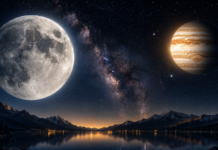
When the Moon meets Jupiter, the sky retells a story humanity has known for thousands of years.
On December 7, the night sky offers more than a simple astronomical alignment.
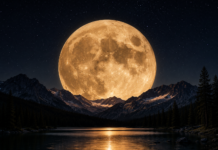
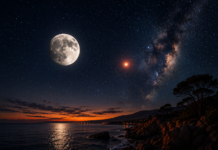
The Moon drifts close to Jupiter — the largest planet in our solar system — glowing like a golden beacon beside the lunar light. But behind this quiet celestial meeting lies a story that echoes across ancient myths, forgotten temples, and the first civilizations that watched the heavens with awe.
A Celestial Encounter Written in Myth
In Roman mythology, Jupiter — the king of the gods — ruled the sky, thunder, and the order of the universe. Every comet, every storm, every flash of lightning was his voice.
And the Moon? She was the eternal symbol of cycles, intuition, mystery, and rebirth.
When these two appear side by side in the night sky, ancient cultures saw it not as coincidence, but as a cosmic message.
The Babylonians believed Jupiter brought protection and justice.
The Greeks associated him with Zeus, the divine ruler whose presence restored balance to the world.
The Moon, meanwhile, embodied goddesses like Selene, Artemis, and Hecate — symbols of emotion, instinct, and the rhythms of life.
A meeting between the Moon and Jupiter was interpreted as a dialogue between power and intuition,
light and shadow,
the ruler and the dreamer.
Tonight, that ancient story plays again.
The Science Behind the Beauty
Beyond mythology, the alignment we see on December 7 has a simple but elegant astronomical explanation.
The Moon’s orbit constantly brings it past different constellations and planets. Jupiter, currently one of the brightest objects in the night sky, sits in a position that allows it to shine close to the Moon’s path. When the two appear side by side, it creates a visual encounter known as a conjunction — an event that humans have recorded for millennia.
Throughout history, astronomers from Mesopotamia to China documented these pairings, believing they carried meaning for nations and individuals alike. Today, we understand the physics behind them, yet their emotional impact hasn’t faded.
Even with modern telescopes and space probes orbiting Jupiter, the simple sight of the planet glowing next to the Moon still awakens something ancient in us.
What This Alignment Means for Us Today
In a world filled with noise, speed, and digital chaos, looking up reminds us of something essential:
We are part of a much larger story.
Humans have watched the Moon and Jupiter meet for thousands of years —
before electricity, before writing, before nations.
Tonight’s alignment connects us with everyone who ever lifted their eyes to the same sky.
This is not just astronomy.
It’s continuity.
It’s heritage.
It’s the cosmos reminding us that beauty and meaning still exist above the rush of modern life.
How to Watch
Step outside after sunset.
Look toward the eastern or southeastern sky.
You’ll see the Moon shining bright — and right beside it, the steady golden glow of Jupiter.
No telescope needed.
Just a moment of stillness.
A Meeting of Light, Myth, and Time
When the Moon meets Jupiter, the sky becomes a bridge —
connecting ancient mythologies, modern science, and the timeless human desire to understand our place in the universe.
For one night, the cosmos tells an old story in a new way.
All we have to do is look up and listen.