Abstract
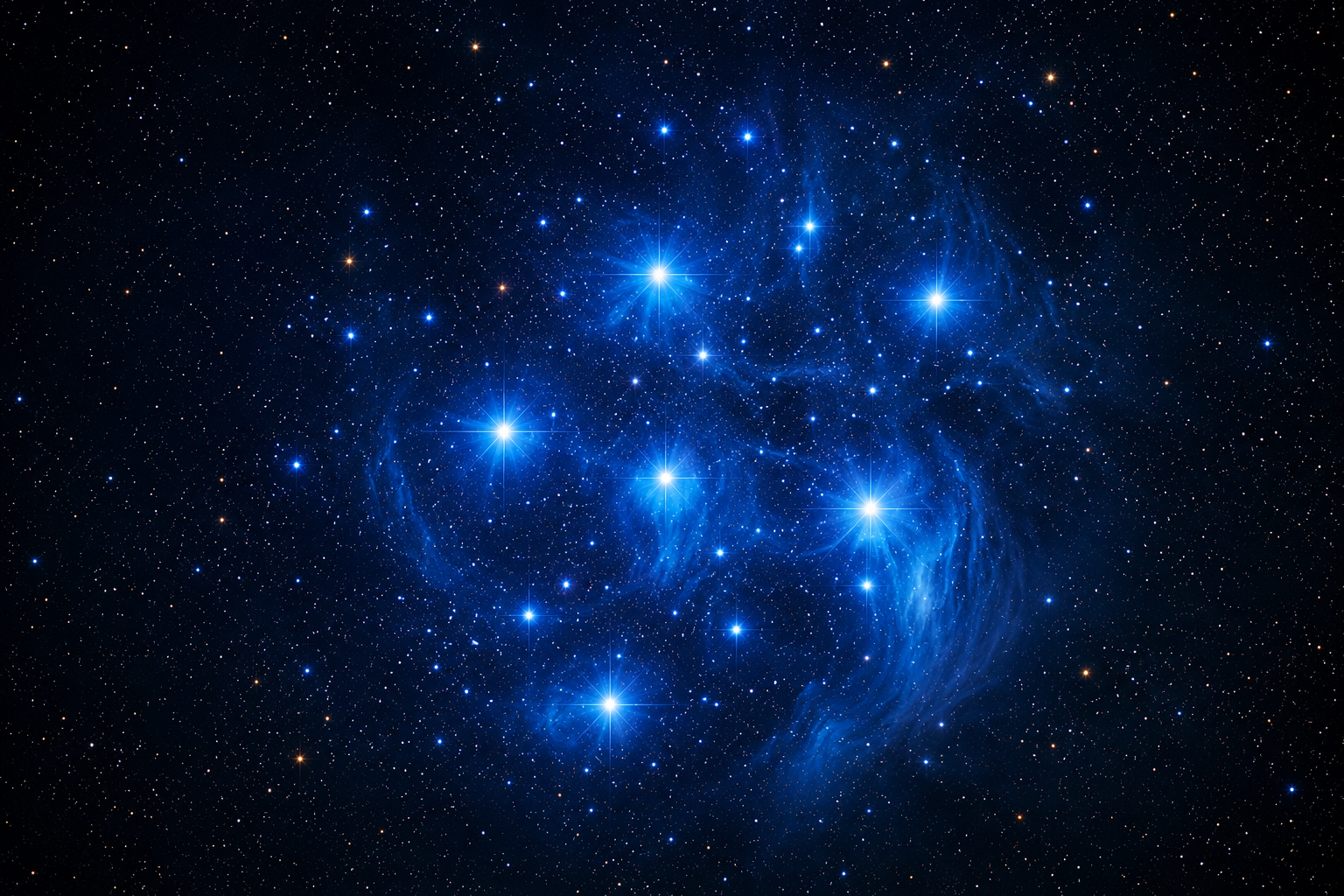
The Pleiades star cluster (Messier 45), commonly known as the Seven Sisters, represents one of the nearest and most extensively studied open clusters in the Milky Way. With an estimated age of ~100 Myr and a distance of approximately 440 light-years, the Pleiades provides a rare and accessible laboratory for investigating early stellar evolution, circumstellar disk dissipation, magnetic activity in young stars, and the dynamics of open clusters within the galactic environment. This article reviews the physical characteristics, evolutionary history, and scientific importance of the Pleiades across contemporary astrophysical research.
1. Introduction
Open clusters are gravitationally bound groups of stars formed from the same molecular cloud. Among them, the Pleiades (M45) is particularly significant due to its proximity, richness, and visibility in the night sky. Its bright B-type stars and extensive reflection nebulosity make it a prominent target across observational astronomy, from amateur studies to high-resolution space-based research.
The cluster’s young age and dynamic structure allow researchers to examine questions related to stellar birth, early stellar rotation, magnetic evolution, disk lifetimes, and early planetary system formation.
2. Physical Characteristics of the Pleiades
2.1 Distance and Spatial Distribution
Parallax measurements from the Gaia mission place the cluster at a distance of 135 ± 2 parsecs.
The Pleiades spans roughly 110 arcminutes on the sky and contains over 1,000 confirmed members, including:
-
Several B-type blue stars
-
Numerous K and M-type dwarfs
-
A population of brown dwarfs
The cluster’s spatial distribution indicates partial mass segregation, typical of young open clusters undergoing dynamical relaxation.
2.2 Stellar Composition and Spectral Features
The Pleiades is dominated by hot, young B-type stars such as Alcyone, Electra, and Maia. Their spectra reveal:
-
Strong hydrogen Balmer lines
-
High surface temperatures (10,000–25,000 K)
-
Rapid rotation rates
These factors contribute to the cluster’s intense blue-white luminosity.
3. Reflection Nebulosity
The blue nebulosity surrounding the cluster is not leftover from its formation but rather a reflection nebula created as the cluster moves through a region of interstellar dust.
The dust grains scatter the blue light emitted by the massive stars, producing the iconic bluish glow.
This scattering is governed by Rayleigh scattering, favoring shorter wavelengths.
4. Age Determination and Stellar Evolution
4.1 Age Estimates
The estimated age of the Pleiades (~100 Myr) is derived through multiple methods:
-
Main-sequence turnoff fitting
-
Lithium depletion boundary (LDB) analysis
-
Rotation-period studies
-
Isochrone fitting using Gaia photometry
The lithium depletion boundary—a method using low-mass stars’ Li absorption lines—is particularly precise for young cluster age measurement.
4.2 Stellar Rotation and Magnetic Activity
Young stars in the Pleiades exhibit:
-
Rapid rotation (periods from hours to days)
-
Strong chromospheric activity
-
Intense stellar flares
These properties make the Pleiades central to studies of stellar dynamos and early magnetic evolution.
5. Protoplanetary and Debris Disks
Although most primordial disks dissipate within ~10 Myr, several Pleiades stars show infrared excesses consistent with debris disks.
This suggests ongoing processes of:
-
Planetesimal collisions
-
Dust production
-
Early-stage planetary system evolution
Such disks offer clues to how planetary systems—including our own solar system—may have formed billions of years ago.
6. Cluster Dynamics and Galactic Motion
The Pleiades is gravitationally bound but slowly dispersing, as is typical for open clusters.
Studies of its proper motion using Gaia DR3 have shown:
-
A coherent motion through the local interstellar medium
-
Evidence for past tidal interactions with the Galactic disk
-
Gradual evaporation of low-mass stars
This dynamical behavior provides insight into the life cycle of open clusters.
7. Cultural and Historical Significance
The Pleiades holds major cultural importance across civilizations:
-
Ancient Greece: The Seven Sisters pursued by Orion
-
Japan: Subaru (reflected in the Subaru car logo)
-
Native American cultures: Agricultural markers and seasonal indicator
-
Māori (New Zealand): Matariki, the Māori New Year
-
Anatolian cultures: Winter onset and harvest timing
This global presence underscores the cluster’s visibility and symbolic influence throughout human history.
8. Observing the Pleiades
The cluster is best viewed:
-
In November–February
-
In the eastern sky during evening hours
-
With binoculars (reveals dozens of stars)
-
With small telescopes (shows reflection nebulosity)
Dark-sky locations reveal its full beauty, including faint blue mist around the brightest stars.
9. Conclusion
The Pleiades star cluster stands as one of the most scientifically informative and visually striking objects in the night sky. Its proximity, youth, and rich stellar population make it an indispensable target for studies of early stellar evolution, cluster dynamics, and disk formation. As observational technology advances—especially with Gaia and upcoming ELT-class telescopes—the Pleiades will continue to play a central role in refining our understanding of star formation and the early stages of planetary system development.