When we celebrate a birthday on Earth, we are marking the completion of one full orbit around the Sun. It takes our planet approximately 365 days to make that journey, creating the familiar cycle of seasons and defining what we call a year.
But what if you lived somewhere else in the Solar System?
The answer reveals one of the most fascinating facts in astronomy: a year is different on every planet.
What Defines a Year?
A planetary year is the amount of time a world takes to complete one full orbit around the Sun.
The closer a planet is to the Sun, the shorter its orbital path and the faster it moves. The farther away it is, the larger its orbit becomes and the longer it takes to complete a revolution.
This simple relationship creates enormous differences in the length of a year across the Solar System.
The Fastest Year in the Solar System
Mercury, the closest planet to the Sun, races around our star at incredible speed.
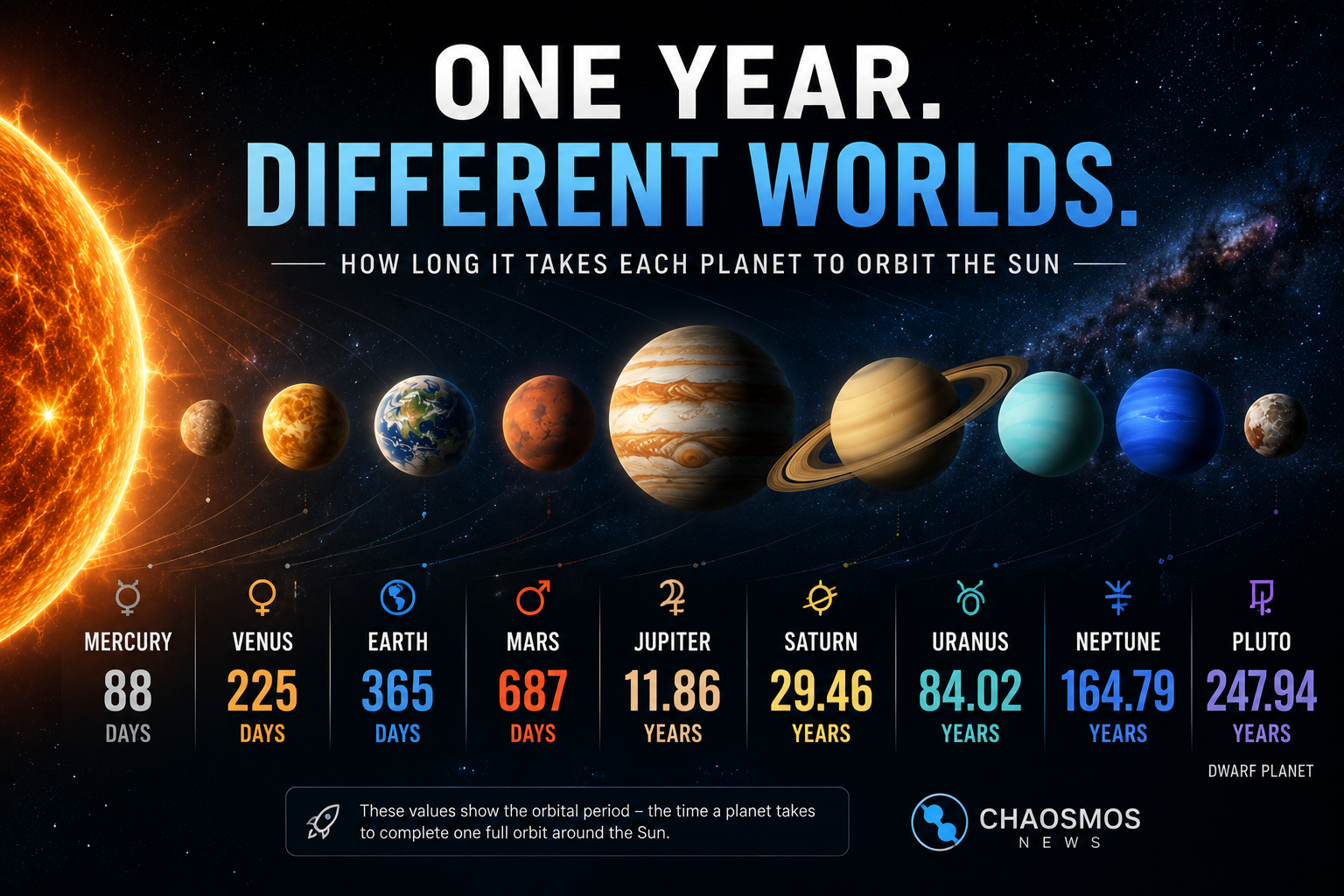
A single year on Mercury lasts only 88 Earth days.
If humans could live there comfortably, someone celebrating their tenth birthday on Earth would already have experienced more than forty Mercury years.
Venus, Earth’s neighboring planet, takes 225 Earth days to orbit the Sun. Interestingly, Venus rotates so slowly that one Venusian day is actually longer than its entire year.
Earth and Mars
Earth completes its orbit in 365 days, making our calendar system possible.
Mars, however, requires 687 Earth days to complete a single orbit. This means a Martian year is nearly twice as long as an Earth year.
Future astronauts living on Mars may one day celebrate birthdays only half as often as they do on Earth.
The Giant Worlds
Beyond Mars lie the giant planets, where the concept of a year becomes dramatically different.
Jupiter, the largest planet in the Solar System, takes 11.86 Earth years to orbit the Sun.
A child born on Jupiter would be nearly twelve years old on Earth before experiencing a first birthday.
Saturn moves even more slowly. One Saturn year lasts 29.46 Earth years. Someone living there would celebrate only two birthdays during an average human lifetime.
Uranus stretches the concept even further. One orbit around the Sun takes 84 Earth years, nearly the length of an entire human life.
Neptune: The World of 165-Year Seasons
Neptune, the most distant major planet, orbits the Sun once every 164.79 Earth years.
Discovered in 1846, Neptune completed its first full orbit since its discovery only in 2011.
Think about that for a moment.
Humanity discovered Neptune, developed modern electricity, built airplanes, reached the Moon, invented the internet, and entered the age of artificial intelligence before Neptune completed a single year.
If a person were somehow born on Neptune, they would need to live for 165 Earth years to celebrate their first birthday.
Why Are Outer Planet Years So Long?
The explanation comes from gravity and distance.
As planets move farther from the Sun, two things happen:
- Their orbital paths become much larger.
- Their orbital speeds become slower.
The combination of these factors dramatically increases the time needed to complete a full orbit.
This relationship was first described by Johannes Kepler in the early 1600s and remains one of the fundamental principles of planetary motion.
A Different Experience of Time
We often think of time as universal, but astronomy reminds us that many measurements of time depend on where you are.
Days change from planet to planet.
Years change from planet to planet.
Even seasons can last decades on distant worlds.
Our familiar Earth year is simply one version of time among many.
The next time you celebrate a birthday, remember that while Earth has completed another orbit around the Sun, Neptune is still slowly making its way through a journey that lasts longer than most human lifetimes.
In the Solar System, time is not truly the same everywhere.