In the vast and mysterious universe, there are objects so enormous that they completely challenge our understanding of scale. One of the most extreme examples is TON 618, the largest known black hole ever discovered.
This cosmic giant is not just massive — it is almost impossible to comprehend.
Astronomers estimate that TON 618 contains the mass of around 66 billion Suns, making it one of the most powerful gravitational objects ever observed.
What Exactly Is TON 618?
TON 618 is a supermassive black hole located roughly 10.4 billion light-years away from Earth in the direction of the constellation Canes Venatici.
It was first identified in 1957 as a quasar — an extremely bright object powered by matter falling into a black hole at incredible speeds.
For decades scientists believed the bright quasar hid something extraordinary. Later measurements confirmed the truth:
TON 618 contains one of the largest black holes ever discovered.
A Black Hole Beyond Imagination
To understand how massive TON 618 truly is, astronomers compare it to objects we know — like our own Solar System.
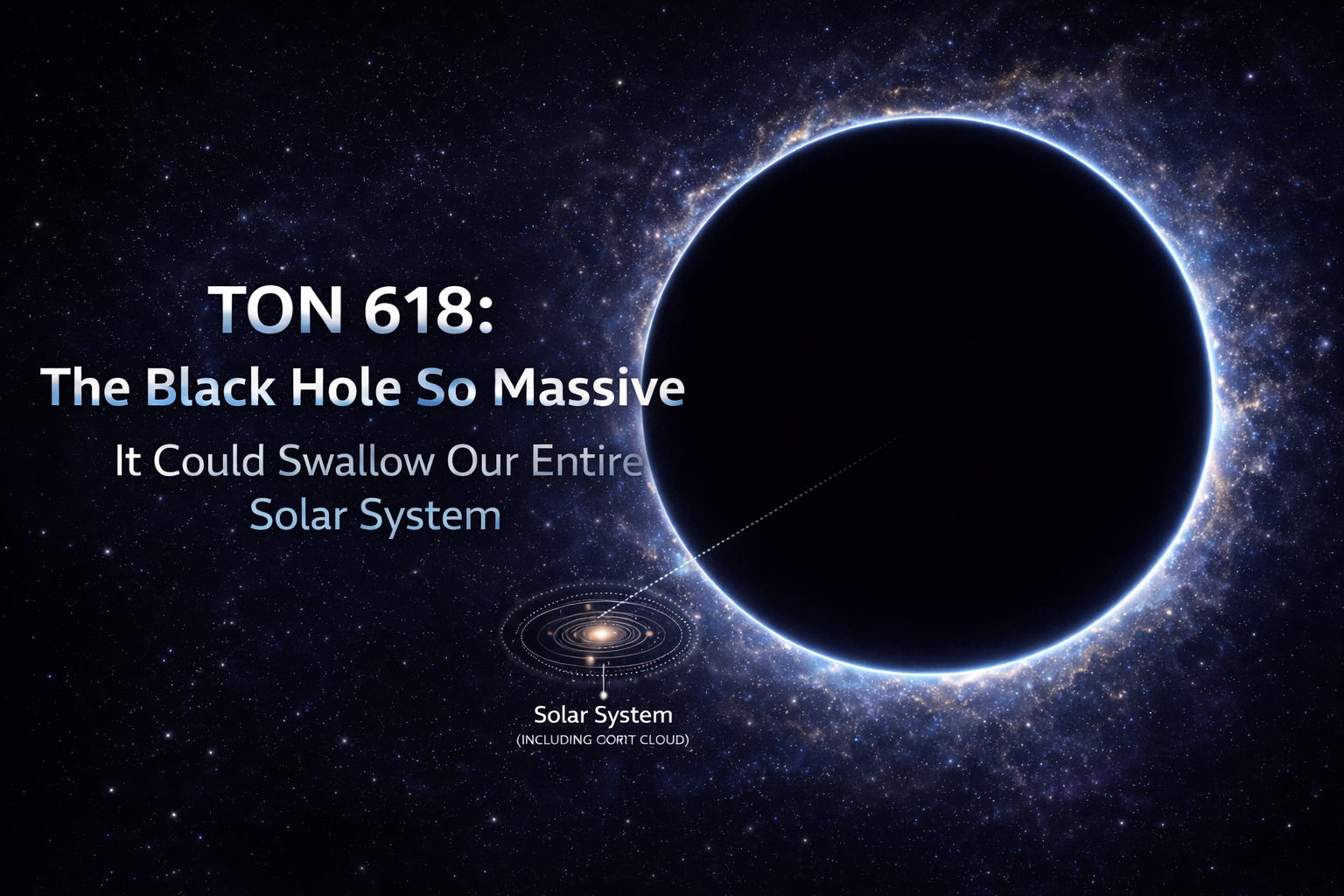
The event horizon of TON 618 — the boundary beyond which nothing can escape, not even light — is estimated to be about:
~390 billion kilometers wide.
That is more than 40 times the distance between the Sun and Pluto.
But even that comparison barely captures its scale.
If TON 618 were placed at the center of our Solar System, its event horizon would extend far beyond the orbit of Neptune, potentially engulfing the entire planetary system.
Including the distant Oort Cloud, the icy halo of objects surrounding our Solar System, everything would appear as nothing more than a tiny speck compared to this colossal black hole.
The Power of a Quasar
TON 618 is not just massive — it is also incredibly energetic.
Because it is actively consuming enormous amounts of gas and dust, the region around the black hole forms a blazing accretion disk that shines brighter than entire galaxies.
This is why TON 618 appears as a quasar, one of the most luminous types of objects in the universe.
The energy released by matter spiraling into the black hole can outshine trillions of stars combined.
How Do Scientists Measure a Black Hole This Large?
Since black holes themselves emit no light, scientists cannot observe them directly.
Instead, astronomers measure:
• the motion of nearby gas
• the brightness of the quasar
• the speed of matter orbiting the black hole
Using these clues, researchers can estimate the mass of the hidden object powering the quasar.
In the case of TON 618, those measurements revealed something staggering:
a black hole weighing tens of billions of Suns.
Why Objects Like TON 618 Matter
Extreme objects like TON 618 help scientists answer some of the biggest questions in cosmology.
How do supermassive black holes grow so large?
How did they form so early in the universe?
And how do they shape the galaxies around them?
Studying these cosmic giants gives astronomers clues about the evolution of galaxies, quasars, and the structure of the universe itself.
A Reminder of Cosmic Scale
Perhaps the most striking thing about TON 618 is not just its mass, but what it tells us about the scale of the universe.
The entire Solar System — every planet, moon, asteroid, and comet — would be nothing more than a tiny dot compared to this cosmic giant.
In a universe filled with unimaginable extremes, TON 618 stands as one of the most powerful reminders of how vast and mysterious space truly is.
? Final Thought
From our perspective on Earth, the universe often feels infinite. Yet objects like TON 618 remind us that even the largest structures we know — like our Solar System — can seem incredibly small in the face of cosmic giants.
And somewhere, billions of light-years away, this colossal black hole continues to grow.