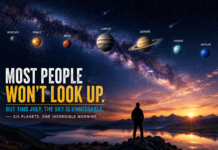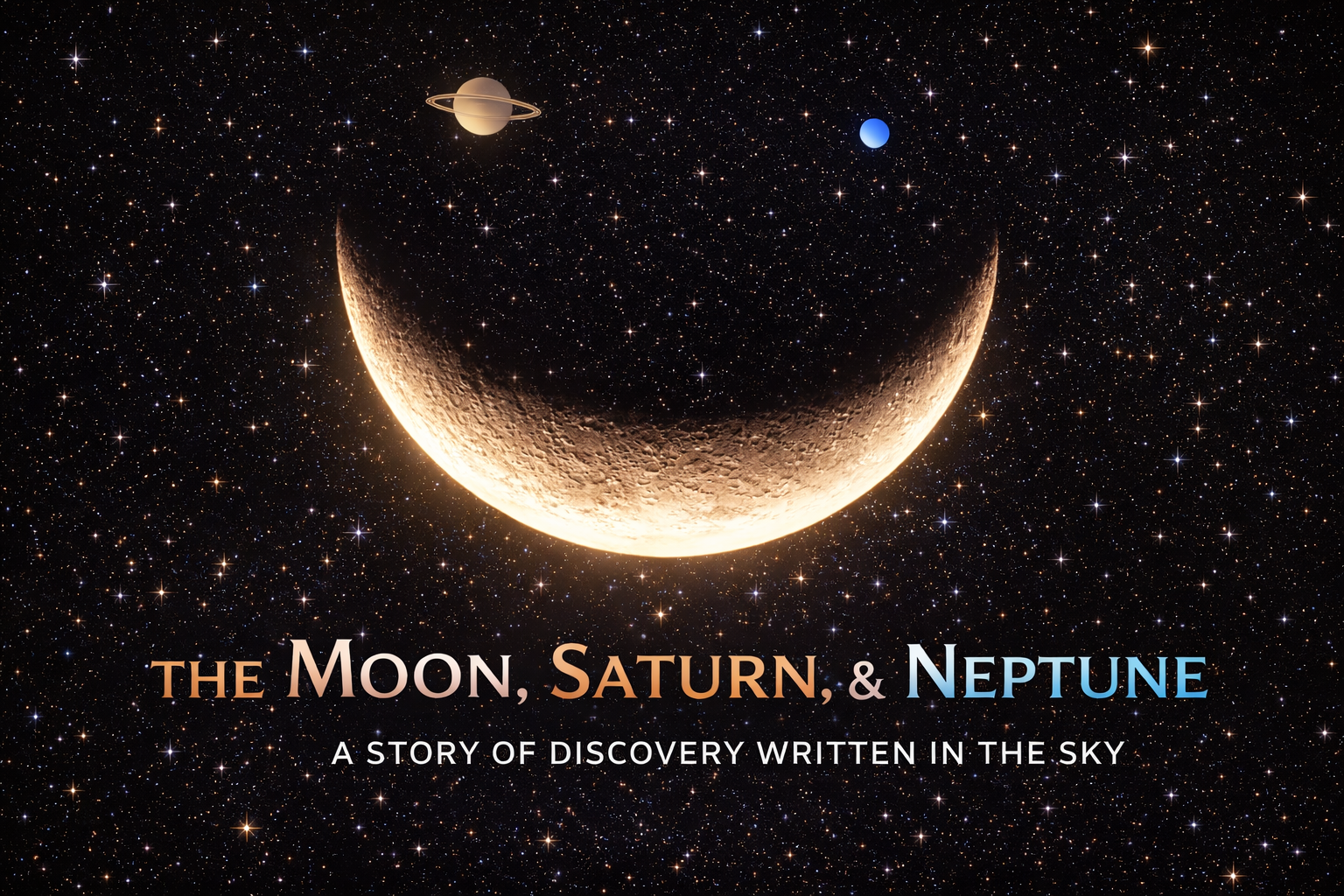
For as long as humans have existed, the night sky has served as both a mirror and a mystery. Long before modern science, people looked upward and tried to understand the patterns of light moving silently above them. Among all celestial objects, the Moon, Saturn, and Neptune each represent a different chapter in humanity’s journey to comprehend the universe.
Though they sometimes appear near one another in the sky, these three worlds exist at vastly different distances and scales. Their true connection lies not in physical proximity, but in the history of astronomical discovery.
The Moon: Humanity’s First Celestial Teacher
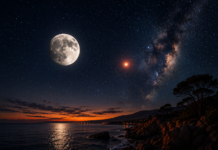
The Moon is the most familiar object in the night sky. Its changing phases were among the first astronomical patterns ever recognized by early civilizations. Long before clocks and calendars, the Moon marked time, seasons, and cycles of life.
Because it changes shape predictably, the Moon taught early observers a critical lesson: the sky is not fixed. It moves, evolves, and follows laws that can be understood. In many ways, the Moon became humanity’s first introduction to scientific observation — a natural laboratory visible to everyone.
Even today, despite centuries of study, the Moon continues to guide modern astronomy, from tidal science to space exploration.
Saturn: The Slow Wanderer
Unlike the Moon, Saturn moves slowly across the background of stars. Ancient astronomers classified it as one of the “wandering stars,” or planets — objects that did not remain fixed in place like the constellations.
For centuries, Saturn appeared as nothing more than a steady point of light. Its true nature remained hidden until the invention of the telescope. When its rings were first observed, Saturn transformed from a mysterious dot into a complex and dynamic world.
Saturn represents a turning point in astronomy: the moment when technology expanded human perception beyond naked-eye observation. It showed that the universe was far more intricate than previously imagined.
Neptune: A Planet Discovered by Thought
Neptune stands apart from both the Moon and Saturn in one crucial way — it cannot be seen without optical aid. Unlike other planets known to ancient civilizations, Neptune was never discovered through direct observation alone.
Instead, it was found through mathematics. Astronomers noticed irregularities in the orbit of Uranus and predicted the existence of another planet based purely on gravitational effects. Only later was Neptune visually confirmed, exactly where calculations had predicted.
Neptune’s discovery marked a revolutionary moment in science. It proved that the universe could be understood not only by looking, but by thinking. Knowledge had extended beyond vision.
Perspective and Distance
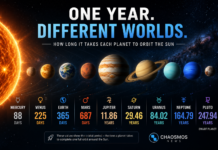
Although the Moon, Saturn, and Neptune may appear close together in the sky at times, their true separations are immense.
-
The Moon orbits Earth at a distance of about 384,000 kilometers
-
Saturn lies more than a billion kilometers away
-
Neptune resides nearly 4.5 billion kilometers from Earth
Light itself takes minutes or hours to travel from these worlds to our eyes. What we see in the sky is not closeness, but alignment — a reminder that perspective shapes perception.
Why These Worlds Matter
Together, the Moon, Saturn, and Neptune tell the story of astronomy’s evolution:
-
The Moon represents observation and pattern recognition
-
Saturn symbolizes technological advancement
-
Neptune embodies theoretical science and mathematical prediction
They remind us that astronomy is not only about planets and stars, but about how humanity learns, adapts, and expands its understanding of reality.
A Quiet Cosmic Lesson
The universe does not always reveal itself through dramatic events. Sometimes, its most powerful lessons are subtle — written in slow movements, faint lights, and invisible forces.
The Moon, Saturn, and Neptune continue to move through the sky, indifferent to human attention. Yet in observing them, we discover something profound: our place in a universe governed by order, distance, and time.
Astronomy teaches patience.
It rewards curiosity.
And it reminds us that wonder does not fade — it evolves.
ChaosmosNews
Exploring the universe through science, perspective, and discovery.