Each month, the Moon quietly resets its cycle. There is no dramatic glow, no brilliant spectacle in the sky. Instead, the night grows darker than usual. This moment is known as the New Moon, and while it may appear uneventful at first glance, it plays a crucial role in both astronomy and humanity’s long relationship with the night sky.
What Is a New Moon?
A New Moon occurs when the Moon passes directly between the Earth and the Sun. During this alignment, the side of the Moon facing Earth receives no direct sunlight. As a result, the Moon becomes nearly invisible against the darkness of the sky.
Astronomically, this phase marks the beginning of a new lunar cycle, a rhythm that repeats approximately every 29.5 days. While the Moon itself has not disappeared, its position and orientation cause it to blend perfectly into the night.
Why the Night Sky Becomes Darker
During brighter lunar phases, especially the Full Moon, reflected sunlight from the Moon illuminates the atmosphere. This light scatters through the sky, reducing contrast and washing out faint celestial objects.
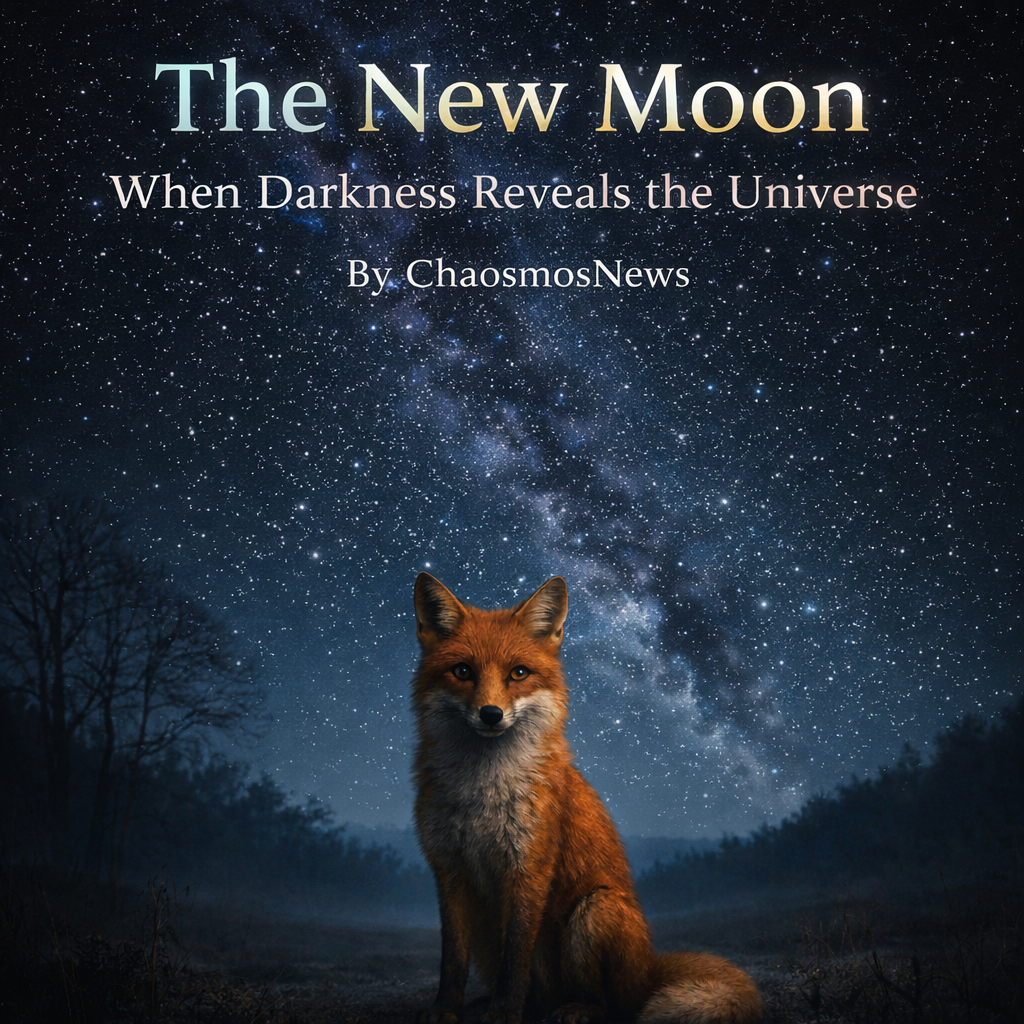
During a New Moon, this source of light is absent. The result is a noticeably darker sky, particularly in areas with low light pollution. Under these conditions:
-
Stars appear sharper and more numerous
-
The Milky Way becomes more defined
-
Faint galaxies and nebulae emerge from the darkness
In astronomy, darkness is not emptiness. It is clarity.
The Best Time for Deep-Sky Observing
New Moon nights are highly valued by astronomers and astrophotographers. Without moonlight interfering, deep-sky objects become far easier to observe.
These include:
-
Distant galaxies, located millions or even billions of light-years away
-
Nebulae, vast clouds of gas and dust where stars are born
-
Star clusters, ancient stellar groupings orbiting within the Milky Way
Many of these objects are always present in the sky, but they remain hidden during brighter nights. The New Moon does not create them — it simply allows us to see them.
The New Moon in Human History
Long before telescopes and modern astronomy, early civilizations carefully tracked the Moon’s phases. The New Moon, in particular, held great significance.
It marked:
-
The beginning of new months in early calendars
-
Important moments for navigation and seasonal planning
-
A natural system of timekeeping shared across cultures
In a world without artificial lighting, the disappearance of the Moon was a noticeable and meaningful event. It shaped how societies understood time, seasons, and the sky itself.
A Rare Kind of Darkness
In the modern era, true darkness has become increasingly rare. Artificial lighting now fills most nights with a constant glow, even when the Moon is absent. For this reason, New Moon nights offer a unique opportunity — a brief return to the sky as it once appeared.
Under truly dark skies, the universe feels larger, quieter, and more ancient. The absence of moonlight reminds us that much of the cosmos is subtle, revealed not through brightness, but through patience and careful observation.
A Quiet Beginning
Unlike eclipses or meteor showers, the New Moon does not demand attention. There is nothing obvious to watch, no single moment to capture. Instead, it invites stillness.
It is a reminder that the universe does not always announce itself with light. Sometimes, its deepest beauty is found in darkness.
? Chaosmos Perspective
The New Moon is not an ending, but a beginning — a reset in the Moon’s endless orbit around Earth. In its silence, it offers the clearest view of the cosmos and a moment to reconnect with the vast, steady rhythm of space.
Look up on a New Moon night.
When the light fades, the universe reveals itself.