In the night sky, some stars simply shine.
Others command attention.
Regulus is one of the rare few.
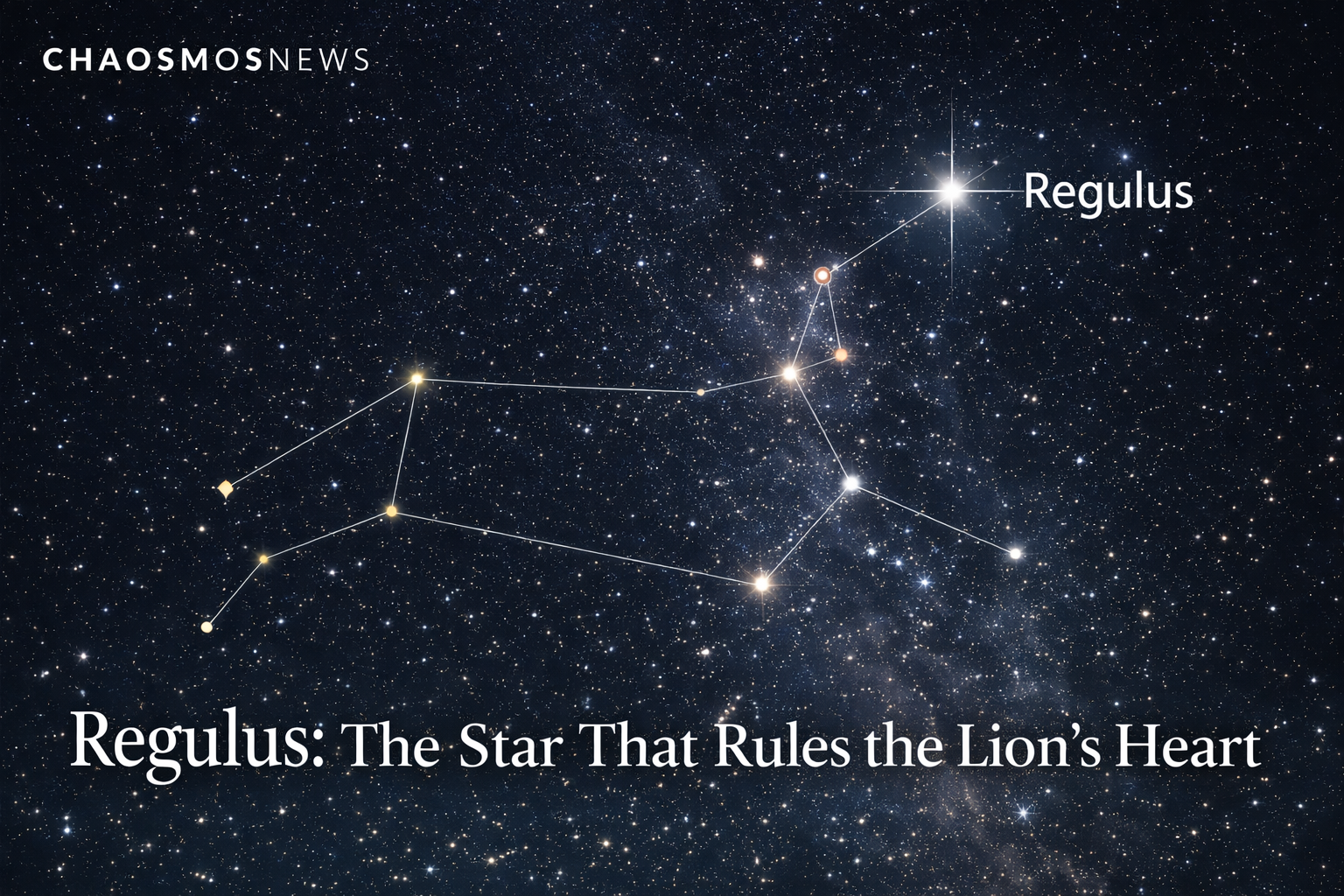
Positioned at the heart of the Leo constellation, Regulus has been watched, named, and revered for thousands of years. Bright, steady, and unmistakable, it stands as one of the most important fixed stars in human skywatching history.
A Star with a Royal Identity
The name Regulus means “the Little King.”
Across ancient civilizations, this star symbolized authority and balance in the heavens.
Babylonian astronomers associated it with kingship and order. Persian sky traditions counted it among the four Royal Stars guarding the sky. Even in later astrological systems, Regulus was linked to leadership, ambition, and legacy.
Unlike many stars whose meanings changed over time, Regulus consistently retained its royal identity.
The Science Behind the Legend
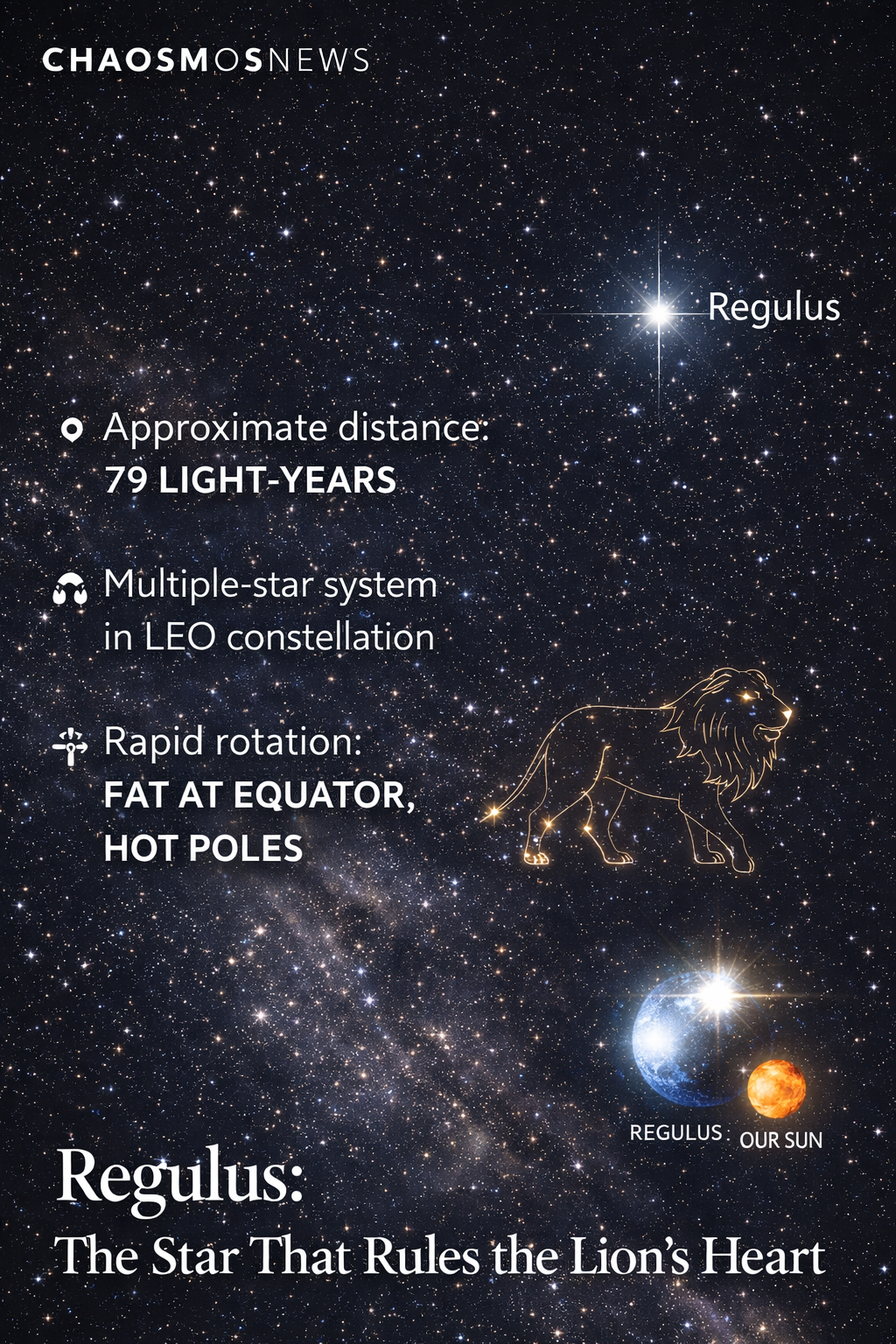
Regulus is not a single star, but a multi-star system located approximately 79 light-years from Earth.
Its primary star is a blue-white main-sequence star, significantly hotter and more massive than our Sun. What makes Regulus truly exceptional is its extreme rotational speed. It spins so fast that the star is physically flattened, bulging at its equator and glowing hotter at its poles.
This rapid rotation makes Regulus a key object of study in stellar physics, helping astronomers understand how mass, gravity, and rotation shape stars.
Why Regulus Is So Easy to Spot
With an apparent magnitude of 1.35, Regulus is the brightest star in Leo and one of the brightest stars visible from Earth. Its light is stable and sharp, lacking the deep color shifts seen in red giants.
This makes Regulus especially striking during winter and early spring, when Leo climbs higher in the night sky.
Even when the Moon passes nearby, Regulus often remains visible — a testament to its brilliance.
When the Moon Meets Regulus
As the Moon travels along the ecliptic, it regularly passes close to Regulus. These conjunctions are quiet but powerful visual events, where a nearby celestial body briefly aligns with a star that has burned for millions of years.
Such moments highlight the scale of the cosmos:
a moving Moon crossing paths with a stellar beacon that has witnessed civilizations rise and fall.
A Fixed Point in a Moving Sky
Planets wander.
The Moon shifts nightly.
But Regulus holds its place.
Marking the heart of Leo, it serves as a celestial reference point, a reminder that while the sky is in constant motion, some lights remain steady across vast stretches of time.
Why Regulus Still Matters
Regulus connects ancient sky lore with modern astrophysics. It is both a symbol and a subject — admired by storytellers, studied by scientists, and visible to anyone willing to look up.
In a universe defined by motion, Regulus stands as a reminder of endurance, structure, and cosmic order.
✨ A royal star.
? A scientific marvel.
? The beating heart of the Lion.