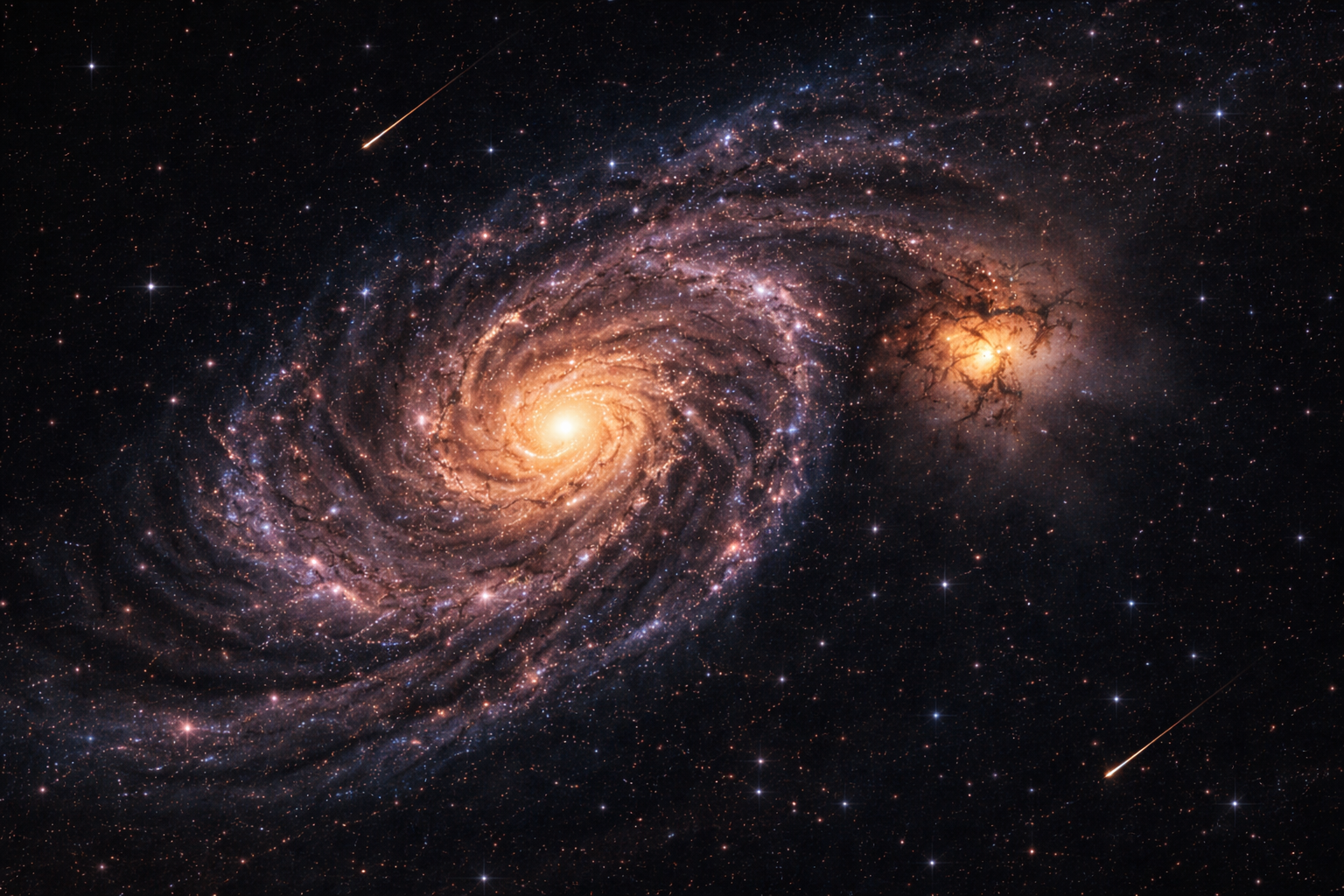
In the vast darkness of the universe, where time stretches across unimaginable scales, there exists a galaxy so elegant, so structured, that it has become one of the most iconic views of the cosmos — the Whirlpool Galaxy (M51).
Located approximately 23 million light-years from Earth, M51 is not just a distant collection of stars. It is a dynamic, evolving system — a place where gravity sculpts structure, triggers star formation, and reveals the true nature of galactic interactions.
? A Perfect Spiral in Motion
The Whirlpool Galaxy is often described as a “grand-design spiral galaxy.” Unlike irregular or loosely structured galaxies, M51 displays clearly defined spiral arms that wind outward from a bright central core.
These arms are not static. They are regions rich in gas and dust — the raw materials for star formation. As density waves move through the galaxy, they compress these materials, igniting bursts of new stars. This is why the spiral arms appear so luminous and structured.
But what makes M51 truly extraordinary is not just its shape — it’s what’s happening behind it.
? A Gravitational Encounter
M51 is interacting with a smaller companion galaxy known as NGC 5195. This nearby galaxy is visibly connected to M51, appearing as a smaller, glowing mass at the end of one of its spiral arms.
Over millions of years, the gravitational pull between these two galaxies has:
- Distorted M51’s spiral structure
- Enhanced the brightness of its arms
- Triggered waves of star formation
This interaction is not a violent collision in the traditional sense, but rather a slow cosmic dance — a gravitational interplay unfolding over vast timescales.
What we observe today is a snapshot of this interaction, frozen in light that has traveled for millions of years to reach us.
? Observing M51 from Earth
Despite its enormous distance, the Whirlpool Galaxy is surprisingly accessible to amateur astronomers.
Under dark skies, and with a small to medium telescope, M51 can be observed as a faint, misty patch of light. With larger instruments, observers may even begin to detect hints of its spiral structure and its companion galaxy.
However, it’s important to note:
- It will not appear as colorful as astrophotographs
- The human eye sees it in shades of gray
- Its beauty lies in its subtlety — and its scale
When you look at M51, you are seeing light that left the galaxy 23 million years ago — long before modern humans existed on Earth.
? Why April Matters: Galaxy Season
Each year, spring in the Northern Hemisphere marks the arrival of what astronomers call “galaxy season.”
During this period:
- The night sky faces away from the dense dust of the Milky Way
- Deep-sky objects like galaxies become easier to observe
- M51 reaches an optimal position high in the sky
This makes April one of the best times to observe the Whirlpool Galaxy.
Located near the handle of the Big Dipper (Ursa Major), it can be found with a star chart or astronomy app, making it a popular target for both beginners and experienced observers.
✨ A Window Into the Universe
The Whirlpool Galaxy is more than just a beautiful object in the night sky. It is a living system — one that helps astronomers understand:
- How galaxies evolve
- How stars are formed
- How gravity shapes the universe on a grand scale
It reminds us that the universe is not static, but constantly changing — shaped by forces that operate over millions and billions of years.
When you look up at the Whirlpool Galaxy, you are not just observing a distant object.
You are witnessing a story —
a story of motion, interaction, and time.
A story that began 23 million years ago,
and is only now reaching your eyes.