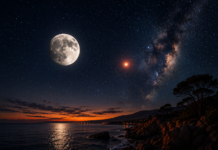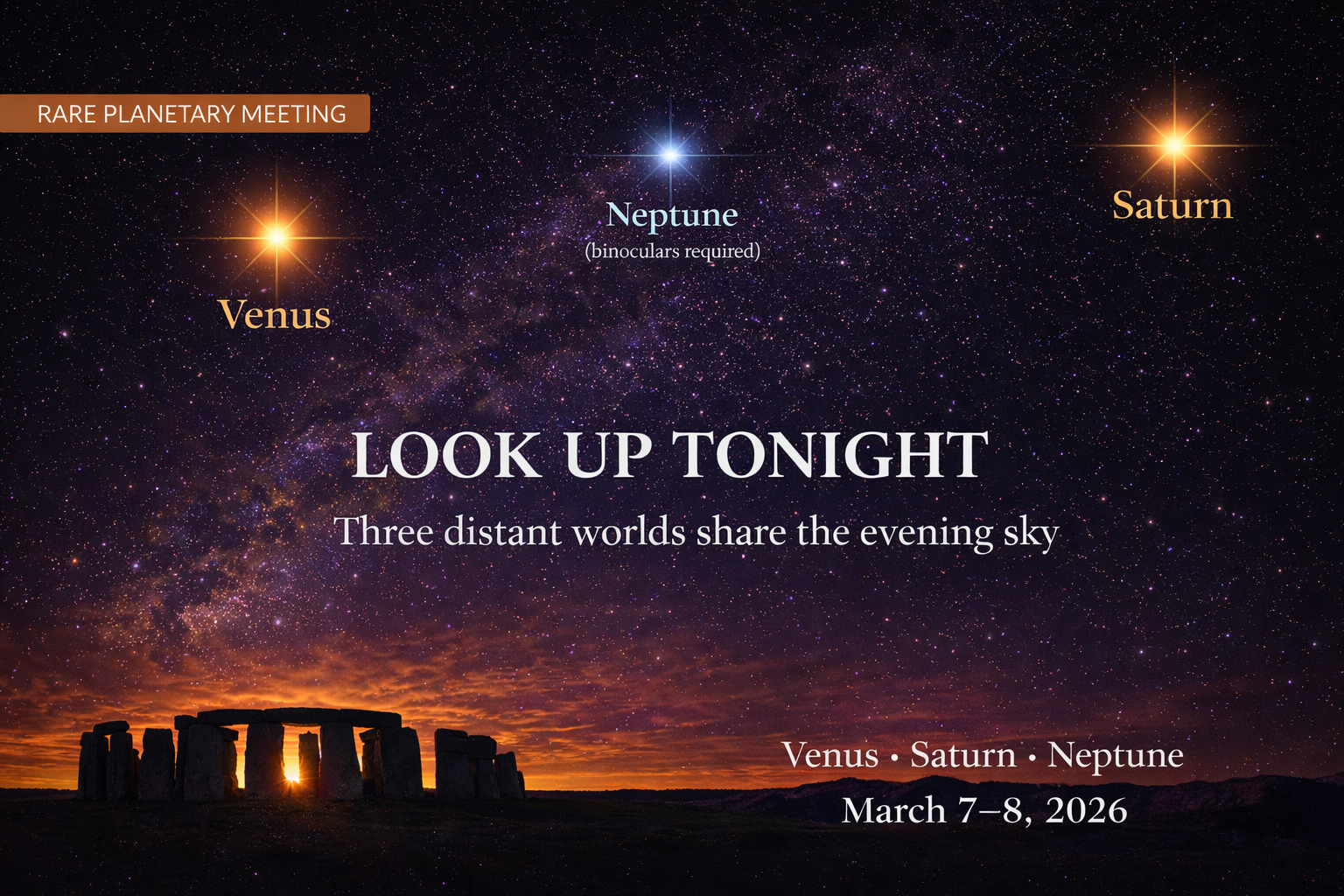
On the evenings of March 7–8, 2026, skywatchers around the world will have the chance to witness a beautiful and subtle celestial alignment. Three distant planets — Venus, Saturn, and Neptune — will appear unusually close together in the western evening sky shortly after sunset.
While planetary alignments are not extremely rare in astronomy, seeing multiple planets clustered together in the same small region of sky always creates a special moment for observers. For a brief window after sunset, these three worlds will seem to share the same cosmic stage.
A Quiet Planetary Gathering
During this event, the three planets will appear within the same region of the sky along the ecliptic, the imaginary path the Sun and planets follow across our sky.
Each planet brings its own unique character to the scene:
Venus will be the star of the show. Known as the Evening Star, Venus is the brightest planet visible from Earth and will shine brilliantly against the twilight sky. It will be easy to spot even before the sky becomes fully dark.
Saturn, the famous ringed giant, will appear nearby with a softer golden glow. While not as dazzling as Venus, Saturn will still be clearly visible to the naked eye and adds a warm, steady light to the planetary trio.
Neptune, the most distant planet in the alignment, will be far fainter. Because of its immense distance from Earth — nearly 4.5 billion kilometers away — Neptune will likely require binoculars or a small telescope to observe.
Together, the three planets will create a beautiful visual grouping that rewards patient skywatchers.
When and Where to Look
The best time to observe this planetary gathering will be shortly after sunset on March 7 and March 8, 2026.
To see it:
• Look toward the western horizon after the Sun sets.
• Find Venus first, as it will be the brightest object in that part of the sky.
• Saturn will appear nearby.
• Neptune will be located close to the pair but will require optical aid.
Because the planets will be relatively low in the sky, observers should try to find a location with a clear, unobstructed western horizon.
Dark skies away from city lights will also help reveal the fainter planet Neptune.
Why Planetary Alignments Happen
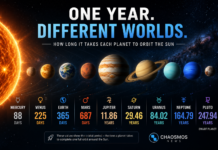
Planetary alignments occur because all the major planets orbit the Sun in roughly the same flat plane, known as the plane of the solar system.
As they move along their individual orbits at different speeds, there are moments when several planets appear to cluster together from our perspective on Earth.
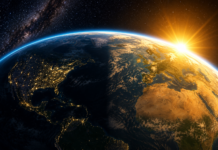
These events are more about our viewing angle than the planets physically coming close to one another in space. In reality, the planets remain separated by hundreds of millions or even billions of kilometers.
Still, when viewed from Earth, they can appear to gather together in a surprisingly small patch of sky.
A Reminder of the Solar System Above Us
Events like this are a reminder that our night sky is not static. The planets wander slowly across the heavens, tracing out ancient paths that humans have observed for thousands of years.
For early civilizations, these wandering lights were mysterious celestial travelers. Today we understand their motions through science, yet their beauty remains just as captivating.
Watching Venus blaze in the twilight, Saturn glow softly beside it, and distant Neptune hiding nearby offers a quiet but powerful connection to the vast solar system we live in.
Don’t Miss the View
This alignment won’t last long. The planets will gradually shift position in the following nights as they continue along their orbits.
But for a short time in early March, three distant worlds will appear to share the same sky.
So if the weather is clear on March 7–8, step outside after sunset, face the western horizon, and take a moment to look up.
The sky may seem still — but above us, the solar system is always in motion.