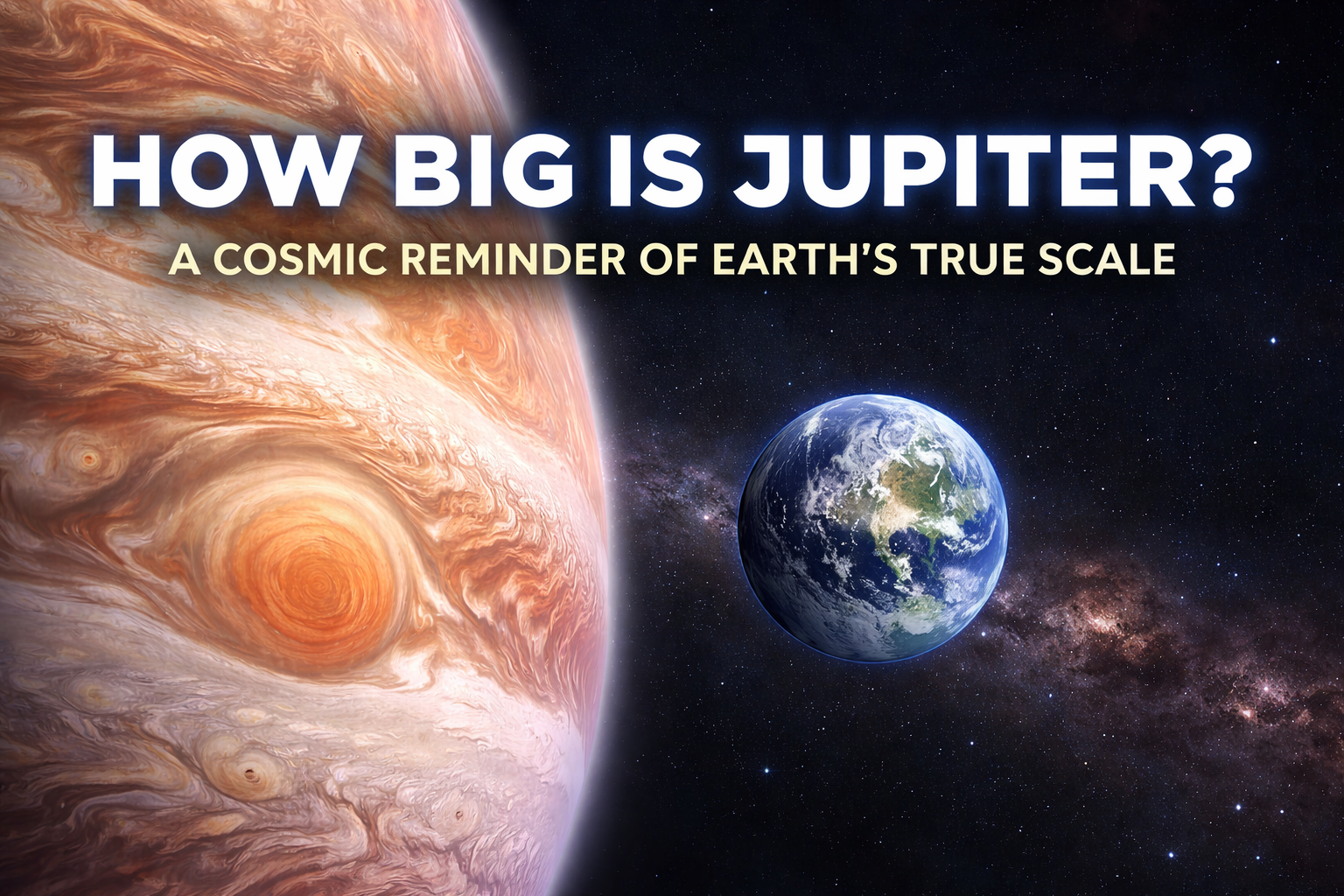
When we look at images comparing Earth and Jupiter, the first reaction is often disbelief.
That tiny blue sphere floating beside a swirling giant of clouds is not a visual trick.
It is our home — Earth — next to the largest planet in the solar system.
Jupiter’s immense size challenges our intuition and forces us to confront a fundamental truth:
the universe operates on scales far beyond everyday human experience.
Jupiter: The Giant of the Solar System
Jupiter is the largest planet orbiting our Sun. Classified as a gas giant, it is composed primarily of hydrogen and helium — the same elements that dominate the Sun itself.
With a diameter of approximately 143,000 kilometers, Jupiter is more than 11 times wider than Earth, whose diameter measures just 12,742 kilometers. But diameter alone does not fully convey Jupiter’s dominance.
In terms of volume, Jupiter is truly staggering.
1,300 Earths Inside One Planet
If Earth were hollow, more than 1,300 Earth-sized planets could fit inside Jupiter.
This number is difficult to visualize, but it explains why scale comparison images feel so unsettling. Jupiter is not just slightly larger — it exists in an entirely different category of planetary size.
Despite this, Jupiter remains a planet, not a star. It lacks the mass required to ignite nuclear fusion. Had it been about 80 times more massive, it might have become a small star, transforming our solar system into a binary system.
Instead, Jupiter became something else:
a gravitational giant.
Mass and Gravity: Jupiter’s Invisible Power
Jupiter contains more mass than all the other planets in the solar system combined.
Its gravity is so powerful that it shapes the architecture of the entire solar system.
Asteroids, comets, and debris from the early days of planetary formation are constantly influenced by Jupiter’s gravitational pull. Many scientists believe that Jupiter acts as a cosmic shield, redirecting or absorbing objects that might otherwise collide with the inner planets — including Earth.
Without Jupiter, the history of life on our planet may have unfolded very differently.
A World of Endless Storms
Jupiter’s enormous size allows it to host atmospheric phenomena unlike anything seen on Earth.
The most famous of these is the Great Red Spot — a colossal storm that has been raging for over 300 years. This single storm is so vast that Earth could fit entirely inside it.
Wind speeds within the Great Red Spot exceed 600 kilometers per hour, dwarfing the strongest hurricanes ever recorded on Earth. On our planet, such a storm would cause global devastation. On Jupiter, it is merely one feature among many.
Earth Beside Jupiter: A Humbling Perspective
Placed next to Jupiter, Earth appears fragile — almost insignificant.
Yet this comparison reveals something profound.
While Jupiter dominates in size, mass, and power, Earth holds something far rarer:
life.
Oceans, forests, ecosystems, civilizations, and consciousness all exist on this small blue world. Jupiter, for all its grandeur, remains a hostile environment of crushing pressure and extreme temperatures.
In cosmic terms, Earth may be small — but it is extraordinary.
Why Cosmic Scale Matters
Understanding Jupiter’s size is not just an exercise in astronomy.
It reshapes perspective.
It reminds us that:
-
Our planet is not the center of the universe
-
Size does not equal significance
-
Fragile worlds can still be profoundly meaningful
When we study Jupiter, we are not diminishing Earth — we are placing it in context.
A Final Thought
Jupiter represents the raw power of the universe — vast, chaotic, and relentless.
Earth represents something else entirely — balance, rarity, and life.
That tiny blue dot floating beside a gas giant is everything we have ever known.
And in a universe this vast, that makes it priceless.
ChaosmosNews
Exploring the universe, one perspective at a time.